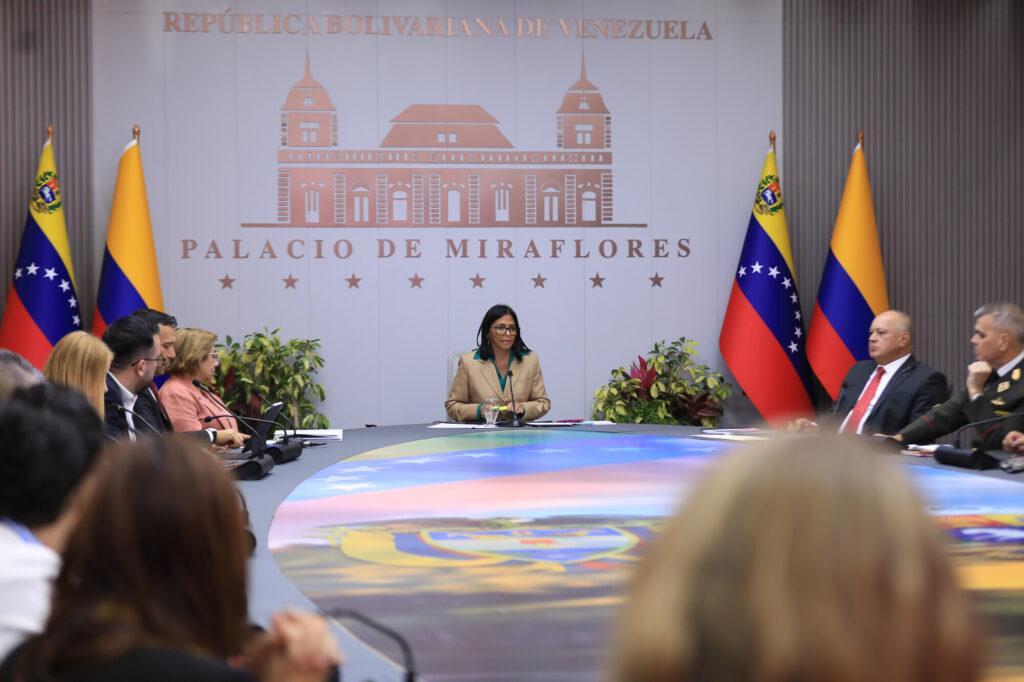
Venezuelan Acting President Delcy Rodríguez presides over a meeting with high-level Colombian officials at Miraflores Palace, Caracas, March 13, 2025. Photo: Presidential Press.

Orinoco Tribune – News and opinion pieces about Venezuela and beyond
From Venezuela and made by Venezuelan Chavistas
Venezuelan Acting President Delcy Rodríguez presides over a meeting with high-level Colombian officials at Miraflores Palace, Caracas, March 13, 2025. Photo: Presidential Press.
Caracas (OrinocoTribune.com)—The acting president of Venezuela, Delcy Rodríguez, announced on Friday, March 13, that Venezuela has begun exporting liquefied petroleum gas (LPG) to Colombia, marking a significant milestone in regional energy cooperation. Following the announcement, Colombian President Gustavo Petro expressed his intention to request the lifting of Venezuela’s suspension from MERCOSUR, advocating for its return as a full member of the regional trade bloc.
“All the efforts that we are making are to honor the Liberator Simón Bolívar so that, in a few months, we can export methane gas by pipeline,” Rodríguez stated. She stressed the importance of revitalizing the Antonio Ricaurte pipeline to connect Venezuela and Colombia’s gas networks.
Energy integration and infrastructure
Julio Enrique Rojas, president of PDVSA Gas Comunal, said that the resumption of gas supply to Colombia seeks to strengthen the economy, stability, and energy security of the two countries.
Ha sido supremamente exitosa la reunión binacional Colombia/Venezuela.
Pediremos que se levante la moratoria para que entre Venezuela al mercosur como miembro pleno y nosotros como Colombia haremos solicitud de entrada como miembro pleno al mercosur.
Se emprende la coordinación… https://t.co/rboVBuRht0
— Gustavo Petro (@petrogustavo) March 14, 2026
The acting president of Venezuela also announced that the authorities of the two countries have initiated talks to reactivate broader energy infrastructure projects, which include direct collaboration between the primary state-owned hydrocarbon and petrochemical companies of the two countries, Ecopetrol and PDVSA, focusing on gas and electricity.
High-level binational meeting
The announcements followed a meeting of high-level officials from the two governments on Friday, addressing economy, energy, tourism, migration, trade, foreign relations, and defense issues. The session concluded with a plenary led by Acting President Rodríguez at Miraflores Palace.
President Petro, whose term ends in August, is working to solidify a legacy which is very distinct from the previous far-right administrations that have governed Colombia. Most polls and the results of the March 8 parliamentary elections suggest that his longtime political partner, Iván Cepeda, is expected to continue and broaden these policies as the next president.
Security and trade coordination
On Saturday, Petro described the comprehensive binational meeting as “extremely successful.” He noted that a coordinated military effort will be undertaken to dismantle drug trafficking networks operating along the border.
“Energy integration is progressing, and we hope the lifting of US sanctions will allow us to achieve this,” Petro stated. He also proposed “zero tariffs on all binational trade” and a coordinated strategy to dislodge armed groups from the border.
Regarding the binational zone, Petro called it a “fundamental pillar of the real integration of the two republics founded by Bolívar.” He further proposed, as his Venezuelan counterpart did on Friday, making dual nationality a reality, ensuring full rights for Venezuelan citizens in Colombia and Colombian citizens in Venezuela.
Venezuela to Host Binational Commission Meeting With Colombia in April
Context of Venezuela’s MERCOSUR suspension
Petro confirmed that Colombia will make the formal request so that Venezuela can rejoin MERCOSUR (Common Market of the South) as a full member, ending the country’s suspension.
Venezuela was indefinitely suspended from MERCOSUR in August 2017 for allegedly violating its “democratic clause” following the election of the National Constituent Assembly. Previously, in December 2016, the country faced a temporary suspension for allegedly failing to incorporate 300 regional norms. At that time, Delcy Rodríguez, serving as foreign minister, presented evidence that Venezuela had already incorporated 90% of those norms into its legal framework.
The Venezuelan government has consistently argued that these decisions were politically motivated. Former presidents of the region, such as Mauricio Macri of Argentina, Michel Temer of Brazil, and Horacio Cartes of Paraguay—referred to by Caracas as a “Triple Alliance”—were accused of acting under US influence to diplomatically isolate Venezuela. These countries were also key members of the Lima Group, a US-backed initiative aimed at facilitating regime change in Venezuela. The Lima Group was created three days after Venezuela was suspended from MERCOSUR.
Special for Orinoco Tribune by staff
OT/JRE/SC