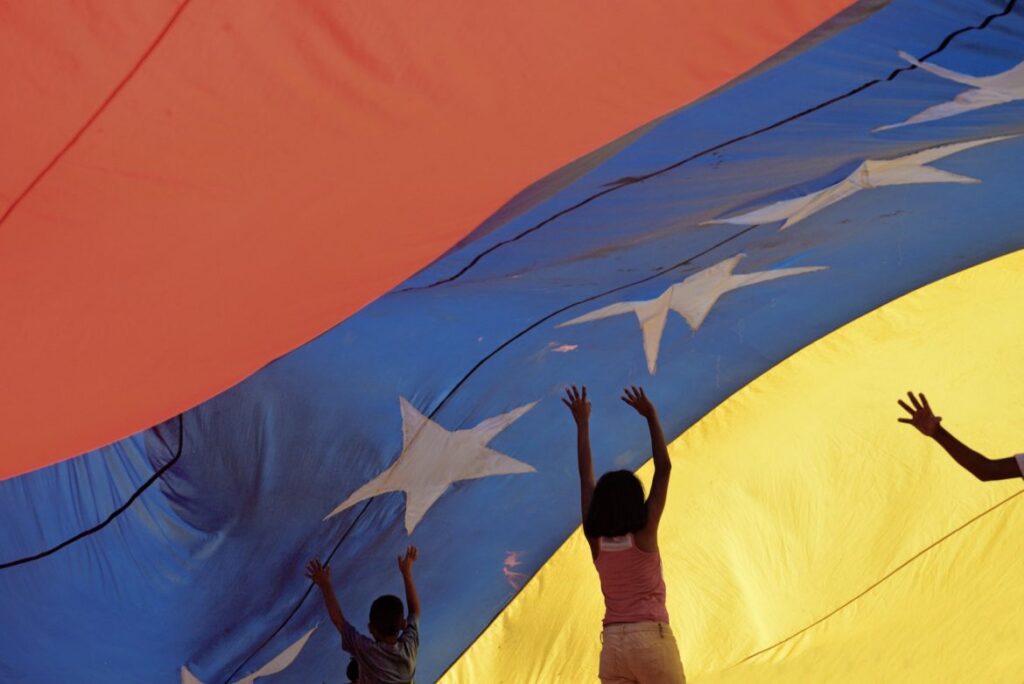
Kids playing below a giant Venezuelan flag. File photo.
Kids playing below a giant Venezuelan flag. File photo.
Following a discussion centered on national peace, unity, and the defense of sovereignty, Venezuela’s National Assembly has unanimously approved the Amnesty Bill for Democratic Coexistence in Venezuela during its first discussion. Proposed by Acting President Delcy Rodríguez on January 30, the legislation passed its first reading with broad support for the reconciliation efforts.
“In the name of God, unanimously approved,” said the president of the National Assembly Jorge Rodríguez this Thursday, February 5, explaining that the bill will now undergo a public consultation process.
He instructed that the debate should take place across all sectors of society, and asked the deputies to speak not only with those currently in detainment, but also with the victims of political violence promoted over the last 27 years by sectors of the right.
Following the approval of the bill in its first reading, Rodríguez announced that a Special Commission for Public Consultation on the law had been formed.
The session will be chaired by Deputy Jorge Arreaza, who earlier presented the legislative proposal to the speaker’s podium in the Protocol Chamber. Nora Bracho will serve as vice-chair.
The Special Commission will also include the following members of parliament: Pedro Infante, Luis Augusto Romero, Grecia Colmenares, Timoteo Zambrano, Carolina García Carreño, Pablo Pérez, Jacqueline Faria, Antonio Ecarri (who did not attend the session this Thursday), Tania Díaz, Luis Florido, Winston Vallenilla, Yosmaro Jiménez, Iris Varela, Nicolás Maduro Guerra, Roy Daza, América Pérez, and Pedro Carreño.
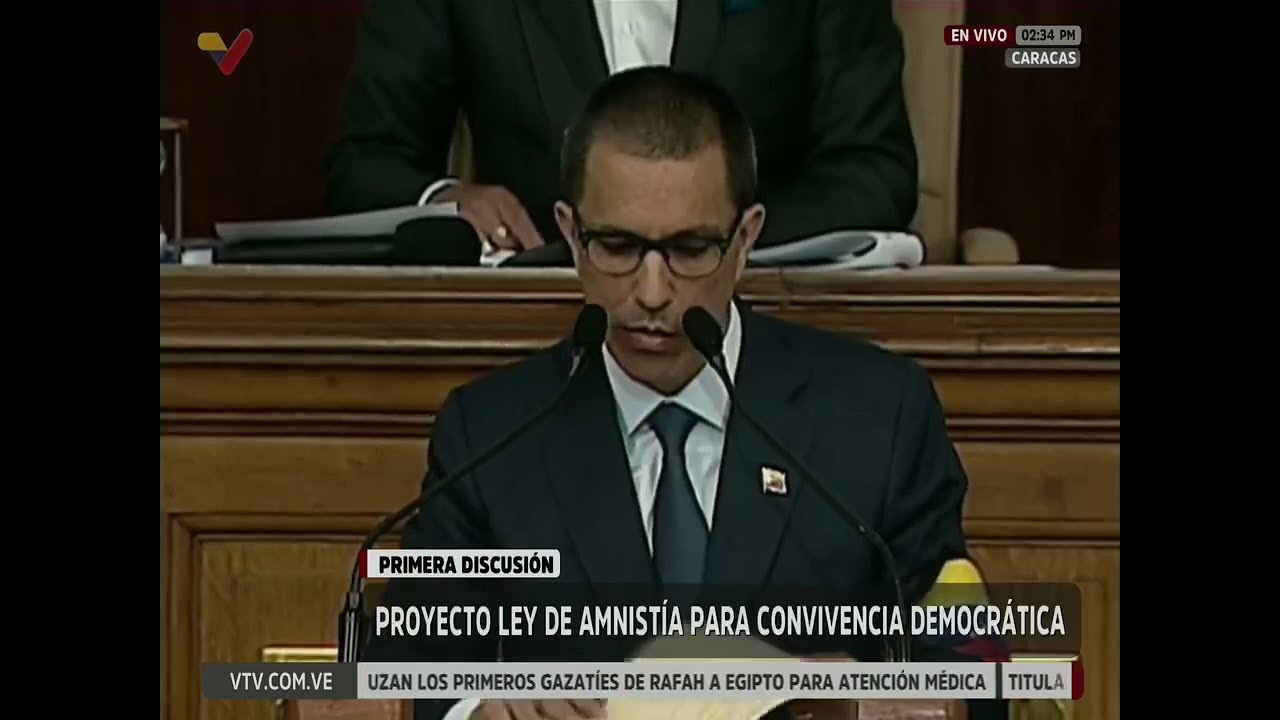
“Go, members of parliament, and proceed with the consultations,” Rodríguez urged. “One last thing, we don’t have much time; speed must be our motto at this time.”
Acting President Delcy Rodríguez announced on Friday, January 30, a general amnesty law for those who have engaged in political violence since 1999. She made the announcement during the opening of the 2026 judicial year. On that occasion, she instructed the Special Commission for the Judicial Revolution, chaired by the Vice President for Political Affairs, Citizen Security, and Peace, Captain Diosdado Cabello, and the Democratic Coexistence for Peace Program, coordinated by the Minister of Culture, Ernesto Villegas, “to convene urgently and present the law to the National Assembly in the coming hours.”
What did the members of parliament say during the debate?
The first to speak was Jorge Arreaza, deputy of the Homeland bloc and president of the Permanent Commission on Families, Freedom of Religion and Worship, who highlighted the need for peace to reign in the country.
The parliamentarian began his speech by quoting a message that on June 10, 1820, the Father of the Nation, Simón Bolívar, transmitted to Francisco de Paula Santander, in which he explained that the hurricane of Independence had taken him to different corners without his will prevailing and affirmed: “‘I find myself on the high seas looking for a port where I can disembark, peace will be my port, my glory, my reward, my hope, my happiness and all that is precious in this world’.”
“Our victory, as President Nicolás Maduro would say since 2014, is peace,” Arreaza added, to loud applause.
Later he referred to the Treaty of Armistice and Regularization of War signed on November 25 and 26, 1820, in Trujillo, Venezuela, by the Liberator Simón Bolívar and the royalist Pablo Morillo, putting an end to the “war to the death”; as well as the embrace of peace in Santa Ana on November 27 of that year. Arreaza emphasized that the spirit of coexistence and amnesty shown by the Father of the Nation and his son Antonio José de Sucre, even in the worst circumstances of the war to the death, “should inspire us today in the Venezuela of the year 2026.”
“We believe that we should invoke those treaties and that we should create our own Trujillo treaties for the 21st century,” he said.
He stressed that mutual recognition is fundamental. “Not knowing each other has led to demonization, invisibility, contempt, a lack of communication, a failure to meet, and a failure to build bridges. We must, as they did in those treaties, humanize and create true and sincere coexistence with the differences we always have, to work on and define them and continue working together.”
Arreaza recalled that the country has a long history of amnesties, pardons, and dismissals of charges. In that regard, he mentioned that in 1827, the Liberator, to prevent the separation of Gran Colombia, the Bolivarian Republic, granted amnesty to the separatists. A year later, after surviving an assassination attempt, Simón Bolívar pardoned Francisco de Paula Santander and General Obando and continued with his mission.
“In 1864, after the bloody Federal War, the Constituent Assembly, after signing the Treaty of Coche, also granted amnesty to the delegates of both sides,” he explained, and further noted that Antonio Guzmán Blanco and Joaquín Crespo were also granted amnesty. “In 1902, Cipriano Castro, faced with the threat of a blockade against Venezuela, pardoned, for example, José Manuel Hernández. And not only did ‘El Mocho’ Hernández, very bravely, despite being an enemy and a staunch opponent, not only ask for his rifle to defend the homeland from foreign aggression, but he also served as Cipriano Castro’s Minister of Development for a few months,” he continued.
He mentioned that similar measures were also implemented in the 20th century by the dictator Juan Vicente Gómez and Eleazar López Contreras. He added that Rafael Caldera, in 1969, allowed men and women who had joined the guerrillas to return to political life, and mentioned that it was this former president who dismissed the legal case against Hugo Chávez, who led the civic-military rebellion of February 4, 1992.
Arreaza mentioned that Hugo Chávez himself, during the first years of his first government, in 2000, granted amnesty to the participants of the 4-F Rebellion, who had not yet received this measure.
He highlighted the 2007 Amnesty Decree that favored the coup plotters of April 2002, those who promoted the oil sabotage of 2002-2003, and those who promoted violent actions from 2000 to 2007.
Arreaza took note of the fact that the measure was taken on December 31, 2007, when they were celebrating the New Year. At the meeting, he had a pensive mood, and Chávez asked him why. Arreaza replied that he was having trouble processing the Amnesty Decree, and the Commander gave him “a lesson in politics, ethics, leadership, and understanding the circumstances, which lasted from 11:40 at night until 4:00 in the morning. The conciliatory spirit of Commander Chávez was also present,” he recalled amidst applause.
He noted that the constitutional president, Nicolás Maduro, after the violent actions promoted by the Venezuelan far right in 2014, granted a similar political pardon in 2017.
Dialogue and recognition
Arreaza mentioned the bombings carried out by the US empire against Venezuela on Saturday, January 3, as well as the kidnapping of President Maduro and the First Lady and National Assembly Deputy, Cilia Flores, and emphasized that these events force us to work together in defense of the homeland, to recognize each other.
“We have passed January 3rd,” he stated. “Circumstances compel us in the best sense, our homeland compels us to be responsible, to heal wounds, to recognize each other, to understand each other and to build together, the steps, the paths.”
“This bill helps the entire political dialogue process,” he stated. “It aims to reach agreements and establish common ground with all political sectors of the country. This law facilitates those processes that are geared towards bringing us peace and prosperity.”
He said that it is necessary to build trust for the good of the Venezuelan people at this delicate moment for the Republic.
Neither weakness nor impunity
He stated that no one should interpret the law as a sign of weakness, “that no one should use it to fuel hidden agendas, pettiness, or biased political calculations, neither within Chavismo nor in the opposition. We must have the wisdom and political awareness that the people demand of us at this time.”
“Let no one confuse this initiative of the National Executive with impunity and carte blanche,” he added. “Let us be ethically and historically responsible.”
He noted that human rights experts have said “that the military attack is the sum of all evils applied; let us make the Amnesty Law the sum of all good things for Venezuela, which so deserves it.”
He later clarified that this Amnesty Law must not lead to further political violence and conspiracies. “It will not be repeated what Bolívar called criminal clemency; rather, this must be a process of genuine reconciliation among Venezuelans.”
Human rights violations will not be forgiven
Parliamentarian Jorge Arreaza explained to the plenary that the Amnesty Bill states that those who have committed crimes that, by their nature, compromise ethics and human dignity, serious human rights violations, crimes against humanity, war crimes, intentional homicide, corruption, and drug trafficking are excluded from this benefit.
He indicated that the regulation does not require additional budgetary contributions, given its human, social, and political significance, and stated that its implementation falls under the ordinary powers of existing public authorities.
He later indicated that if this law is approved in the first reading, it will go to consultation—real consultations, “in the catacombs, paths, hamlets, neighborhoods, fishing villages, housing developments, urbanizations, community councils, condominiums, communes,” stating that “we have to face the people, we have to explain its necessity, its relevance, its importance. Let us allow ourselves to be challenged by the people, by the real victims of the aggression against the country.”
National reconciliation
Deputy Luis Augusto Romero began his speech by referring to the bombings carried out by the US entity against the country on January 3, 2026, an event that he emphasized was felt with deep sorrow by all Venezuelans.
He later said that the discussion of the Amnesty for Democratic Coexistence Bill should help national reconciliation.
“This bill could be a tremendous opportunity to begin a long, painful, and complex path to national reconciliation,” he stated, “but it is our responsibility to take the initiative and engage in this debate. I welcome the fact that the government, through President Delcy Rodríguez, has raised this issue (…) we, from the opposition, will be there, we will participate, we have observations and arguments.”
“This country cannot endure one more act of revenge, one more act of retaliation,” he continued.
To elevate human greatness
Congresswoman Carolina García asserted that the Amnesty Law strengthens civic virtues.
“It’s not about turning the other cheek, let’s not see it that way,” she said. “It’s about elevating human greatness amidst all differences; it must be placed above all else. It shouldn’t be seen as a weakness, let’s not think that.”
She emphasized that we must rise to the occasion of this historic moment in Venezuela, and that the law “primarily calls for national unity, so that Venezuelans can resolve their differences within our country, but peacefully. With tolerance and coexistence amidst the diversity that certainly exists; of political ideologies, but with respect and dignity.”
The standard should be a source of pride for all Venezuelans
While ignoring the US aggression and bombings against the country, nor the kidnapping of the presidential couple, the right-wing deputy, Tomás Guanipa, stated that the Amnesty Law could be the starting point for the families of imprisoned politicians to reunite with their loved ones.
“From the freedom caucus, we will make all our contributions so that this law becomes a source of pride for all Venezuelans and begins a stage in the national reconstruction that we must all undertake together,” he added.
He called for it to have all the guarantees and international standards.
High politics demands peace
During the debate, opposition member David Uzcátegui pointed out that “high politics demands peace.”
He emphasized that the law is the fuel for the engine of reconciliation, where they will show the world that Venezuela is capable of resolving its differences among Venezuelans through the law, at home and under the open sky. “We voted for peace, which is the only fertile ground where progress grows.”
Justice is not revenge
Opposition deputy Yusmaro Jiménez also celebrated the discussion of the Amnesty Law. “From Vamos Vamos Venezuela, we will support the approval of this law,” he said, referring to its first reading. “No more scores to settle or revenge. Justice is not about retribution.”
He also raised the issue of reviewing the police forces, which in his view have been involved in the violence, “and the actions that have put many behind bars.”
Jiménez proposed eliminating the Law Against Hatred and the Simón Bolívar Law, because according to his view they are “unjust”; as well as “interpretations of the crimes of treason and terrorism” that, in his opinion as a far-right opposition politician, compromise democratic guarantees.
He also suggested that those who left the country for political reasons should be allowed to return.
Politics without hatred, without violence, without missiles
National Assembly Deputy Nicolás Maduro Guerra stated that the proposed law will be effective for national development because it seeks peace and reconciliation.
“Why do we guarantee peace and reconciliation?” he asked. “So that our country can develop, can move forward, so that Venezuelan families have a peaceful environment that allows them to have a quality education and productive forces at work,” adding that we have to work together to unify the country.
“After this law, we have to ensure that politics can be done without violence, without hatred, without missiles, without military invasion, without the kidnapping of the President,” he said.
Reconciliation without impunity
The first vice president of the National Assembly highlighted that more than 95% of Venezuelans are committed to a country of peace and coexistence.
He emphasized that the legislative project on amnesty is not intended as an act of impunity, but as a mechanism to facilitate national reconciliation.
He explained that the regulations will not evaluate people, but rather the facts associated with each case, and that judicial considerations will correspond to established legal procedures.
The congressman maintained that those who benefit must make clear commitments. “That they never again call for bombings of Venezuela, that they never again call for invasions, economic blockades, or unilateral coercive measures. That they never again incite hatred or promote violence.”
Speak to everyone without fear
The debate was closed by the president of the National Assembly, Jorge Rodríguez, who urged that this public consultation process for the legislation should include all sectors. “Let’s not be afraid to talk to everyone,” he said, “to anyone who wants to tell us something, to anyone who has a testimony, to anyone who has a proposal, to anyone who wants to be included in the bill.”
Rodríguez indicated that the bill, fortunately, is not a list of names, as he considered that exclusionary. He proposed that all elements that could be subject to this law, which covers the period from 1999 to 2026, be taken into account.
“So go and talk to the people, go and talk to the families of those deprived of their liberty, talk to the deprived of their liberty. Talk to the victims as well of the crimes that have been committed all these years,” he urged the members of the special commission.
Translation: Orinoco Tribune
OT/JRE/AU