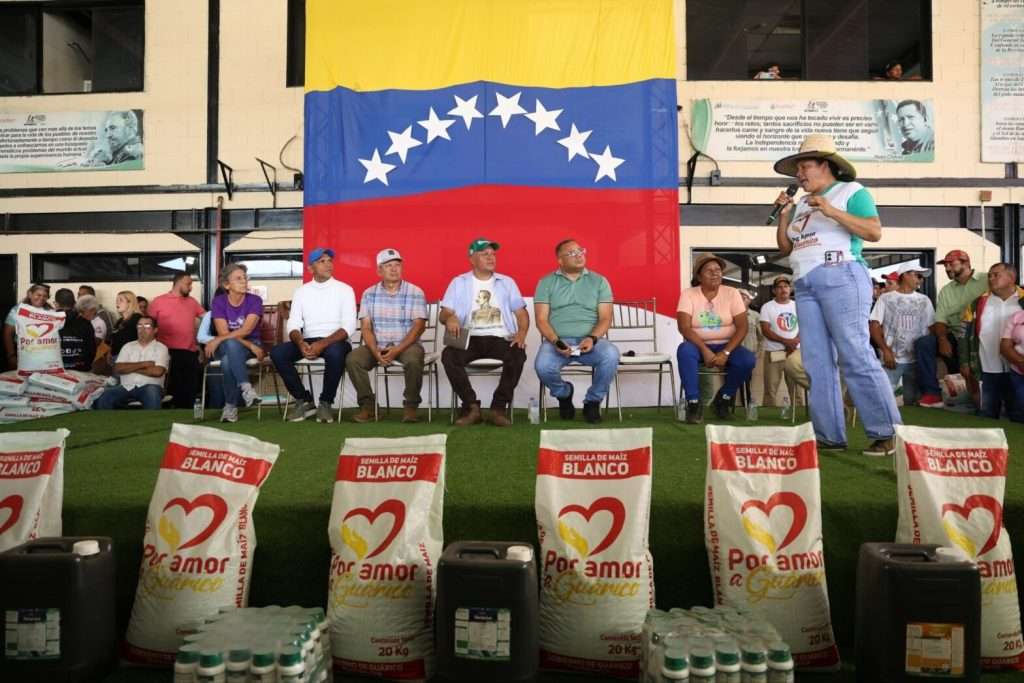
Seeds and fertilizers distributed to the communes in Guárico state. Photo: Ministry of Communes.
Seeds and fertilizers distributed to the communes in Guárico state. Photo: Ministry of Communes.
The 2026 Communal Agro-Food Plan of Venezuela aims to plant corn on more than 22,500 hectares of land during the second half of the year, as corn is a crop of this season.
In the states of Guárico, Monagas, and Yaracuy, the communes have taken control of the production chain, which covers land preparation to harvesting and storage, to strengthen the country’s food sovereignty. The goal is to harvest 79,000 kilograms of corn by the end of 2026.
According to information by the Ministry of Communes, producers have the capacity of three silos in the states of Monagas and Guárico for the storage of the harvest.
The plan began in the Ortiz municipality of Guárico state with the delivery of supplies for the planting of 17,000 hectares under the communal model. Meanwhile, in Pedro Zaraza, the communes launched the planting phase with the aim of establishing self-sustaining productive units. Guárico is one of the strategic states for the agri-food program, as it could achieve the goal of 14,000 hectares of white corn and 3,000 hectares of yellow corn.
To this end, local producers are focusing massively on the Winter Cycle 2026.
Meanwhile, Monagas is advancing with corn planting in the municipalities of Ezequiel Zamora and Cedeño, where 1,848 hectares of land are dedicated to the crop, of which 563 hectares are for yellow corn and 1,285 for white corn, with yield expectations ranging from 4,500 to 6,000 kilograms per hectare. Additionally, in Yaracuy, producers are working with regional seeds, strengthening a production that, although on a smaller scale, is key for local supply.
Financing of production by Ministry of Communes
The agro-food plan is a strategy of the Ministry of Communes to enhance productive capacities in five strategic agricultural sectors: corn, rice, coffee, legumes, and soybeans.
The plan is being executed through a new financing method that arrives in the form of seeds, fuel, fertilizers, tractors, equipment, and tools through the Bank of the Commune.
The ministry will handle the financing, the monitoring of the production cycle, the reception of the harvest, and the subsequent social reinvestment.
The process
Once the producers harvest the corn, they will take it to the communal silos, where the harvest will be kept. The Venezuelan State will buy from the producers and will distribute the crop to companies for processing for animal and human consumption. This program aims to transfer control of food production to communes. The entire process, including the seeds, the commercialization of the crops, the collection and the supplies remain under the administration of the communes.
According to the Ministry of Communes, the aim is to break the chains of speculative intermediation, ensuring access to healthy and sovereign food, while reducing costs.
It specified that communal control over storage and processing would ensure that the social value generated would remain in the community, to be invested in health, education, and services.
Translation: Orinoco Tribune
OT/SC/SH