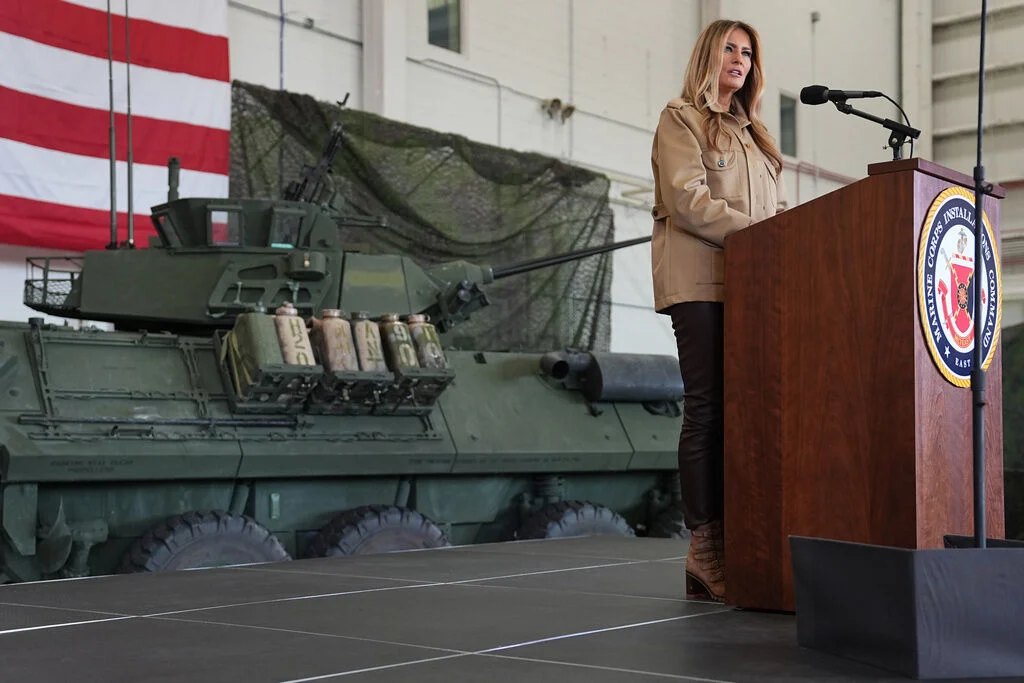
Melania Trump, delivers a speech at the Mega Hangar at New River Marine Corps Air Station in North Carolina, on November 19, 2025. Foto: AFP.
Melania Trump, delivers a speech at the Mega Hangar at New River Marine Corps Air Station in North Carolina, on November 19, 2025. Foto: AFP.
By Rosa Miriam Elizalde – Nov 20, 2025
The Reagan administration updated the dated Monroe Doctrine, referring to Latin America as “our backyard.” In the United States, the expression sounds almost endearing: the backyard is the place for barbecues and children’s games. South of the Rio Grande, however, “backyard” translates into corral: the place where chickens are raised, junk is accumulated, old washing machines are thrown away and it ends up looking like a small domestic cemetery.
That is the image that many Latin Americans conjure up when they hear a politician in Washington talk about the region as their “backyard”: a secondary, degraded space, useful while it serves a purpose, dispensable when it gets in the way. This is not a cultural misunderstanding, but rather a symptom of an imperial view that has been consolidated over two centuries.
The idea that the Western Hemisphere is “America’s thing” was institutionalized with the Monroe Doctrine (1823) – “America for Americans,” that is, for US citizens – and radicalized with the expansionism of the early 20th century. Gregorio Selser rescued a brutal statement by President William Howard Taft in 1912 that sums up this mentality and helps to understand Donald Trump’s current delusions:
“The day is not far off when three stars and stripes flags will mark the extension of our territory at three equidistant points: one at the North Pole, another at the Panama Canal, and the third at the South Pole. The entire hemisphere will be ours, in fact, as, by virtue of our racial superiority, it is already morally ours.”
That structure has not disappeared; it has only changed its words. The US elite continues to speak of Latin America as its own space. Mauricio Claver-Carone, Trump’s key operator for the region, said it bluntly to The New York Times: “This is the neighborhood we live in… and you can’t be the preeminent global power if you’re not the preeminent regional power.” Secretary of War Pete Hegseth was equally explicit: “The Western Hemisphere is the United States’ neighborhood, and we will protect it.”
“Neighborhood,” “protect”: a seemingly benign lexicon that hides the same old logic. Latin America does not appear as sovereign subjects, but as an area that Washington administers, corrects, and, if necessary, punishes.
Bush and Rubio Are Rocking the Political Cradle of María Corina Machado
Trump’s proposal to rename the Gulf of Mexico as the “Gulf of America,” with the understanding that “America” is the United States, fits into this context. It is not a cartographic extravagance: it is the condensed metaphor of the backyard in the 21st century. Changing the name of the gulf means reaffirming symbolic ownership of the space, inscribing dominance in geography—as Taft dreamed of with his three flags—and preparing the ground for reinforced military hegemony. Whoever renames a sea assumes the right to decide what happens in it, and historically, naming has been an instrument of domination.
That is why the nominal gesture is accompanied today by a military deployment unprecedented in recent times in the Caribbean. Since September, a U.S. operation has attacked ships under the pretext of the “war on drugs,” stretching the legal argument to equate fentanyl trafficking with a chemical weapons threat. The scene is reminiscent of other prologues to intervention: Panama, Iraq, Libya, Syria.
In the logic of the backyard, everything fits: the country with the largest oil reserves in the world (Venezuela) would be punished, the historical symbol of resistance (Cuba) would be struck, and the uncomfortable ally of both countries (Nicaragua) would be disciplined, sending a message to the rest of the region: the corral has an owner, and the owner has not gone away.
Trump wants to control the “backyard” for four reasons: to sustain his claim to global leadership—there is no global hegemony without regional hegemony—to curb the influence of China, Russia, and the BRICS, to secure strategic resources and energy routes whose hinge is the Gulf of Mexico, and to capitalize, before his domestic base, on the hard-line discourse against the insubordinate in the neighborhood.
The dispute is not just semantic: it is territorial, military, and political. Latin America can accept the map drawn by Washington—that of a backyard ordered from the North—or move toward another, in which the region thinks of itself as a subject and not as anyone’s backyard. The challenge is not only to resist the owner of the corral, but to stop being a corral. And that means changing more than just the names on the maps: it requires changing who draws them.
(Resumen Latinoamericano – English)

Rosa Miriam Elizalde is a Cuban journalist who was First Vice President of the Union of Cuban Journalists (UPEC), a founder of Cuba Debate and a writer of several books. She is also a regular contributor to La Jornada.