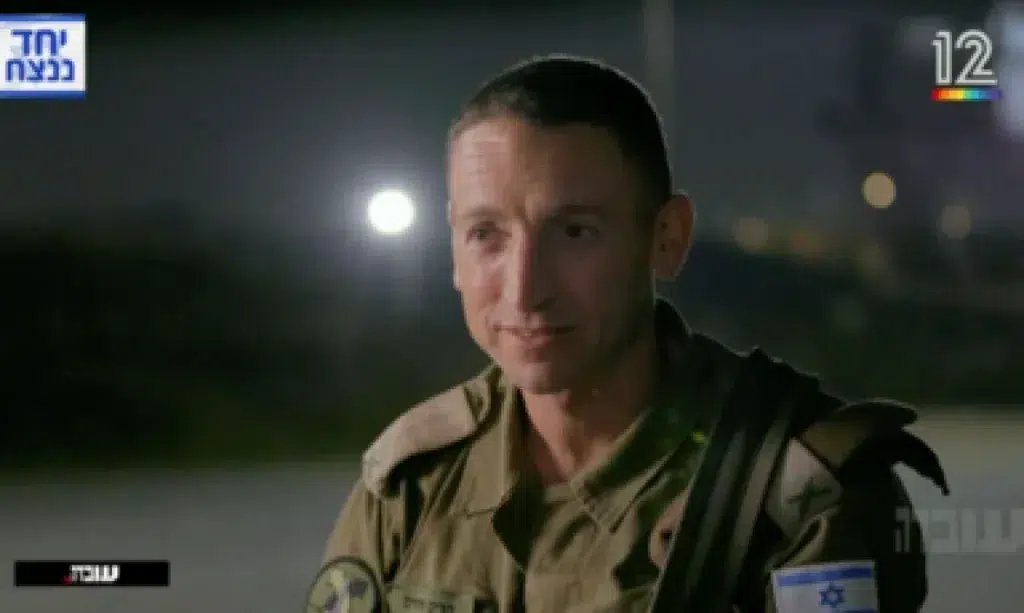
Brigadier General Barak Hiram on Israeli media casually admitting the war crimes he committed, such as killing 12 Israeli civilians (including children) in their homes. Photo: Uvda.
Brigadier General Barak Hiram on Israeli media casually admitting the war crimes he committed, such as killing 12 Israeli civilians (including children) in their homes. Photo: Uvda.
By Ali Abunimah and David Sheen – Dec 24, 2023
Video and witness accounts recently published by Israeli media reveal new details about how Israeli forces killed their own civilians in Kibbutz Be’eri on 7 October.
Last week, Israel’s Channel 12 released previously unseen footage of an Israeli tank firing at a civilian home in the settlement, just a few miles east of Gaza.
The new evidence shows that the Israeli commander on the scene, Brigadier General Barak Hiram, lied to a top Israeli journalist about what happened in the kibbutz that day, after Palestinian resistance fighters launched a large-scale assault on Israeli military bases and settlements across the boundary from Gaza.
This amounts to an attempted cover-up by a senior military officer, with media complicity.
But far from being held in any way accountable, Hiram is soon set to take up his new role as commander of the Gaza Division, the Israeli army brigade that was routed by Palestinian forces on 7 October.
Hiram resides in the settlement of Tekoa, built in violation of international law near the occupied West Bank city of Bethlehem.
In an interview with Ilana Dayan, the host of Israeli Channel 12’s prestigious investigative program Uvda, on 26 October, Hiram gave a false account of the efforts to rescue civilians in Be’eri.
He also fabricated atrocity propaganda, claiming that Palestinian fighters had tied up and executed in cold blood 10 civilians in the kibbutz, eight of them children.
These sorts of lurid stories – amplified by Israeli leaders and relayed directly to the White House and world media – played a direct role in inciting Western governmental and public support for Israel’s genocidal response.
Hiram’s interview with Dayan was broadcast more than 10 days after Yasmin Porat gave her own testimony to Israeli state radio – a very different account from Hiram’s and one much less flattering to Israeli forces.
Porat was among 15 civilians held by Palestinian fighters in the house shot at by a tank seen in the new video, the home of Kibbutz Be’eri resident Pessi Cohen, who was also killed there.
In her 15 October interview with Israeli radio, which went viral after The Electronic Intifada translated it, Porat described how she and her partner Tal Katz had been at the Supernova rave when rocket fire from Gaza began early on the morning of Saturday, 7 October.
The couple got in their car and escaped to Be’eri, where they knocked on the door of kibbutz residents Adi and Hadas Dagan.
They hid with the Dagans until Palestinian fighters found them and took them to another nearby house where more civilians were being held by several dozen Hamas fighters.
Early reports mistakenly stated these events took place in the kibbutz dining hall.
At Pessi Cohen’s house, according to Porat, the Palestinian fighters treated the dozen plus Israeli civilians “humanely,” and assured them they would not come to any further harm.
The Palestinians provided them with water and allowed them outside onto the lawn to escape the heat.
According to Porat, the fighters wanted Israeli authorities, who they thought would already be massing in the area, to grant them safe passage back to Gaza, where they would then release the civilians at the border.
The fighters’ demands were relayed to Porat via Suhayb al-Razim, a Palestinian minibus driver from occupied East Jerusalem, who they had also captured and forced to serve as their Hebrew translator.
Al-Razim had been taken captive earlier in the day while ferrying Israeli partygoers to and from the Supernova rave.
At the behest of the Palestinian fighters, Porat called the Israeli police so that the gunmen could negotiate their way out.
After numerous phone calls with the police, the hostages and their captors waited out the arrival of Israeli forces. When those forces finally pulled up to Pessi Cohen’s home, they began firing without warning, Porat said.
Killed by their own side
“We were outside and suddenly there was a volley of bullets at us from the [Israeli unit] YAMAM. We all started running to find cover,” Porat told Channel 12.
Amid the gun battle that ensued, one Palestinian commander, later identified as Hasan Hamduna, negotiated his own surrender with the Israeli forces. They instructed him to strip and come outside with Porat.
As they came out, Porat called on the Israelis to stop firing, which they did. Then she saw several kibbutz residents lying on the ground – people who with one exception would end up dead.
Asked if Israeli forces may have killed them, Porat replied, “undoubtedly.”
“They eliminated everyone, including the hostages. Because there was very, very heavy crossfire,” Porat said. “I was freed at approximately 5:30 pm. The fighting apparently ended at 8:30 pm. After insane crossfire, two tank shells were shot into the house.”
Among those killed by the tank shells were Adi Dagan and Porat’s partner Tal Katz.
Hadas Dagan was injured but survived – the only Israeli aside from Porat to come out of the battle alive.
In another interview last month, Porat revealed that according to Hadas Dagan, the tank shelling had also killed Liel Hatsroni, a 12-year-old girl whom Israeli propagandists had been claiming was murdered by Palestinians.
Earlier this month, Hadas Dagan gave her first interview, confirming key parts of Porat’s account.
It is part of a half-hour long Channel 12 report published on 9 December that also features Porat as well as family members of other Israeli captives killed in the same incident.
“It’s obvious that this incident presents a very heavy moral dilemma. I don’t want someone to take the story with the very difficult moral dilemma presented here and point an accusatory finger at the army,” Dagan says when identifying the immediate cause of her husband’s death. “To me it’s very clear that I, and Adi, were wounded from the shrapnel of the tank shell because it happened at that very moment.”
She describes the horrifying experience of watching her husband bleed out onto her from a hole in his neck several centimeters long, until he stopped moving.
“I am mad, I am very mad. I am mad that we were abandoned, that we were betrayed, that we were alone, alone, alone, for so many hours,” she says. “Adi, to end his life like that, in that way, crunched up.”
“Suddenly I saw a tank”
A video shot near ground level shows a tank rolling through the kibbutz on 7 October, while aerial footage taken by an Israeli helicopter shows a tank firing a shell at Pessi Cohen’s house at 5:33 pm. Israeli fighters present described it as a warning shot.
That tank then suffered damage, possibly by an RPG rocket reportedly shot from inside the house by the Hamas fighters. “Afterwards, the tank was damaged and another tank arrived and it completed the mission,” Channel 12 reported.
In the 9 December report, Hadas Dagan corroborates Yasmin Porat’s account of extensive negotiations with the Palestinian fighters before Israeli forces arrived and began shooting.
Channel 12 played audio from phone calls made by Porat in which she, 12-year-old Israeli twins Liel and Yanai Hatsroni and Palestinian commander Hasan Hamduna speak to emergency services.
Hamduna tells the Israeli officer that he wants the army to ensure their passage to Gaza, claiming the Palestinians are holding some 50 Israelis.
As Porat has explained, Hamduna was deliberately exaggerating the number of Israelis being held, apparently in an attempt to make the police and army treat the situation more urgently.
After Hamduna surrendered with Porat, there is video of him in Israeli custody, naked, blindfolded and handcuffed, calling on his comrades to surrender as well, telling them through a megaphone that the Israelis would treat them humanely and tend to any injuries.
While this attempt to renew negotiations was going on, there was nonstop shooting in both directions, Porat told Israeli state television Kan on 6 December.
Eventually a second Israeli tank rolled up, likely commanded by armored battalion commander Lieutenant Colonel Salman Habaka, who was killed weeks later in Gaza.
“I myself arrived in Be’eri and reported to Brigadier General Barak Hiram,” Habaka said in a video produced by the Israeli army in the days following the battle at Be’eri.
“The first thing that he demands of me: to fire a shell into the house.”
Asked by an Israeli social media channel to supply a story of how he “succeeded in saving a family,” Habaka offered none.
Instead, he said his mission was “to locate and destroy terrorists,” and if they were found indoors, “we destroyed the terrorists before we sent in the infantry to bring people out.”
The arrival of such weaponry immediately raised Yasmin Porat’s fears.
“Suddenly I saw a tank,” she told Kan. “I remember, I said to one of the police officers, ‘What, are you going to fire a tank shell? There are hostages outside.’”
“And he says to me, ‘No it’s just so that the units are able to break into the house, they are bringing down the walls,’” Porat added.
But those were not the only heavy weapons Israeli forces used in Be’eri.
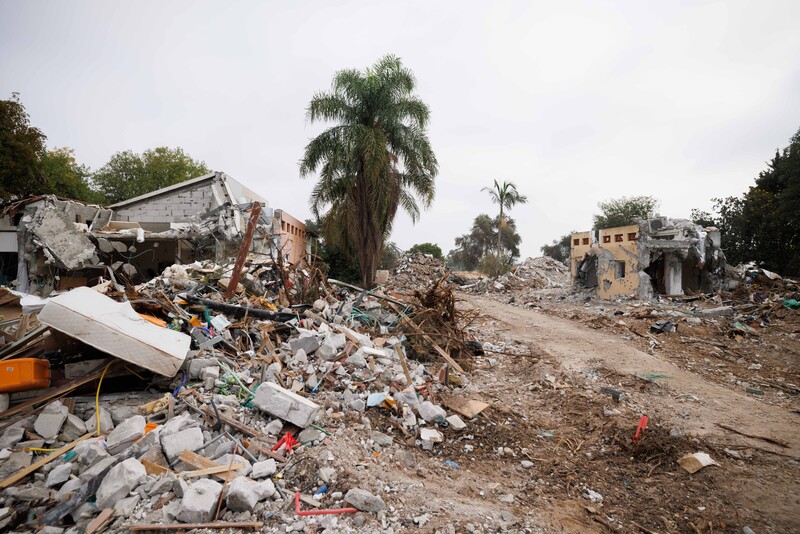
Mainstream media outlets worldwide have broadcast footage of the aftermath in the kibbutz, where entire streets of houses were reduced to rubble.
But none have been asking the obvious question: How could Hamas fighters armed only with AK-47 assault rifles and a few RPGs have done such extensive damage?
The answer, of course, is that they didn’t do so alone. Israeli state television has reported that in addition to tanks, Israeli forces utilized combat helicopters in their counter strike to reconquer Be’eri.
Two veterans of the Israeli military’s elite tactical rescue squad Unit 669, who were volunteer rescuers on 7 October, told Kan earlier this month what they witnessed in Be’eri.
Israeli volunteer saw Apache helicopter fire into Kibbutz Be’eri on October 7
Evidence continues to amass that the Israeli military destroyed its own settlements and killed citizens, but army brass refuses to investigate.
Full story: https://t.co/vMMAmu8WWg
By @dancohen3000 pic.twitter.com/8S9x0rte6e
— Uncaptured News (@UncapturedNews) December 14, 2023
“This was the situation: You’re sitting in a kibbutz in the state of Israel where we take the kids bike riding on weekends. Every second a missile falls on you. Every minute,” says Erez Tidhar, one of the volunteers. “Suddenly you see a missile from a helicopter that shoots into the kibbutz.”
“An IDF helicopter firing into an Israeli kibbutz,” Tidhar adds in consternation, “and then you see a tank rolling down the roads of the kibbutz, fire the cannon and shoot a shell into a house. These are things you can’t quite comprehend.”
Tidhar, notably, is the head of Israel’s national cybersecurity directorate.
Israel’s American-built Apache helicopters were already known to have been deployed in large numbers across the region on 7 October, firing enormous quantities of devastating Hellfire missiles and exploding cannon shells, killing Palestinians and Israeli civilians alike.
This fierce firepower burned to death hundreds of people so completely that Israeli authorities could not tell for weeks if they were Palestinian fighters or Israeli civilians.
The confusion led to Israel reducing its death toll to 1,200 on 10 November, with senior Israeli government spokesperson Mark Regev admitting that 200 of the dead it had originally counted as Israelis had actually been Palestinian fighters.
“Authorization to shoot”
But this is not how Barak Hiram, the brigadier general who was on the scene, describes events in Be’eri.
Hiram portrays himself as heroically stepping into a chaotic situation, assuming command, bravely battling terrorists and rescuing civilian hostages.
He also tells atrocity tales exposed as lies by the accounts of the two survivors, Yasmin Porat and Hadas Dagan.
“Saturday morning, when we understood there was an invasion happening in the area around Gaza, many soldiers and former soldiers from around Israel came together to defeat the terrorists and save Israeli families in their homes,” Hiram told Israel’s i24News on 11 October.
Two weeks later, he expanded on his version in his 26 October interview with Channel 12’s Ilana Dayan.
“At a certain point Nissim Hazan also arrived, who was a brigade commander in my division,” Hiram explains.
Like Hiram, Hazan also resides in a settlement in the occupied West Bank
“He arrived as a tank commander on a single tank that he managed to put into use after it was damaged, and he was our first tank inside the settlement,” Hiram says.
“And I gave him authorization to shoot mortars into structures to simply stop the terrorists,” Hiram adds.
Speaking about the hostage situation, Hiram says that while an Israeli commando unit known as YAMAM was “purifying” one of the neighborhoods, “one of the citizens manages to flee from the buildings.”
This appears to be a reference to Porat’s negotiated exit from the Cohen house with Palestinian fighter Hasan Hamduna.
“And it creates a kind of dynamic or feeling that the terrorists are barricaded there inside the block [of houses] might be ready to talk or something like that,” Hiram recalls.
A special negotiations team arrived on the scene and tried to communicate with the fighters inside, according to Hiram.
Hiram’s distortions and lies
Up to this point, Hiram’s account is more or less congruent with Porat’s but then, with Ilana Dayan’s complicity, it spirals into distortion and outright fiction.
“Do they answer?” Dayan asks regarding the efforts at negotiation. “They answer us with an RPG rocket,” Hiram says.
“At this stage I authorize the YAMAM force commander there to burst inside and to try to save the citizens trapped in those buildings,” Hiram claims.
“So the YAMAM force wages a truly heroic battle there, and charges inside,” Dayan embellishes. “Does any hope remain that there are still hostages that can be saved?”
“I think in that block there were about 20 citizens and I think the YAMAM force managed to save about four of them,” Hiram asserts.
“All the rest were murdered,” Dayan says.
“All the rest were murdered in cold blood,” Hiram replies. “And there we found eight children tied together and shot, a couple, husband and wife, tied together and shot.”
Deadly lies heard in Washington
Hiram’s story is likely the source of Israeli Prime Minister Benjamin Netanyahu’s assertions, made directly to US President Joe Biden in the immediate aftermath, that “They took dozens of children, bound them up, burned them and executed them.”
Israeli newspaper Haaretz debunked the claim, reporting early this month that “There is no evidence that children from several families were murdered together.”
This is also true for the families held hostage at the home of Pessi Cohen, as confirmed by the only captives to leave it alive.
Hadas Dagan has never claimed that hostages were tied up and Yasmin Porat noted in a 12 October interview with Channel 12 that her partner Tal Katz, also killed by the final tank shelling, was the only one in their group of 15 hostages whose hands had been tied up by the Hamas fighters.
Dagan has never claimed there were executions and Porat has insisted that there were none.
In the same 12 October interview, Porat said that although the Palestinian fighters all had loaded weapons, she never saw them shoot captives or threaten them with their guns.
“They did not abuse us. They treated us very humanely,” Porat said in her now famous radio interview three days later with Kan.
“By that I mean they guard us. They give us something to drink here and there. When they see we are nervous, they calm us down,” she added. “It was very frightening but no one treated us violently. Luckily nothing happened to me like what I heard in the media.”
Furthermore, neither Porat nor Dagan ever reported, nor has any video emerged, of Israeli commandos storming the house in an attempt to save captives.
And contrary to Hiram’s portrayal, there had been negotiations – as Porat described.
Days after Channel 12 published its interview with Hiram, Channel 13 broadcast recordings of calls to the emergency services in which the Palestinian fighters sought to negotiate their safe passage back to Gaza.
An account of events at Be’eri published in The New York Times on 22 December also portrays Hiram as being in a hurry to use force, even when other officers thought negotiations might produce better results.
“As the dusk approached, the SWAT [commando] commander and General Hiram began to argue,” the Times reports. “The SWAT commander thought more kidnappers might surrender. The general wanted the situation resolved by nightfall.”
“Minutes later, the militants launched a rocket-propelled grenade, according to the general and other witnesses,” the newspaper states.
“The negotiations are over,” Hiram recalled telling the tank commander, according to the Times. “Break in, even at the cost of civilian casualties.”
Instead of saving four people as he claimed to Ilana Dayan, with his order to shoot tank shells at the house, Hiram ensured that everyone on the battlefield save for Hadas Dagan was killed, and that at least three others – Liel Hatsroni, her aunt and guardian Ayala Hatsroni and Suhayb al-Razim – were almost totally incinerated on the spot.
Relatives call for investigation
Relatives of those killed in Be’eri are asking questions about what happened to their loved ones and they are taking note of Hiram’s lies.
“We collect bits and pieces of information, no one talks to us in an orderly manner,” says Naama Ben Ami, whose mother Hava was killed in Be’eri. “We don’t really know what happened here.”
Ben Ami and other relatives were interviewed amid the ruins of Be’eri, in the same 9 December Channel 12 report in which Hadas Dagan spoke out for the first time.
“I think there are a lot of disturbing operational questions here,” says Omri Shifroni, nephew of Ayala Hatsroni and cousin of the 12-year-old twins she raised, Liel and Yanai Hatsroni, all of whom perished in the Be’eri bloodbath.
“How did they get here? When did they open fire, who fired? I do not know whose shooting killed them,” Shifroni says.
He then refers directly to Hiram’s claims made in the interview with Dayan.
“He had no idea!” Shifroni says of the brigadier general. “Even when he spoke, and this was two weeks after [the events of 7 October], he had no idea what happened here. No clue – because it was not the truth.”
“This is something that has to be investigated,” says Sharon Cohen, the daughter-in-law of Pessi Cohen. “It must be.”
They were speaking specifically about their own kin, but what occurred at Kibbutz Be’eri was no singular incident of Israel killing its own people, whether through reckless incompetence or by design.
The truth leaks out
Until now, the truth has been leaking out only in dribs and drabs.
In November, an Israeli police source admitted that military helicopters shot at civilians at the Supernova rave – the desert dance party near Be’eri that Yasmin Porat and her partner had attended.
Nof Erez, an Israeli air force colonel, has even gone as far as to call the Israeli response to 7 October a “mass Hannibal” – an application on a wide scale of Israel’s military doctrine that allows the deliberate killing of its own people rather than permitting them to be taken captive.
That same month, Israel revealed that hundreds of unrecognizably burned bodies it thought were its own civilians were actually Hamas fighters – a clear admission of indiscriminate fire on a massive scale.
Earlier this month, the Israeli military admitted to an “immense” quantity of so-called friendly fire incidents on 7 October, but asserted that it would not be “morally sound” to investigate them, as Israeli newspaper Yedioth Ahronoth reported.
Israel has moreover faced huge international embarrassment and anger at home after its army admitted to killing three Israeli prisoners who had managed to get away from their captors in Gaza.
The Palestinian “monster”
While the killing of Israeli civilians – men and women, young and old – by Palestinian fighters on 7 October has been widely reported, the killing of Israeli civilians by Israeli forces on the same day is being covered up by the Israeli state.
Meanwhile, Israel’s media and its sympathizers abroad blast unverified claims and lies at full volume in order to distract from or justify the genocide in Gaza.
These include notorious lies about Jewish babies being executed and hung from a laundry line, beheaded, and even cooked in an oven.
But in an Israel more hyped up than ever to annihilate Palestinians, there are few voices calling for any real accountability about what happened on and after 7 October.
Take Ilana Dayan for instance.
As one of Israel’s premier “investigative” reporters, she has tried to clear Barak Hiram of culpability in the Be’eri tank shelling that killed Israeli citizens by claiming, “When the news reports on a hostage incident at Be’eri, in actuality, sadly, there were no hostages.”
Here’s how she explained what happened on that day in a recent episode of the Unholy podcast, hosted by Channel 12’s Yonit Levy and The Guardian’s Jonathan Freedland: “There’s a monster that grew up on the other side of the fence, on the other side of the border.”
While happy to repeat exaggerations and fictions, Dayan expressed no interest whatsoever in what Israel has been doing for over 75 years to Palestinians across the country, and especially in Gaza, that would lead them to launch an armed attack against Israel at any scale.
When asked if Israelis would one day have to reckon with the horrifying scale of death, suffering and devastation their army is inflicting on civilians in Gaza, Dayan pushed back indignantly.
“Is it possible to understand that a heartbroken nation is too broken to have a reservoir of empathy for the other, for the enemy?” Dayan asked. “What was Hamas expecting when they launched this brutal, sadistic, terrible, horrific atrocity? What were they expecting?”
And asked whether Israelis should be shown that reality, Dayan responded: “We are not foreign reporters, we are Israeli reporters. This is not the time for us to weigh both sides.”
That might explain why Dayan was willing to carry water for Barak Hiram and buttress his fictional account of the battle at Be’eri, burying the truth about how Israel killed its own citizens there.
It does not however explain why international media, organizations and governments, including the UN, continue to accept Israel’s lies and have failed to call for credible, independent investigations into what really happened on 7 October.
The price of this complicity is being paid by the people of Gaza.
Ali Abunimah is executive director of The Electronic Intifada.
David Sheen is the author of Kahanism and American Politics: The Democratic Party’s Decades-Long Courtship of Racist Fanatics.