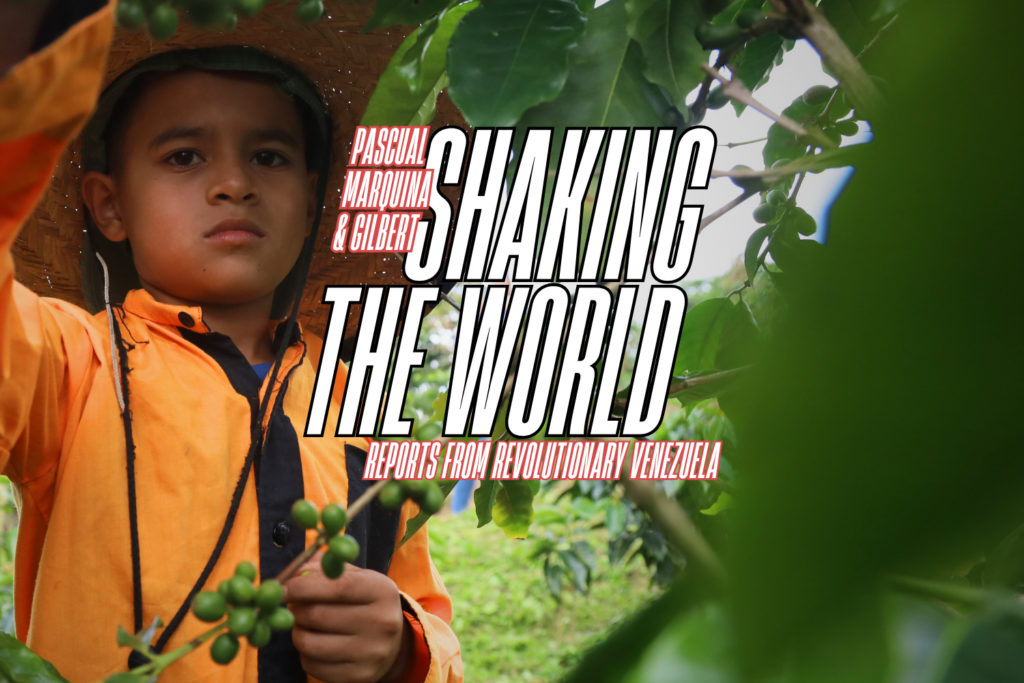
In the mountainous coffee-growing region of Morán municipality, in Lara state, generations of families have built their lives growing coffee. Steep slopes, misty mornings, and hard physical labor are part of daily life in this territory, where coffee is not only a crop but a way of organizing time, work, and community. In recent years, this long history of cooperation has taken a new form through the Vida Café Communal Economic Circuit, an initiative that brings together seven coffee-growing communes in a joint effort to sustain production, life, and collective organization under adverse conditions.
Communal economic circuits are initiatives promoted by the Bolivarian Government to organize production, processing, commercialization, and reinvestment at the territorial level, seeking to operate outside the logic of the capitalist market. Vida Café is one such circuit: a relatively recent but robust project that brings together freely-associated producers organized within their communes, while also addressing broader community needs such as infrastructure, communications, and access to healthcare and services.
This testimonial work explores the origins, functioning, and meaning of Vida Café through the voices of the people who built it. The first, second, and third installments focused on the history of the region, its long-standing cooperative practices, how the Vida Café communal economic circuit was made, and the impact of the US blockade. This final installment turns to the collective responses that have allowed life to continue despite the sanctions, while also building conditions for socialism.

Collective solutions in times of blockade
The Vida Café Communal Economic Circuit took shape under US-imposed sanctions that disrupted everyday life in Venezuela, including production, mobility, healthcare, and access to basic goods and agricultural inputs. The communes in the Moran region organized to generate collective solutions to this life-threatening situation.
Healthcare for the community
Morelys Malvacías: Because of the blockade, we spent more than a decade without a working ambulance in town. If someone got seriously ill and needed to go to the hospital, which is more than an hour away, there was no way to move them. It was a serious problem: we lost lives because of it!
So in 2021, we decided to organize. We asked each family in the parish for a kilo of green coffee, which at the time was worth about two dollars. It wasn’t easy because people were already hurting economically, but it was understood that this would benefit everyone. That’s how we were able to recover the ambulance: by working together.
You could say that was part of the prehistory of Vida Café, but also a teaching moment. Getting the ambulance running was only the first step. Now, it requires constant maintenance—fuel, spare parts, care. That’s where the Circuit has become essential: part of its surplus covers those ongoing costs, sustaining something that belongs to everyone.
In that sense, the ambulance reflects what Vida Café is about—returning to the community what is produced collectively. Here, the surplus is being applied to living conditions in the zone. That is why we call ourselves Vida Café, and why hundreds of coffee growers choose to work within the Communal Economic Circuit, with all the participation it demands, rather than follow the more immediate but isolating path of selling to intermediaries.
Norkys Ramos: The Circuit is not only about organizing coffee production. It also allows us to sustain things like the ambulance and support the medical ambulatory. Sometimes that support is material, sometimes it’s organizational. What matters is that these needs—needs that everyone has at some point or anothe—are addressed collectively. Health is not something separate from what we are building; it is part of it.
Right now, for example, we are working on renovating a wing of the medical center. Part of the funding comes from a National Popular Consultation, but the Circuit is also contributing.
We don’t see healthcare as something external to the community. It’s something we sustain together, while also demanding that the state—at the regional and national levels—fulfill its responsibilities. The same logic applies to other areas where the crisis has made everyday life more difficult.
Fuel and collective distribution
Javier Ramos: There was a period when we simply couldn’t get diesel, and when we could, it was extremely expensive. At one point, a drum of 200 liters could cost the equivalent of two or even three quintales of green coffee [approx. 46 kilos each]. The liter went up to around a dollar, sometimes more. For many producers, that meant choosing between drying the coffee at a loss or losing the crop altogether.There was a period when we simply couldn’t get diesel, and when we could, it was extremely expensive. At one point, a drum of 200 liters could cost the equivalent of two or even three quintales of green coffee [approx. 46 kilos each]. The liter went up to around a dollar, sometimes more. For many producers, that meant choosing between drying the coffee at a loss or losing the crop altogether.
Access depended on who had more money or who had connections. That created a lot of inequality and left many small producers without the means to continue working.
So we stopped waiting and began to organize. Each communal council carried out a census of producers and their real needs. From there, we created committees to manage distribution, and the communes began to take on a coordinating role.
Mauro Jiménez: Now the process is far more organized and there is good institutional coordination. The communal councils identify the needs, which are centralized through the communes. Now, when diesel shipments arrive, there’s already a plan.
Today, through this system, a drum [of diesel] can be obtained at a much lower price—around $31—compared to much higher prices in the conventional market. It’s not that everything has been solved, but the difference between now and then is clear. People know how much they will receive, and they can plan.
What once depended on money or connections now passes through organization. The distribution is not perfect, but it is more transparent, more equitable, and more predictable.
The Communal Economic Circuit is part of this broader process, helping to solve problems and sustain production, especially during the harvest, when fuel is most critical.
This experience shows how things can improve when people organize. What was once an individual struggle marked by uncertainty becomes a collective process, where decisions are made together, and conditions begin to shift.

Roads
The Communal Economic Circuit has developed a Roadworks Social Property Enterprise (EPS de Vialidad) to maintain the roads in this hilly region.
Norkys Ramos: In a mountainous territory, when roads deteriorate, costs rise. For years, road maintenance depended on external actors, whose response were often delayed or insufficient. The blockade aggravated this situation.
The Roadworks EPS means that we can now keep up the roads in a self-managed way. It’s a qualitative change.
Javier Ramos: We started by recovering machinery that had been abandoned, but later we incorporated a dump truck and a backhoe with support from the Ministry of Communes. At first, we didn’t even have machine operators, so we had to bring someone from outside. But over time, we trained ourselves. Now we have operators, we have mechanics, and the Roadworks EPS maintains the roads with the direct participation of the communes in the Communal Economic Circuit.
We do most of the work with the communes, but we also work directly for individual producers. And we do it at a lower cost—sometimes 40 or 50 percent less than private enterprises. That makes a big difference, especially in a place where roads require constant maintenance.
Alexander Grabovic: The EPS doesn’t just have the equipment—it has people who know how to use it, how to maintain it, how to organize the work. That’s what allows the project to continue over time. Road maintenance, in this context, is not simply a technical task. It becomes part of a broader process of increasing our production…and it keeps us working together!
Alternative currency, mutual aid, and everyday solutions
Javier Ramos: There was a time when we were all paying with green coffee. Everyone carried a small bag, and that’s how we bought what we needed, from food to inputs to fuel. In fact, it’s still common, even if less widespread.
This form of exchange was not planned; it emerged out of necessity, as the economic war left us without cash. At the same time, it has deeper roots—our grandparents also used coffee to acquire goods. In that sense, the practice reemerged as a practical response to hyperinflation and scarcity, allowing goods to circulate when conventional money vanished.
Norkys Ramos: We learned many things during those years, and we also recovered the ways of our parents and grandparents.
Mairelys Escalona: Many collaborative practices reemerged during the worst of the crisis, and they don’t always get mentioned. Support for schools, for teachers, and for basic services became important. Sometimes it’s not about money, but about working together to solve a problem.
These practices—barter, mutual support, collective problem-solving—do not resolve structural problems on their own, but they form part of a broader fabric that allows communities to navigate situations created by the blockade.
Taken together, these experiences point to a shared way of responding. Faced with disruptions that affected every aspect of life, the communes and Vida Café did not rely solely on external actors or individual strategies. Instead, we organized—sometimes in more structured ways, sometimes more informally—to respond to what was happening.
What emerged was not a single solution, but the ability to organize around common problems and generate responses rooted in the territory itself. From this accumulated experience, a broader horizon begins to take shape.
The communal horizon
The practices within the Vida Café Communal Economic Circuit have a strategic significance that transcends the immediate. In Villanueva, communal efforts to sustain production and life are giving shape to new ways of thinking, organizing, and relating to one another that point toward socialism.
Industrial Integration and the Impact of the US Blockade: Vida Café Economic Circuit (Part 3)
Political education and social fabric
Mairelys Escalona: When we talk about the commune, we are not only talking about producing coffee or solving problems. We are talking about educating ourselves.
We’ve had many teachers: Chávez himself, elders in the community, Hernán Vargas [former Communal Economy Viceminister], and our comrades at Escuela Nuestra América.
Jesús Silva: Escuela Nuestra América is a space for political education. We study and reflect, but always in relation to real existing processes. The school draws on Marxist thought and on Venezuelan experiences, including the work of our dear Carlos Lanz, but it’s not something separate from practice. It accompanies it. In that sense, it contributes to processes like Vida Café—not by directing them, but by helping communards understand what they are building and why.
Mairelys Escalona: The Escuela Nuestra America is very important because it helps us reflect on what we are doing. It’s not just about working—it’s about understanding why we work together and what kind of society we are trying to build.
However, education does not take place only in classrooms. It is also embedded in everyday practice—in assemblies, in collective decision-making, and in the responsibility of managing shared resources.
Carlos Terán: Political education is fundamental. You can take over land and start a project, but if people are not organized and clear about what they are doing, it doesn’t hold.
That’s the hardest part—not the material side, but building consciousness and commitment over time.
Chávez’s legacy and the future of the commune
Antonia (Nilda) Gil: I remember when Chávez passed through here in the 1990s. People came out to see him, to listen. He was very charismatc; was what the pueblo was looking for.
There was a lot of hope in that moment, a sense that things could be different and better. Later, when Chávez was elected, we felt that he was one of us. That’s a first in our history!
Mauro Jiménez: Chávez spoke about the need to move from communal councils to communes, and from communes toward a communal state. But for that to happen, the communes cannot remain isolated!
If each commune resolves its problems internally but has no economic linkages with others, it becomes limited. It can’t scale up The Communal Economic Circuit that we have built is part of a broader attempt to overcome that limitation.
Chávez left us a blueprint for a larger structure. We at the Communal Circuit are laying some of the bricks to build it.
Carlos Terán: Chávez spoke about a revolution within the revolution. For us, that means organizing ourselves as a people, not depending on others to resolve our problems. That’s what the commune is all about.
Morelys Malvacías: The Circuit allows us to connect communes. It’s not only about coffee production—it’s about linking the communes, making sure that what we do in one place has an impact beyond it.
What is at stake, then, is not only improving conditions within a given territory, but creating the basis for a broader form of organization—one that can extend beyond the local without losing its communal character.
This process remains incomplete and full of challenges. But it points toward a different way of organizing economic and social life, grounded in collective decision-making and regional linkages.
What emerges in Vida Café is not simply a set of solutions to a moment of crisis. It’s the outline of a different logic: one in which production, infrastructure, and care are organized by the people themselves, and where the capacity to respond to immediate needs opens onto the possibility of something more.

(MR Online) by Cira Pascual Marquina and Chris Gilbert

Cira Pascual Marquina
Cira Pascual Marquina is a Political Science professor at the Universidad Bolivariana de Venezuela in Caracas. She is also co‐producer and co‐host (with Chris Gilbert) of the Marxist education program Escuela de Cuadros. She is actively engaged with grassroots organizations in Venezuela and abroad, and is dedicated, both as a militant and as an investigator, to communal initiatives.
Pascual Marquina is co-author of Venezuela, the Present as Struggle: Voices from the Bolivarian Revolution (Monthly Review Press) and co‐compiler of two books: Para qué sirve El Capital: un balance contemporáneo de la obra principal de Karl Marx and ¿Por qué socialismo? Reactivando un debate (both Editorial Trinchera).