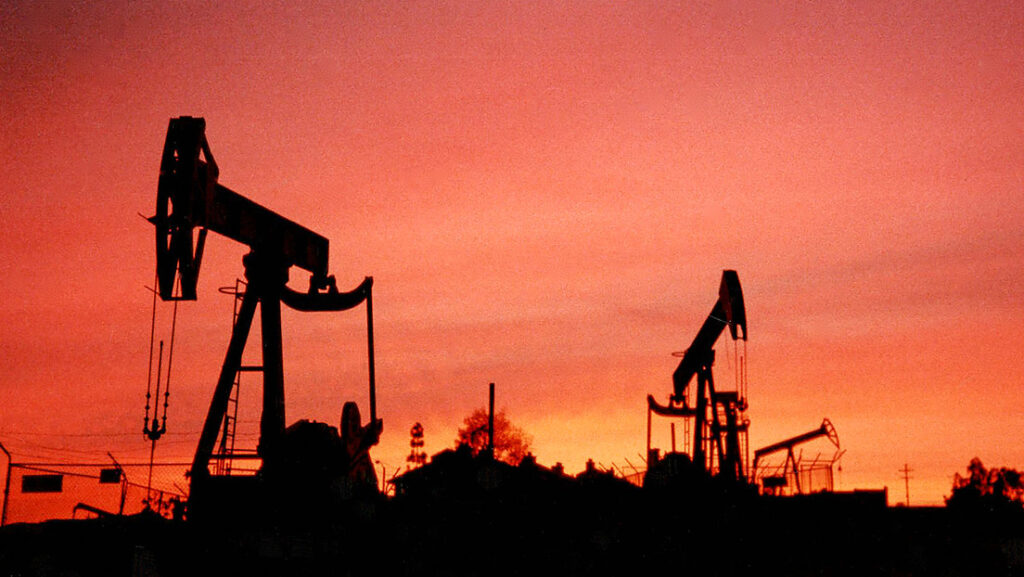
Silhouette of oil rigs against a sunset sky. Photo: Bob Riha, Jr./Getty Images.
Silhouette of oil rigs against a sunset sky. Photo: Bob Riha, Jr./Getty Images.
The crude oil production by the Organization of the Petroleum Exporting Countries (OPEC) has fallen to the lowest level in 36 years due to the impact of the US-Israeli war against Iran, reported Bloomberg.
The organization—currently composed of Saudi Arabia, Venezuela, Iran, Iraq, Kuwait, Algeria, Congo, Equatorial Guinea, Gabon, Libya, and Nigeria, following the departure of the United Arab Emirates (UAE) earlier this month— has seen its activities affected by the expansion of the conflict in the Middle East and the blockade of the Strait of Hormuz.
With the exports of the Gulf countries seriously disrupted, in addition to damage of several of their extraction facilities, OPEC’s joint production plummeted by 420,000 barrels per day in April to 20.55 million barrels per day. This is the lowest level since 1990.
The reduction is mainly due to the losses in Iran and Kuwait. In March, the first month of the war following the unprovoked US-Israeli aggression against Iran, the drop was 8.6 million barrels per day, the largest in recent decades.
Kuwait suffered the largest losses last month, with a decrease of 470,000 barrels per day. Saudi Arabia and UAE also experienced significant declines, while Iran’s production dropped by 180,000 barrels per day due to the war.
The current supply disruption is considered by many to be the largest in the history of the oil market. It has caused a rise in oil prices and a global inflation surge.
US Attacks Civilian Cargo Boats Heading to Iran’s Shores, Killing 5 on Board
After more than a month of hostilities, the US and Iran agreed to a truce on April 7, but tensions remain high due to the failure of peace negotiations, the exchange of verbal attacks, and the naval blockade of commercial ships between the Persian Gulf and the Arabian Sea.
On May 3, US President Donald Trump announced an initiative to free the ships held up in the Strait of Hormuz. According to him, the “Freedom Project” began on Monday morning with the participation of guided missile destroyers, more than 100 aircraft, multi-domain unmanned platforms, and 15,000 Armed Forces personnel.
However, on Tuesday, Trump declared that the operation will be suspended for a brief period, indicating a failure of the operation.
Iran has repeatedly warned commercial and oil vessels to refrain from transiting the Strait of Hormuz without prior coordination with the Iranian Armed Forces, which control its waters.
(RT)
Translation: Orinoco Tribune
OT/SC/DZ