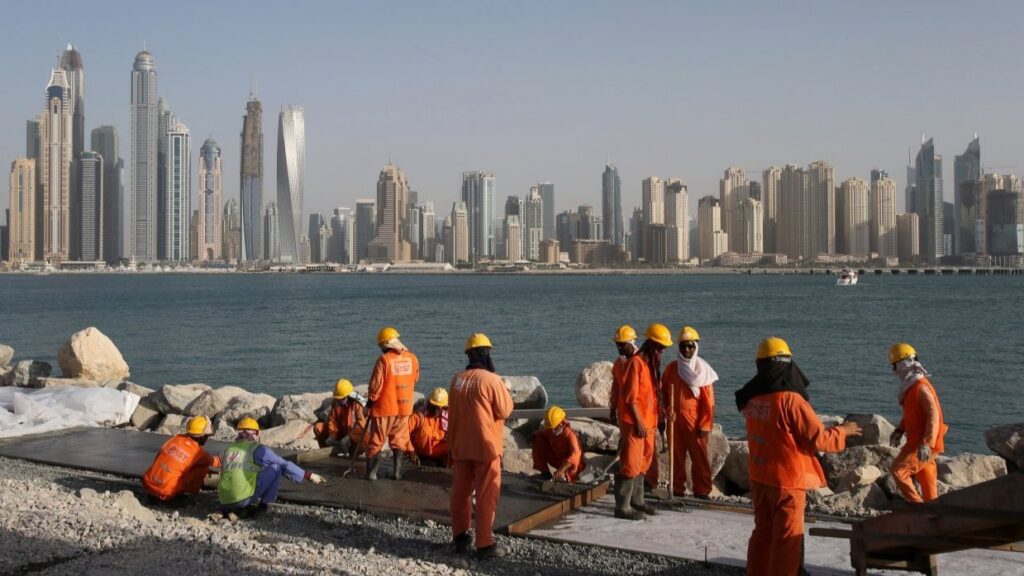
The photo shows construction workers in orange jumpsuits and safety gear working on a coastal project in the United Arab Emirates. Photo: Kamran Jebreili/AP.
The photo shows construction workers in orange jumpsuits and safety gear working on a coastal project in the United Arab Emirates. Photo: Kamran Jebreili/AP.
Many Shia Pakistanis have been targeted by Emirati authorities amid a wave of arrests and layoffs since the start of the war on Iran
UAE authorities have detained and deported as many as 15,000 Pakistanis, many of whom are Shia Muslims, without formal charges or clear explanations, according to testimonies published by New Lines Magazine on 29 April.
The reported removals come as UAE–Pakistan ties face strain following the US-Israeli war on Iran and Pakistan’s expanding mediation role.
The accounts describe a similar pattern of sudden arrests, phone confiscations, transfers between police sites, detention at Al-Awir, and rapid deportation on flights to Pakistan.
Sarah Ali told New Lines that her husband, Taha, was detained on 12 April during an overnight shift in Dubai after officers saw his name and photo appear in a police system.
“He was in complete shock,” Ali said, adding, “They showed him his photo and asked what he had done. Then they told him, ‘We’re really sorry, but we can’t not take your phone away from you, because they’re watching us.’”
Ali said no charges were ever presented against her husband, who was deported to Faisalabad less than a week after his arrest.
The UAE has deported tens of thousands of Pakistanis belonging to the Shia sect, not only deported them, but also took away all their wealth, bank accounts, and & hard earned assets, and sent them literally empty handed back to Pakistan. pic.twitter.com/mJsPgoF5sF
— Nadir Baloch (@BalochNadir5) May 1, 2026
Many of those expelled had spent decades working in the UAE, where migrant remittances remain a critical source of income for families and foreign exchange for Pakistan.
Mohammad Amin Shaheedi, a senior Shia cleric and chief of Ummat-e-Wahida Pakistan, told New Lines that the UAE had launched “what appears to be an organized campaign to deport Shia individuals from the country.”
Shaheedi said around 5,000 Pakistani Shia families, comprising roughly 15,000 people, had been affected.
“They were reportedly sent back with little more than the clothes on their backs, without being given the opportunity to withdraw their funds from banks or settle their financial affairs,” he said.
Several deportees alleged that identity tracking may have been used, including Emirates ID scans at Shia religious sites.
Shaheedi said Shia identity had “reportedly been determined through biometric fingerprint data collected in the past, particularly during their visits to Shia mosques and places of worship.”
Others described harsh detention conditions, including strip searches, poor food, restraints, and physical abuse.
Pakistan’s Foreign Ministry spokesperson Tahir Andrabi denied the deportations when contacted by New Lines.
UAE Launches Muslim Shia Crackdown Under Cover of ‘Iran-Linked Terror’ Claims
Migrant workers in the UAE have also faced broader abuses under the kafala system, which leaves them exposed to wage theft, passport confiscation, and restrictions on movement.
Their situation deteriorated further during the US war on Iran, when many workers were excluded from emergency evacuation measures and denied access to bomb shelters often reserved for citizens.
Delivery drivers, security guards, laborers, and other migrant workers were left exposed during the attacks, despite making up much of the UAE workforce.
Authorities had also launched a crackdown on dissent, arresting hundreds of migrant workers over videos of the attacks posted online or comments that challenged official security narratives.
The legal pressure came alongside severe economic fallout, with workers reportedly placed on unpaid leave, dismissed without compensation, or forced to pay for their own repatriation while trapped in an increasingly dangerous environment.