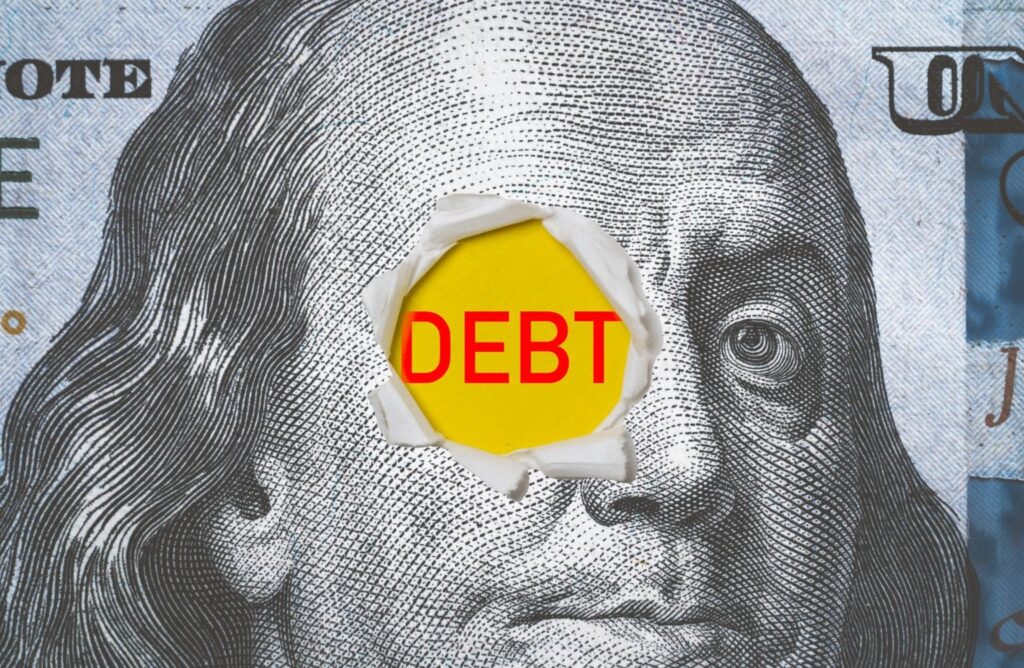
The word "DEBT" written in red on a US dollar bill. Photo: Shutterstock.
The word "DEBT" written in red on a US dollar bill. Photo: Shutterstock.
By Misión Verdad – May 15, 2026
The Venezuelan government has officially launched a “formal, comprehensive, and orderly” process for the restructuring of its external public debt and the debt of the state-owned oil company Petróleos de Venezuela (PDVSA), after nearly a decade of selective default.
In a statement issued by the Vice Presidency of Economy and Finance, the Venezuelan government stated that historically the country has faithfully honored its commitments to its creditors until in 2017 the wave of US and European sanctions against PDVSA and the Central Bank of Venezuela (BCV) disrupted the relations between Venezuelan entities and international bodes.
Reasons, licenses, and debts
The regulatory framework of the US Office of Foreign Assets Control (OFAC) through licenses and the judicial status of the bonds in US courts are the main elements that would define the path of Venezuelan debt restructuring.
To date, various estimates of the amount of Venezuelan debt have emerged in public opinion; some of them are outrageous. This is explained by the fact that the country and its entities that have issued bonds, such as PDVSA and BCV, have incurred involuntary defaults. According to the contracts and terms of the debt, those defaults generate cumulative interest.
This explains that, despite Venezuela not having taken on new debts in nine years, the amounts of commitments to creditors continue to increase, making payments unfeasible under current economic conditions and the destructive accumulation of illegal sanctions.
This is the primary reason why the restructuring process is necessary: to jointly determine with the creditors and through technical arbitration the amount to be paid, how it will be paid, and over what period.
OFAC General License No. 58 (May 2026) is key to explaining the restructuring announcement. It formally authorizes the Venezuelan government and PDVSA to hire legal, financial, and consulting advisory services to deal with this process.
This license expressly prohibits direct negotiations with creditors to finalize settlement agreements, debt swaps, or alternative payments (such as transfers in gold or digital currencies). It is only valid for the preparatory and exploratory phase of the technical teams.
On the other hand, the litigation in US courts over Venezuelan bonds is one of the most complex fronts to deal with due to the claims of the bondholders and the embargo orders. As an example, one may recall the case of the PDVSA 2020 Bonds and CITGO. The main focus of the courts in New York and Delaware has been the bond originally due in 2020, which has 50.1% of CITGO Holding Inc.’s shares as collateral guarantee.
However, so far, CITGO has not been definitively dismantled as the US Department of the Treasury has periodically extended a special license that protects it from being seized or taken by creditors, including the holders of the PDVSA 2020 Bond.
The announcement of PDVSA’s debt restructuring aims to prevent the definitive loss of the CITGO assets by attempting to incorporate the legal claims into the global macroeconomic negotiation package once the OFAC lifts the prohibition on settling liabilities.
What is expected is that the restructuring announcement will create new terms between Venezuelan entities and their creditors to honor their commitments, through a “sustainability” approach that would not compromise the prospects of recovery for the Venezuelan economy.
Regarding the debt contracted with the People’s Republic of China, it has been subject to other payment and compensation mechanisms, such as oil supply. Venezuela’s default has not been linear; it is considered selective, as since 2017, Venezuela has honored part of its commitments to China through the continuous shipment of crude oil.
Venezuela’s objectives
The Venezuelan government is proposing a reset of the terms of its debtor status. It will not be a unilateral process; it will have to be approved by its creditors. But honoring old debt commitments should not limit the possibilities of economic revitalization that the Venezuelan government is trying to execute.
The Venezuelan government hopes that a restructuring process will redefine the terms that would allow for the improvement of Venezuela’s situation in its interaction with international bodies and financing and investment entities.
For almost 10 years, due to unilateral coercive measures, Venezuela has been unable to pay its bond debts. However, irrespective of the cause, the concrete and objective issue is that the country is in debt and with overdue interest.
Once the OFAC licenses enable international financial interactions with Venezuela, the country also becomes a vulnerable target for new legal processes due to non-payment.
A debt-ridden country that fails to renegotiate its debt is a country where neither its government nor its economic sectors generate trust. In that sense, Venezuela would not be viable for issuing new bonds, accessing financing, or swapping debt. It would also not be reliable for receiving new investments because the conditions of trust have remained broken for years due to “insolvency.”
But the crux of Venezuela lies in renegotiating to be able to pay under the most comfortable conditions possible in the current context. This means preventing the burden of debt from robbing the country of the opportunity to recover and grow.
Considering that Venezuela is now receiving new resources and has been enabled via licenses to interact in the international financial system, it cannot resume its commitments in the status and terms in which they were left in 2017, much less with accumulated debt interest. A new agreement is necessary, and this seems to be the best time for it.
This is what the Venezuelan government means when it mentions a renegotiation to free up budgetary burden, that is, reducing the burden of unsustainable obligations to redirect income toward health, education, and public infrastructure.
The restructuring process could even result in a reduction of the actual amount of debt to be paid, putting an end to the maximalist estimates that are circulating, given that the accumulated interest amounts make payment possibilities unfeasible. So the renegotiation is also in the creditors’ interest.
The vice president of Economy and Finance, Calixto Ortega, has stated that the country is seeking access to financing, specifically referring to the Venezuelan private sector. This suggests “allowing the national private sector to regain access to international credit lines and attract foreign direct investment.”
Regarding the restructuring as a process, the strategy is based on the key principles of “transparency, comprehensiveness, sustainability, and speed,” with the aim of ensuring a process that is “honest, versatile, durable, and executed in the shortest possible time without compromising social investment,” Ortega emphasized.
Meanwhile, the International Monetary Fund (IMF) has announced that, to date, there is no ongoing negotiation process with Venezuela regarding debt.
Venezuela’s Economy VP: US Sanctions Responsible for Foreign Debt Default
Other difficult political issues
One of the least discussed elements, but no less important, has been whether the interim president Delcy Rodríguez’s government could sign the restructuring terms.
Ortega revealed that the process has been discussed “for months” with technical teams and it seems that there are conditions for an agreement with some creditors, given that he has pointed out the possible “speed” of the process.
This could explain why the US government has paved the way with licenses enabling Venezuela’s interaction with the international financial system after nearly 10 years.
In other words: the US government is “compensating” with licenses for the damage caused by the sanctions, damage that also affected the creditors of Venezuelan debt. A considerable portion of the bondholders are Americans.
Another important element is that the Venezuelan government has advanced in this direction, even after the January 3 US invasion, when political analysis had proclaimed that Venezuela is approaching a “transition.”
The magnitude and importance of a process of restructuring external debt is very significant, and such a matter is supposed to be delegated at the end of the “transition.” But this is evidently not the case, most likely because in Venezuela the real conditions on the ground contradict the course of a transition and Chavismo is focused on strengthening itself.
This suggests that the dimensions of Venezuelan political realism continue to distance themselves from certain normative dynamics or traditional beliefs. The national government has announced the restructuring of the debt under current conditions, considering that it has the opportunity to gain advantages from this process. The announcement is in itself an indication that the discussions are possibly being resolved in a favorable perspective to honor commitments and make economic recovery viable.
Here there could be a point of convergence and détente in the strategy of Caracas and Washington. The Trump administration is now betting on the success of US investments in Venezuela— in debt and energy securities—those that Trump’s own sanction policies have ruined since 2017. Therefore, he could take the chance that the country would recover from its current status as a major debtor due to the implications that the weight of the debt has for the country’s economic performance.
Meanwhile, Caracas shows signs that it wants to improve its macroeconomic position after renegotiating its debt.
In other words, it is likely that Washington’s participation in the debt restructuring will be to facilitate conditions, as is being done through licenses, but without renouncing its coercive sanctioning mechanisms since they continue to be an expression of its show of force and pressure on Caracas.
Venezuela, for its part, gains breathing room, time, and new opportunities to continue reorganizing the economy.
Translation: Orinoco Tribune
OT/SC/DZ
Misión Verdad is a Venezuelan investigative journalism website with a socialist perspective in defense of the Bolivarian Revolution