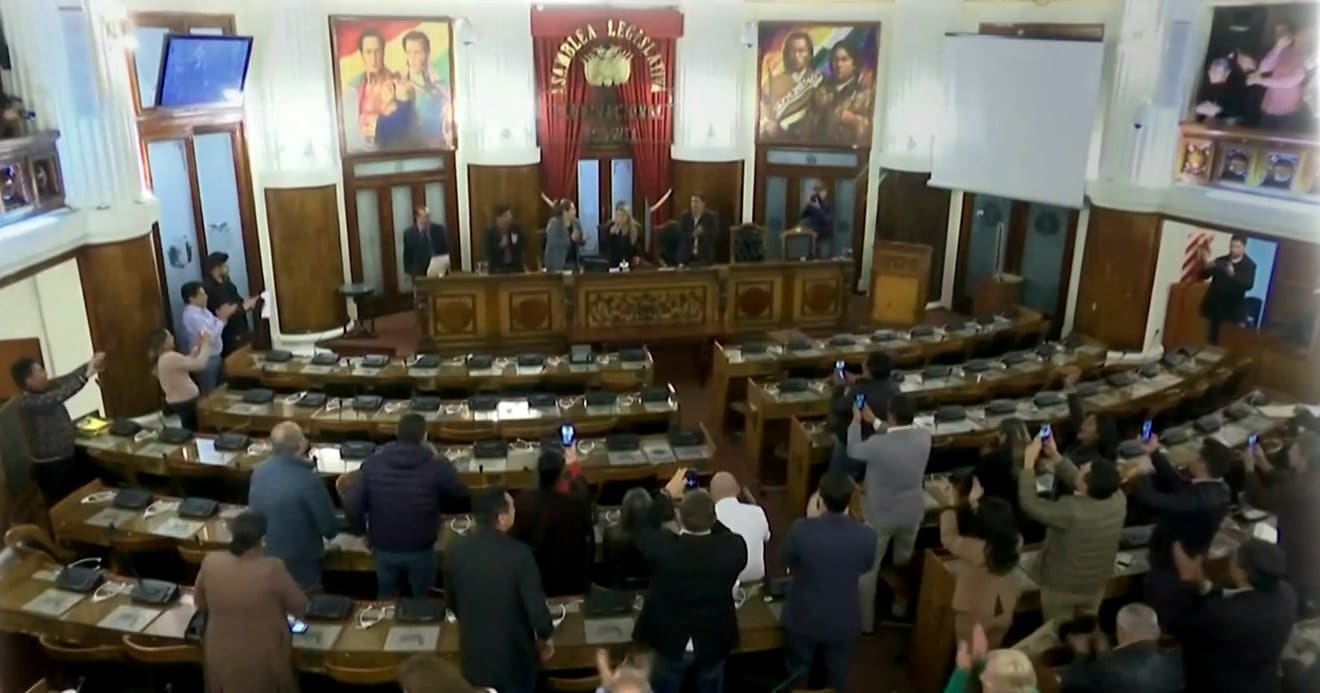
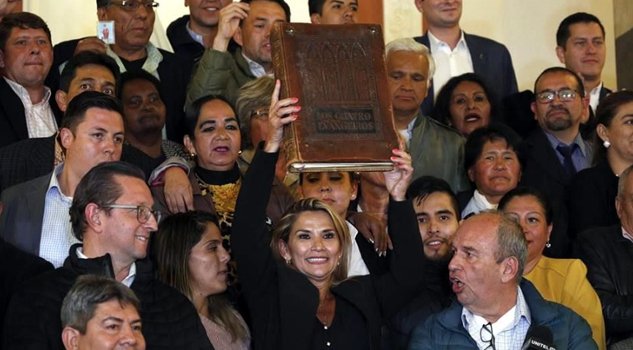
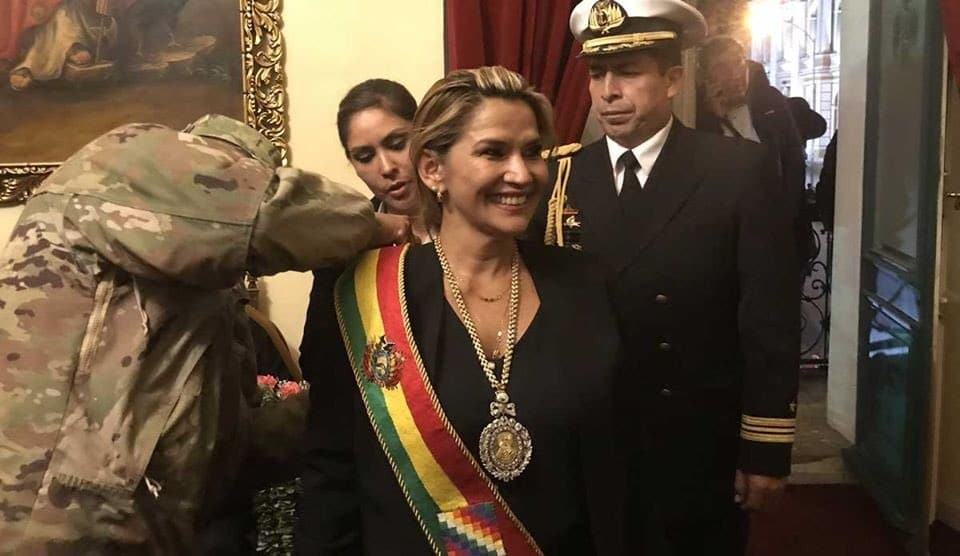
Opposition Senator Jeanine Áñez declared herself president of Bolivia on Tuesday night, despite not complying with the constitutional requirements, as Parliament did not achieve a quorum because the deputies of MAS (mayority) were not in attendance due to lack of guarantees for their security. The senator proclaimed herself president with only a minimum presence of deputies, all from the opposition, and violating articles 161, 169 and 410 of the Constitution.
“I immediately assume the presidency of the State and I undertake all necessary measures to pacify the country,” said Áñez, who is the second vice president of the Senate of Bolivia and the right-wing Social Democratic Movement party.
The MAS bench did not attend Parliament, after having requested “guarantees” so that the congressmen could arrive in La Paz, in the face of the barricades and the military presence that surround the city. However, in a flash session in the Senate, which was in doubt of happening earlier, Áñez declared herself as interim president: “I immediately assume the presidency of Bolivia provided for in the constitutional order,” she said.
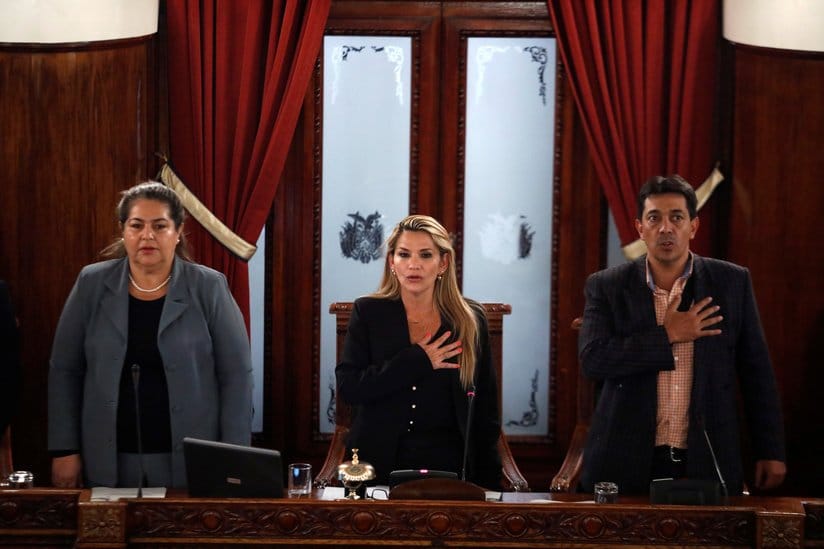
The senator also said that the new elections in Bolivia will take place after the appointment of the new Electoral Tribunal.
“I pledge to take all necessary measures to pacify the country,” said Áñez.
On the absence of the legislators of the deposed president’s party, Áñez said that “the people” had been “witness” that “all the necessary efforts had been made to channel the presence of the assembly members of the three political forces.”
However, she added that the MAS parliamentarians had already publicly expressed their decision not to participate, and blamed the ousted president Evo Morales, and former vice president Álvaro García Linera, for having submitted his resignation, and “leaving the country, taking refuge in Mexico”, which she considered “an abandonment of his duties.”
In a previous public address, Áñez explained that her promotion to the first magistracy is given by line of succession of charges; However, she clarified that she should first assume the presidency of the Senate, a fact that occurred prior to her self-proclamation as national president.
“The most artful and nefarious coup in history”
From exile in Mexico, Evo Morales rejected the opposition maneuver, which he called “the most artful and disastrous coup d’etat in history.”
RELATED CONTENT: Evo Morales on His Way to Mexico
“A coup right-wing senator calls herself president of the senate and then interim president of Bolivia without a legislative quorum, surrounded by a group of accomplices and backed by the armed forces and the police, which repress the people,” Morales wrote on his Twitter account .
Se ha consumado el golpe más artero y nefasto de la historia. Una senadora de derecha golpista se autoproclama presidenta del senado y luego presidenta interina de Bolivia sin quórum legislativo, rodeada de un grupo de cómplices y apañada por FFAA y Policía que reprimen al pueblo
— Evo Morales Ayma (@evoespueblo) November 12, 2019
On the other hand, the indigenous leader denounced “before the international community” that the act of self-proclamation of a senator as president violates the political Constitution of the Plurinational State of Bolivia (CPE), and the internal norms of the Legislative Assembly.
For Morales, this violation “is consummated with the blood of brothers killed by police and military forces used for the coup.”
Denuncio ante la comunidad internacional que el acto de autoproclamación de una senadora como presidenta viola la CPE de Bolivia y normas internas de la Asamblea Legislativa. Se consuma sobre la sangre de hermanos asesinados por fuerzas policiales y militares usadas para el golpe
— Evo Morales Ayma (@evoespueblo) November 13, 2019
Following Morales’s resignation, Vice President Álvaro García Linera, who was to take the reins of the country, in accordance with Article 169 of the Bolivian Constitution, also resigned; along the same line, the president of the Senate, Adriana Salvatierra, joined the resignations.
Morales had to leave power on Sunday, under pressure from military forces and the police, which mutinied in several cities in the country. The president also resigned besieged by opposition groups, who staged violent protests and confronted followers of the president, who went out to defend the government.
The police, together with the armed forces, have been a key piece in the coup d’etat process, repressing and arresting protesters supportive of Evo Morales. On Tuesday, the Ombudsman reported at least 4 people killed during the protests and the Prosecutor’s Office increased the number of deaths to 7.
Bolivia is going through a political crisis after the forced resignation of President Evo Morales, his vice president Álvaro García Linera, and presidents of the Deputies and Senators chambers, due to the wave of opposition violence that lashed out at the indigenous and peasant population.
Translated by JRE/EF