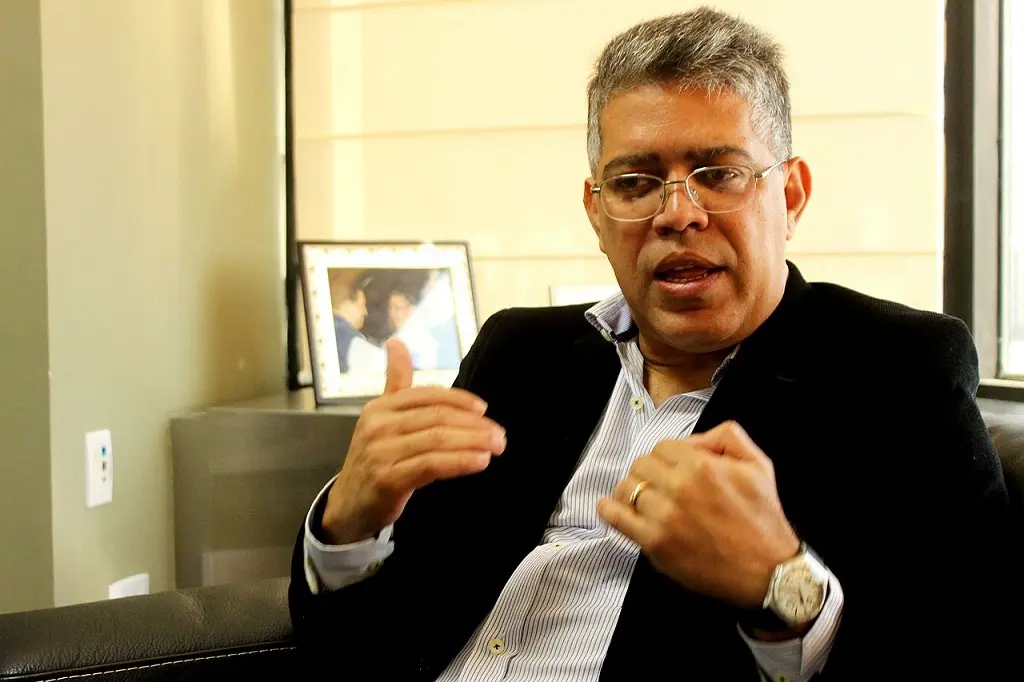
Venezuelan politician, sociologist and former VP Elías Jaua. File photo.
Venezuelan politician, sociologist and former VP Elías Jaua. File photo.
Elías Jaua Milano is a prominent Venezuelan politician, sociologist, and professor, recognized for being one of the central figures in the administration of former President Hugo Chávez Frías. A longtime activist on the Venezuelan left, Jaua held various high-level positions in the State, including the Executive Vice Presidency of the Republic, as well as the ministries of Agriculture and Lands, Communes and Social Protection, and Foreign Affairs. Throughout his career, he has been characterized as being a staunch defender of the Bolivarian project, communal organization, and anti-imperialist thought. After the passing of Hugo Chávez, Jaua remained active in the country’s political life, maintaining a critical stance toward the evolution of the Bolivarian process. Currently, he remains a reference point for patriotic and popular movements, advocating for the reconstruction of national sovereignty and the defense of the foundational principles of the Bolivarian Revolution.
What changed in Venezuela since Nicolás Maduro’s kidnapping?
After January 3, Venezuela lost its independence and economic sovereignty. The economic and social situation has worsened and the political crisis continues. We are a country that is being plundered by the occupying power.
Does international public opinion still not understand how Maduro’s kidnapping was possible?
In Venezuela even, there is no official explanation for the kidnapping of the sitting head of state and his wife without a large-scale military defense, except for the brave soldiers of the Presidential Guard and the Cuban fighters.
Is Maduro’s freedom more important than the mandate of Bolívar and Chávez?
The homeland must always come first; the interests of the people must be the priority. The revolutionary project is a collective endeavor, not an individual one.
Where has anti-imperialist thought gone?
Anti-imperialist thought is in the popular leftist, patriotic, Bolivarian, and Chavista current that is going to wage a political struggle to restore our Republic.
Does the international left not understand that Venezuela has become a US viceroyalty?
There was a military defeat and the leadership chose to cooperate with the plan of the occupying power.
Has this political attitude been around for a while?
The adoption of neoliberal measures, the alliance with the bourgeoisie and landowners, undemocratic leadership methods, and the misuse of state repression, in a context of foreign economic aggression, weakened the base of popular support.
Why did nascent socialism not deepen in Venezuela?
Because the reformist currents gradually took over the leadership of the Bolivarian process after Chávez’s death and, instead of responding to foreign aggression by deepening the transition to socialism, they opted for a restoration of the power of the economic elites.
Do some experts say that the only ones benefiting after Chávez’s death are the Venezuelan bourgeoisie?
The traditional and emerging bourgeoisie, and many more.
Is it possible to restore the Bolivarian Revolution?
From the grassroots, by coming together, building popular organization and defending principles, in a new context that requires being very political astute.
Venezuela Moves Toward Renewed Ties With ‘Israel’ Amid Chavista Criticism
Is the Maracay Manifesto the beginning of the birth of a patriotic movement in defense of national sovereignty against the empire and the Zionist state of Israel?
In principle, it is the coordination of a patriotic, democratic, and popular current of opinion to defend the Constitution of the Bolivarian Republic of Venezuela, fight for the recovery of national independence, and the rights of workers.
You were the vice president of Venezuela during Hugo Chávez’s term. What would Chávez say about this situation today?
He said it many times: that aggression would come and that only a powerful popular movement and Latin American and Caribbean unity could stop it. I say, we have to start over, but not from scratch. We have to fight! I am sure that is what Commander Chávez would say.
(Rebelión) by Lois Pérez Leira
Translation: Orinoco Tribune
OT/SC/CD