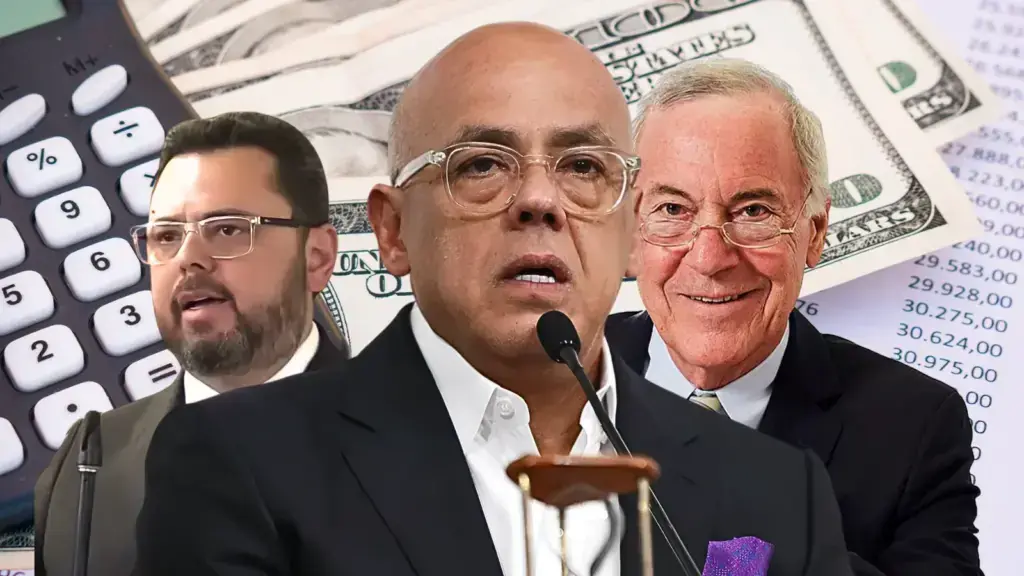
Photo composition depicting National Assembly President Jorge Rodríguez, US neoliberal economist Steve Hanke, and opposition Deputy Antonio Ecarri against a backdrop of US dollar bills and a calculator. Photo: Orinoco Tribune composition based on a CriptoNoticias photo.
Caracas (OrinocoTribune.com)—Venezuelan National Assembly President Jorge Rodríguez reported that opposition Deputy Antonio Ecarri has been removed from the presidency of the Venezuela–United States Parliamentary Friendship Group and an investigation has been opened into his actions regarding a proposal to dollarize Venezuela.
Rodríguez announced the decision on Saturday, August 22, in an official statement, describing Ecarri’s actions as “irresponsible” and accusing him of violating Venezuela’s legal order.
According to the National Assembly president, Ecarri violated Article 133 of the National Assembly’s Rules of Procedure and Debates, which requires deputies conducting interparliamentary diplomacy to act in accordance with the Constitution of the Bolivarian Republic of Venezuela and the interests of Venezuela.
Rodríguez further accused Ecarri of violating Article 318 of the Constitution, which establishes the bolívar as Venezuela’s monetary unit and reserves the exclusive exercise of monetary policy for the Central Bank of Venezuela (BCV).
National Assembly (NA) leadership removed opposition deputy Antonio Ecarri as head of the Venezuela–US interparliamentary group over his dollarization push with US economist Steve Hanke and falsely claiming the "guru" was hired by the NA. A overdue end to a far-right neoliberal… https://t.co/YDeMxIF8tX
“I will not allow a friendship group to be used in an attempt to clumsily and spuriously undermine the constitutional and legal foundations of our Republic,” the statement reads.
The National Assembly board has initiated an investigation to determine the violations allegedly committed by Ecarri and establish any responsibilities and sanctions applicable under the legislature’s internal rules.
Rodríguez denies National Assembly contract with Hanke
The decision came one day after Rodríguez publicly rejected corporate media reports claiming that the National Assembly had hired US economist Steve Hanke—often promoted as a “money doctor”—to advise Venezuela on inflation and dollarization.
During Friday’s plenary session, Rodríguez called the reports absurd, noting that monetary policy and macroeconomic management fall under the authority of the Venezuelan government and the BCV.
“For the past two or three days, I have been reading in international media that the National Assembly has hired the so-called ‘money doctor,’ a man named Steve Hanke, to help us fight hyperinflation,” Rodríguez said.
“The news is so outlandish, so absurd, so childish, and so foolish—since the management of the currency and macroeconomic processes is the responsibility of the national government and the Central Bank of Venezuela—that I decided not to pay much attention to it.”
Rodríguez explained that the National Assembly subsequently came to know that the allegation specifically claimed that the parliament had contracted Hanke.
“I must say that this is absolutely false and that the Board of Directors of the National Assembly will initiate an investigation, since it calls into question the honor and credibility of a deputy when he comes up with such a stupid idea,” he added, without naming Ecarri at the time.
Damage control
On Friday, the traditionally far-right-leaning financial outlet Banca y Negocios published a report claiming that Hanke had drafted a bill to formally dollarize Venezuela.
The timing and framing of the report led many analysts to interpret it as an attempt at damage control connected to Rodríguez’s denial that the National Assembly had hired the US economist.
“Steve Hanke has drafted a ‘dollarization’ bill, with the aim of replacing the bolívar with the US dollar as the currency used in Venezuela,” the outlet wrote, initially presenting the news without attributing it to any source.
“Furthermore, the Central Bank would no longer exist, so that the government would not be able to issue new bills and would not control interest rates,” the report added.
The outlet reported that Hanke was working closely with Ecarri, who has advocated for the dollarization of Venezuela since 2017 and reportedly thanked the US economist for advising his party’s parliamentary team on monetary and energy matters.
“Venezuela is already effectively dollarized. But those who continue to be paid in bolivars, which is losing value every day, are our teachers, nurses, workers, and pensioners. Enough is enough,” Ecarri said, according to the Banca y Negocios report.
However, allowing foreign currencies to circulate alongside the bolívar is not dollarization in the strict economic or legal sense. Formal dollarization would abolish the national currency, eliminate Venezuela’s sovereign monetary policy, and subordinate the country’s economy to decisions taken by the US Federal Reserve.
Such a move would be particularly grave following the January 3 US bombing of Venezuela and the kidnapping of constitutional President Nicolás Maduro and First Lady and Deputy Cilia Flores. Abolishing the BCV and surrendering monetary sovereignty to the currency of the aggressor state would deepen Venezuela’s colonial dependency rather than defend the purchasing power of its working class.
Banca y Negocios even reported that Hanke estimated the proposal’s chances of being approved by the Venezuelan parliament and becoming law at between 50% and 80%—an extraordinary assertion considering that the National Assembly leadership denied sponsoring the initiative.
Inflation remains Venezuela’s main economic distortion
During Friday’s session, Rodríguez also stated that Venezuela is not experiencing hyperinflation. His assertion is technically defensible under the classic definition requiring monthly inflation to exceed 50%.
Nevertheless, Venezuela reportedly registered annualized inflation of approximately 576% between July 2025 and July 2026, making rising prices the country’s principal economic distortion and one of the most serious complaints among the majority of Venezuelans.
An IMF working paper studying modern hyperinflation cycles uses a broader annual benchmark, classifying inflation of 500% or more as a hyperinflationary phase. Under this measurement, Venezuela would remain in an active hyperinflationary crisis despite not meeting the classic monthly threshold.
Unofficial translation of the full statement by the National assembly regarding Ecarri’s removal:
Statement by the President of the National Assembly of the Bolivarian Republic of Venezuela
In my capacity as President of the National Assembly, and exercising the powers conferred upon me by the Rules of Procedure and Debates, I have decided to remove Deputy Antonio Ecarri from the presidency of the Venezuela–United States Parliamentary Friendship Group.
The reason is clear: his actions have been irresponsible and have violated the legal order that we are obligated to defend.
First, he has violated Article 133 of the Rules of Procedure and Debates, which requires parliamentarians performing interparliamentary diplomacy functions to act in accordance with the Constitution and the interests of the Republic.
Second, and most seriously, he has violated Article 318 of the Constitution, which states verbatim:
“The monetary unit of the Bolivarian Republic of Venezuela is the bolívar,” and that the “Central Bank of Venezuela is the public entity that shall exclusively and obligatorily exercise monetary policy.”
The Board of Directors has initiated an investigation to establish the violations committed by the aforementioned deputy and will determine the responsibilities and sanctions applicable in accordance with the provisions of our operating rules.
I will not allow a friendship group to be used in an attempt to clumsily and spuriously undermine the constitutional and legal foundations of our Republic.
Jorge Rodríguez Gómez President of the National Assembly of the Bolivarian Republic of Venezuela