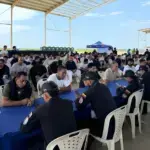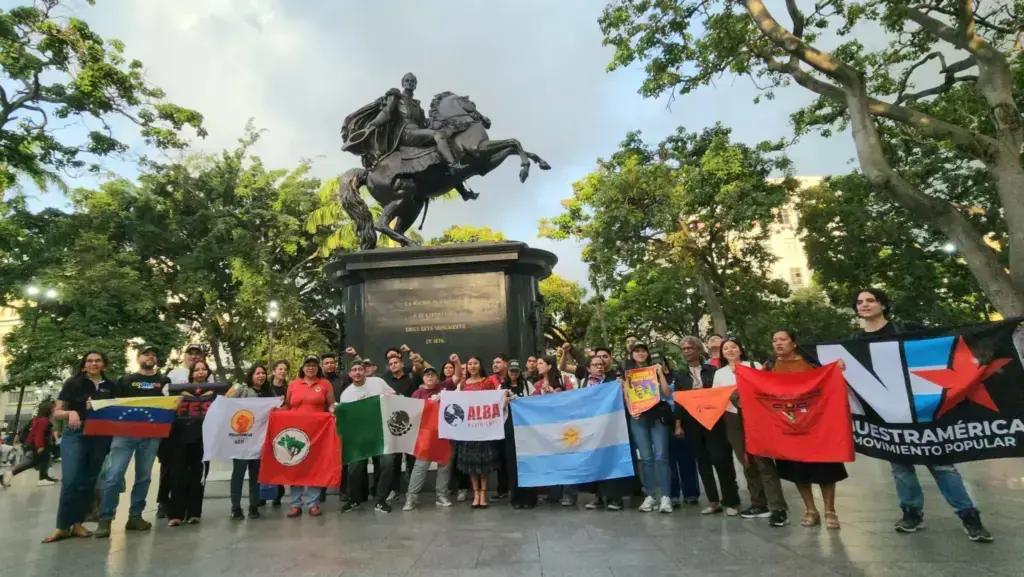
Participants of the ALBA Movements' youth solidarity brigade to Venezuela pose in front of the Simón Bolívar statue at Plaza Bolívar in Caracas. Photo: Leonardo Fernandes.
Participants of the ALBA Movements' youth solidarity brigade to Venezuela pose in front of the Simón Bolívar statue at Plaza Bolívar in Caracas. Photo: Leonardo Fernandes.
A brigade of more than 30 young people from nine Latin American countries arrived in Caracas, Venezuela, on Monday, August 17, for a 10-day solidarity visit to the country. The brigade has been organized by ALBA Movements.
During August 17-26, activists from Brazil, Argentina, Colombia, Mexico, Guatemala, El Salvador, Honduras, Chile, and Panama will engage in experiences in socialist communes and temporary shelters for victims of the June 24 double earthquake, as well as visit the sites affected by the US bombing of January 3. The group will also carry out volunteer work, cultural activities, and tree plantation.
“Fidel [Castro] and [Hugo] Chávez, over 20 years ago, envisioned ALBA as an alternative to the neoliberal project that imperialism wanted to impose on us,” said Hernán Vargas, a housing movement activist and representative of the Venezuelan section of ALBA Movements. “Today, the project that imperialism wants to impose on us goes beyond neoliberalism. It is the project of death, it is the devastation of all resources. The sexist project, the capitalist project, the project of racism, the project of supremacism, is the project of less than 1% who are white, who are elite, who control the entire planet. It is a project that goes against the lives of our peoples. Therefore, it is essential that ALBA raises these issues.”
According to the internationalists, the fundamental task is to build unity against external pressures and in defense of sovereignty of nations.
The solidarity brigades have remained active in Venezuela, especially since the military aggression by the United States and the kidnapping of President Nicolás Maduro and his wife, National Assembly Deputy Cília Flores. The work of the solidarity activists intensified after the double earthquake that killed more than 6,000 people and left around 23,000 homeless. In addition to material support, the brigades focus on the political education of participants about the history of the Bolivarian Revolution and the current challenges of Latin American regional geopolitics.
“What I most wanted was to learn here what happened to Nicolás Maduro and his wife,” Honduran Sinia Esperanza Rápalo Rivera, a member of the Lorenzo Zelaya Revolutionary Student Movement, told Brasil de Fato. “Then, there is the topic of the earthquakes, how they have been able to overcome that situation, and today, we already have a lot of context about what really happened and how they overcame it, especially given that international media tell us other things or speak in a derogatory manner about the reality of Venezuela.”
Panamanian union leader Marco Moreno, head of the National Union of Workers in the Construction Industry of Panama, said, “We are here to acquire knowledge through study, sharing with our comrades from other countries. We have come as a humanitarian brigade, to show solidarity with the people of Venezuela, with those affected at this moment, and to make the greatest effort to express solidarity with the Venezuelan people.”
Veterans for Peace Reaffirm Support for Cuba and President Maduro’s Freedom
Brazil’s MST participates
Among the Latin American social movements participating in the brigade, the Landless Workers’ Movement (MST) is representing Brazil. Vittória Paz of MST explained that, for more than 20 years, the MST has been supporting the Venezuelan people in their revolutionary process. According to her, it is time to strengthen the actions to defend Venezuelan self-determination and sovereignty.
“We have been here for 20 years with the Bolivarian revolution,” the activist said. “In all moments of difficulty, ours and theirs, we have had a very beautiful relationship of solidarity, of brotherhood between the revolution and our movement. And now when the situation once again calls for concrete acts of solidarity, when it once again calls for a very strong demonstration of support, I believe that our role is to continue supporting, to continue listening to the people of Venezuela, to continue listening to what they want, what they ask for, and to show that the revolution is still standing, in order to combat the nefarious narrative from the far right that there is no longer a revolution, that the revolution has been defeated. It has not been defeated.”
“The empire kidnapped the president and the first lady, and we are here to say that we want them back. The revolution remains standing, the people remain in the communes, the people continue fighting, and we from the MST will continue to stand by them,” she concluded.
(Brasil de Fato) by Leonardo Fernandes
Translation: Orinoco Tribune
OT/SC/CD