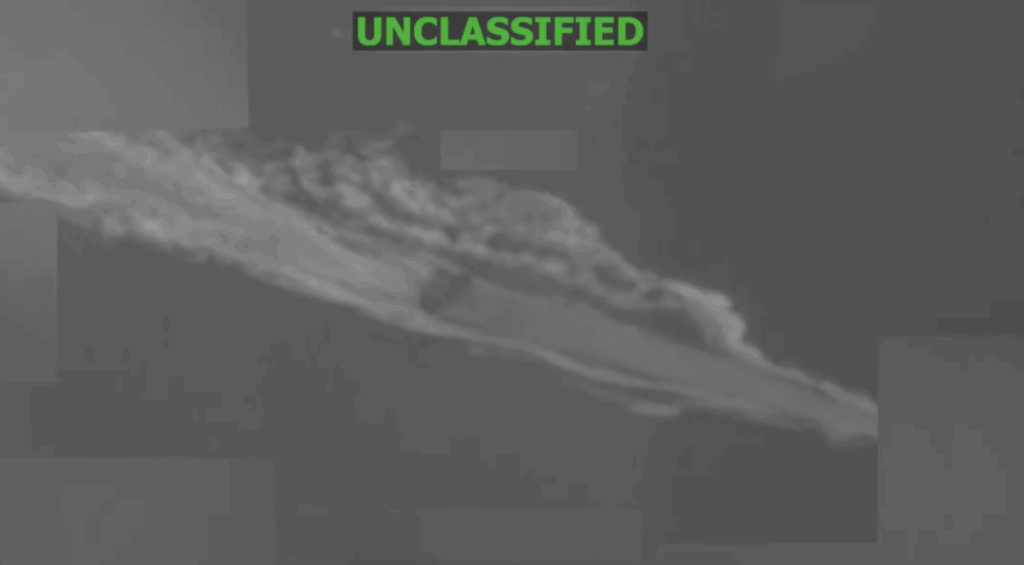
Screenshot showing the low-profile boat struck by the US Southern Command in the Eastern Pacific on August 23, 2026. Photo: US Southern Command.
Screenshot showing the low-profile boat struck by the US Southern Command in the Eastern Pacific on August 23, 2026. Photo: US Southern Command.
Caracas (OrinocoTribune.com)—The US Southern Command (SOUTHCOM) has resumed its lethal attacks against small boats in Latin American and Caribbean waters. It killed two unidentified people in the Eastern Pacific this Sunday, August 23, after a 63-day pause that had raised hopes among human rights advocates that the extrajudicial killing campaign had ended.
SOUTHCOM announced the attack through social media, claiming that its forces targeted a “low-profile vessel” allegedly traveling along a drug-trafficking route. It provided no names, nationalities, precise location, independently verifiable evidence of drugs, or indication that the people aboard presented an imminent threat.
"This operation is a clear and decisive reminder that SOUTHCOM is taking the fight directly to the cartels."
On August 23, under #SOUTHCOM Commander Gen. Francis L. Donovan’s direction, Joint Task Force Western Hemisphere executed a lethal kinetic strike on a low-profile vessel… pic.twitter.com/aIw1qn36gd
— U.S. Southern Command (@Southcom) August 24, 2026
The military command nevertheless labeled the dead as “narco-terrorists,” presenting the cold-blooded killing as another demonstration of US “lethal precision” and its commitment to “taking the fight directly to the cartels.” No attempted interception, arrest, warning, or seizure was reported, and no evidence of a real impact on US consumption of illegal drugs has been provided.
OT database records 211 deaths and only three survivors
According to Orinoco Tribune’s carefully curated database, the August 23 attack was the campaign’s 64th strike, targeting a 65th small boat. It increased the recorded death toll from 209 to 211, while the number of surviving victims remains at only three.
The data show that 46 of the 64 attacks (71.9%) occurred in the Eastern Pacific. These attacks account for 137 deaths, or 64.93% of all recorded victims.
The Caribbean Sea accounts for the remaining 18 strikes, representing 28.13% of the attacks, and 74 deaths, or 35.07% of the total.
Of the 63 strikes with a known final survivor outcome, 61 ended with no known survivors. This means 96.83% of the documented attacks with a confirmed outcome produced zero survivors.
The database also records an especially disturbing practice: people initially reported alive were subsequently listed as dead or presumed dead after SOUTHCOM announced supposed search-and-rescue notifications with no actual rescue documented. At least 16 initial survivors have disappeared or died under those circumstances.
A humanitarian image during the killing pause
During the 63 days separating the June 21 and August 23 attacks, SOUTHCOM’s social media timeline underwent a remarkable transformation. Instead of videos showing small boats being blown apart, it was dominated by public relations material presenting the US military as a humanitarian benefactor responding to regional natural disasters.
Following the June 24 earthquake affecting La Guaira and other parts of Venezuela, SOUTHCOM published numerous photographs, videos, and press releases showing US military personnel unloading emergency supplies, deploying search-and-rescue teams, and assisting Venezuelan communities while establishing a beachhead at the Simón Bolívar International Airport that many analysts report was dismantled a few weeks after the natural disaster.
The August 23 strike demonstrates that the humanitarian messaging did not mark the end of the lethal campaign. Rather, it was a pause between executions.
Legal experts reject SOUTHCOM’s undeclared war
US and international legal specialists have consistently rejected the legal theory behind the operation.
These organizations have concluded that the United States is not engaged in an armed conflict with drug-trafficking organizations. Counter-narcotics operations are law-enforcement activities in which lethal force is permissible only when strictly unavoidable to protect human life. Killing suspected smugglers without an imminent threat, arrest attempt, evidence, charges, or trial therefore constitutes an extrajudicial killing.
Families of Trinidadian victims—including men described by relatives as fishermen and laborers traveling home from Venezuela—have filed legal action in US courts over wrongful deaths and extrajudicial killings.
United Nations experts have similarly warned that deliberate lethal attacks against small boats in international waters, outside an armed conflict and without a valid legal basis, may amount to extrajudicial executions. They have called for the attacks to stop and for independent investigations into those responsible.
The victims are routinely declared guilty through military press releases issued after their deaths. No evidence is tested in court, no opportunity to surrender is offered, and the precise locations of the killings are frequently concealed, obstructing independent verification and regional legal scrutiny.
Venezuela: Delcy Rodríguez Awards Cuban Rescue Brigade as US SOUTHCOM Withdraws Troops
The 63-day silence offered a fragile hope that political pressure, legal challenges, or operational exhaustion had brought the dark campaign to an end. The killing of two more unidentified people on August 23 has dispelled that hope.
Without serious resistance from Latin American and Caribbean governments, independent investigations, or accountability inside the United States, SOUTHCOM retains the power to act simultaneously as accuser, judge, and executioner throughout the region.
Special for Orinoco Tribune by staff
OT/JRE/SF