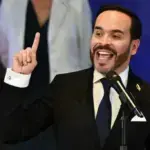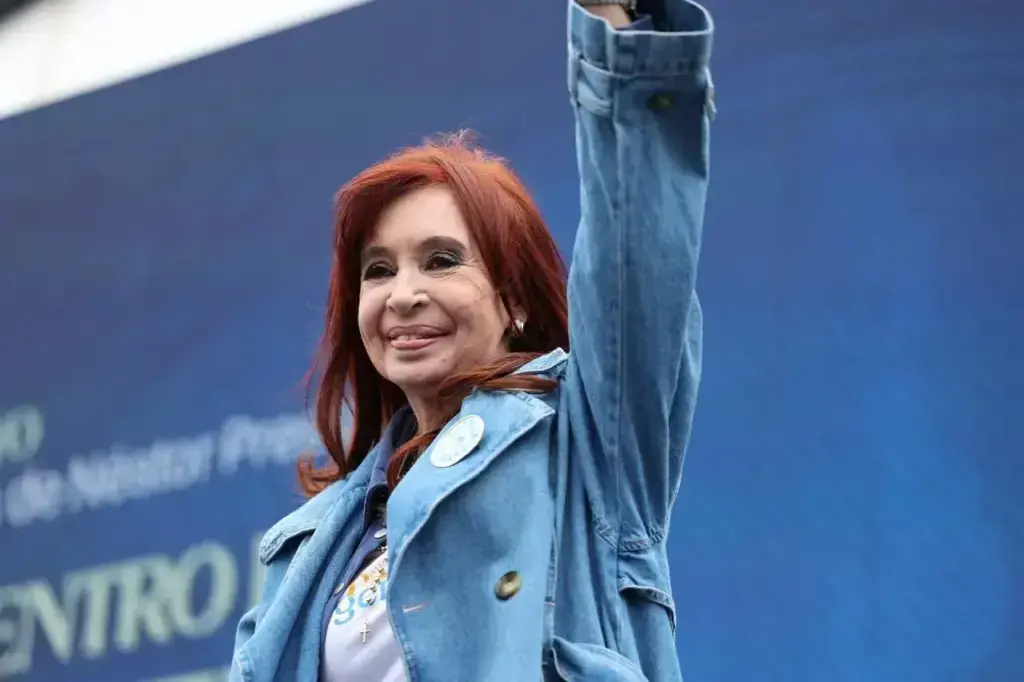
Cristina Fernández de Kirchner, former president of Argentina. Photo: X/@CFKArgentina.
Cristina Fernández de Kirchner, former president of Argentina. Photo: X/@CFKArgentina.
By Charo Solís – Aug 25, 2026
The former president of Argentina, Cristina Fernández de Kirchner presented her appeal against her conviction in the Roadways case to the United Nations, after exhausting legal avenues in Argentina. The presentation of the case to the Human Rights Committee asks an international body to review the process that ended with her conviction, after the Supreme Court of Argentina rejected her final appeal. The defense argues that the irregularities in the process and the disqualification from holding public office violate her political rights.
At the United Nations, Cristina had defended the Argentinian State’s ability to negotiate and preserve economic autonomy. In September 2015, before the General Assembly, she celebrated the approval of the basic principles for the restructuring of sovereign debts and asserted that countries had the right to define their policies without being subjected to speculative creditors. At that time Argentina was trying to establish international rules for negotiating sovereign debts and to limit the power of vulture funds against States. That was the last time Cristina was at the United Nations as president of Argentina. A year later, the government of Mauricio Macri made a sharp turn and agreed to pay billions of dollars to the creditors. Luis Caputo, the current minister of Economy, was at the forefront of that negotiation, on both sides of the aisle, marking the end of that stage.
The presentation made by the defense before the Human Rights Committee strains the Argentinian legal tradition itself. The country played a pioneering role in the construction of regulatory frameworks for the defense of fundamental guarantees, from the prosecution of the crimes of the last dictatorship to the incorporation of international treaties into the Constitution in 1994. It was Cristina herself who stated, in that last General Assembly in which she participated as president, that “the payment of debt cannot be made at the cost of the hunger and misery of the people, nor by suffocating the economies of countries.” That stance was part of a continuity that was interrupted to give way to a stage marked by a growing escalation of political violence, with explicit episodes whose most critical point was the assassination attempt on her and which ultimately led to her house arrest. The question hovering over Geneva is how international justice will weigh all this context of harassment, a background without which it is impossible to understand the scope of her defense.
The Roadways case, the conviction, and the dispute over proscription
The defense argues that Cristina’s political disqualification turned the conviction into a mechanism for excluding electoral competition. This interpretation gained special relevance due to the proximity between the Supreme Court’s decision and Cristina’s announcement of her candidacy for deputy in the province of Buenos Aires. The Supreme Court rejected the appeal in June 2025, just eight days after the former president publicly announced her candidacy. In the letter made public on July 29, 2026, to announce the presentation before the United Nations, Cristina stated that a democracy loses its democratic character when judges replace the people’s will and judicial processes become instruments of persecution and proscription.
The presentation was explained in Buenos Aires by Alberto Beraldi, Cristina’s defense attorney in the Roadways case; Rafael Valim, a Brazilian jurist specializing in public law; and Javier Borrego, a former judge of the European Court of Human Rights and former magistrate of the Supreme Court of Spain. The defense detailed the procedural inconsistencies that turn the ruling into a technical scandal of administrative law, pointing out that the only conduct attributed to the former president was the issuance of Decree 54/2009. This assertion goes to the heart of the thesis of the defense: if the decree remains in force and the president did not directly administer the Roadways funds, the crime with which she has been charged would be legally impossible to commit under the terms established by the sentence. Valim called the ruling a “technical-legal scandal” and warned that, if this criterion is accepted, any president could be criminally held responsible for administrative acts carried out by autonomous entities or provinces.
Borrego considered the sentence as part of a strategy of persecution marked by structural misogyny, pointing out that the true crime of the trial was the political disqualification to exclude from the electoral contest the only woman twice elected president with broad popular support. In that vein, he highlighted the paradox that, despite the significant female majority in the Argentinian judiciary and the Attorney General’s Office, the former president went through four judicial bodies without the presence of a single female judge or prosecutor. In her public letter, Cristina framed this dynamic within the gender biases that permeate judicial institutions: “What I have endured cannot be understood solely as a series of erroneous judicial decisions. We are facing serious human rights violations, born from a structural misogyny that still persists.”
The lawyers explained the scope of the three precautionary measures requested urgently at the Human Rights Committee while the comprehensive review of the conviction is being processed. The first measure demands the suspension of the perpetual political disqualification, a ruling made by Argentinian courts that directly contradicts the United Nations’s doctrine on disproportionate electoral sanctions. The second requests a review of the conditions of house arrest, questioning the use of the electronic ankle bracelet and the visitation restrictions. The third objected to the functioning of the Argentinian Supreme Court with only three members, demanding its reconstitution to guarantee the rules of due process.
To vote, to be voted, and democracy
This scenario is part of the discussion on the political reform project promoted by the government of Javier Milei, which seeks to eliminate the PASO (Simultaneous Open and Mandatory Primaries), claiming that this measure would save funds. The electoral reform project also includes an initiative for Clean Record. Both tools consolidate a clear path to restrict electoral options and create a scheme where judicial timelines and media coverage set the boundaries of political competition, granting the criminal jurisdiction direct influence over the composition of the candidate lists. It is, in fact, the institutionalization of lawfare with the approval of Congress. The discussion focuses on the limits imposed on people’s participation: when the rules of the democratic game tighten, the last way to end a political project is to deprive the electorate the possibility of choosing their representatives at the polls.
Borrego closed the conference by highlighting the right at the core of the democratic system, the right to vote and to be voted, enshrined in Article 25 of the International Covenant on Civil and Political Rights. He summarized it with a warning for the future: “When we lose a democracy and the rule of law, we will remember not having fought hard enough.”
Featured image:
(Diario Red)
Translation: Orinoco Tribune
OT/SC/SH