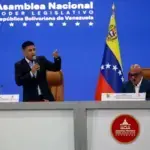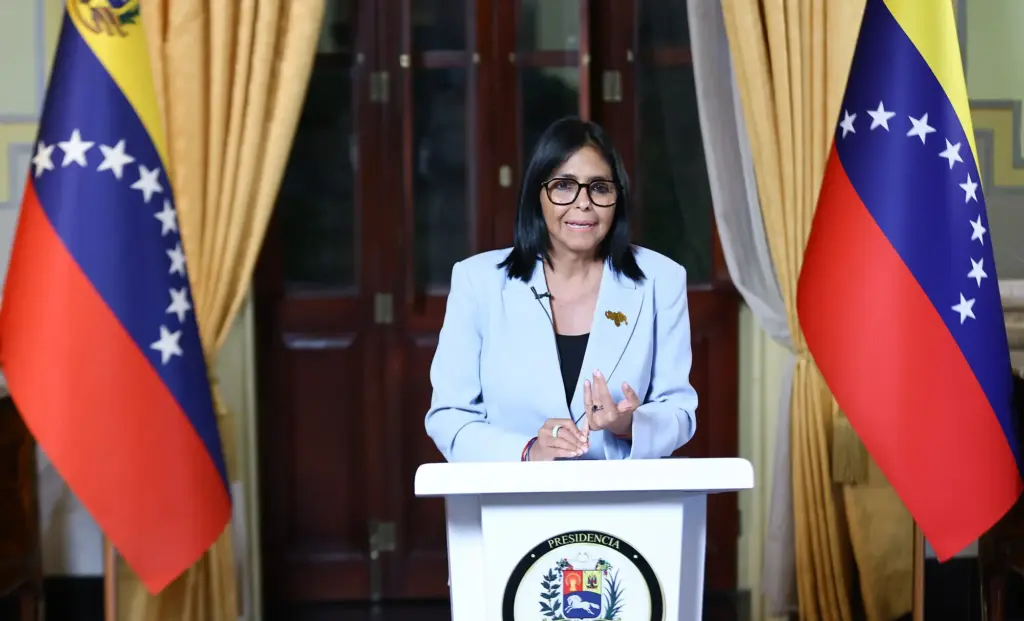
Delcy Rodríguez speaks about the oil agreement with the United States on Saturday, August 29, 2026. Photo: Venezuelan Presidential Press.
Delcy Rodríguez speaks about the oil agreement with the United States on Saturday, August 29, 2026. Photo: Venezuelan Presidential Press.
Venezuela’s Acting President Delcy Rodríguez delivered an address on Saturday evening, Aug 29, providing further details about the agreement signed with the United States government for the joint exploitation of oil fields and greenfield blocks in the Orinoco Oil Belt.
Binational project to boost production
“This binational project, signed for 25 years, contemplates the development of 17 strategic fields with a production target exceeding 1.5 million barrels per day” solely with the Venezuela-United States binational agreement. “But our goal goes further, with the signing of other important agreements that include major companies such as Chevron, Repsol, Eni, Shell, BP, among others.”
Rodríguez noted that, “taking as a reference a price of $65 per barrel—which could be more or less—, our country’s tax income would reach a total of $209.335 billion for the Venezuelan state.”
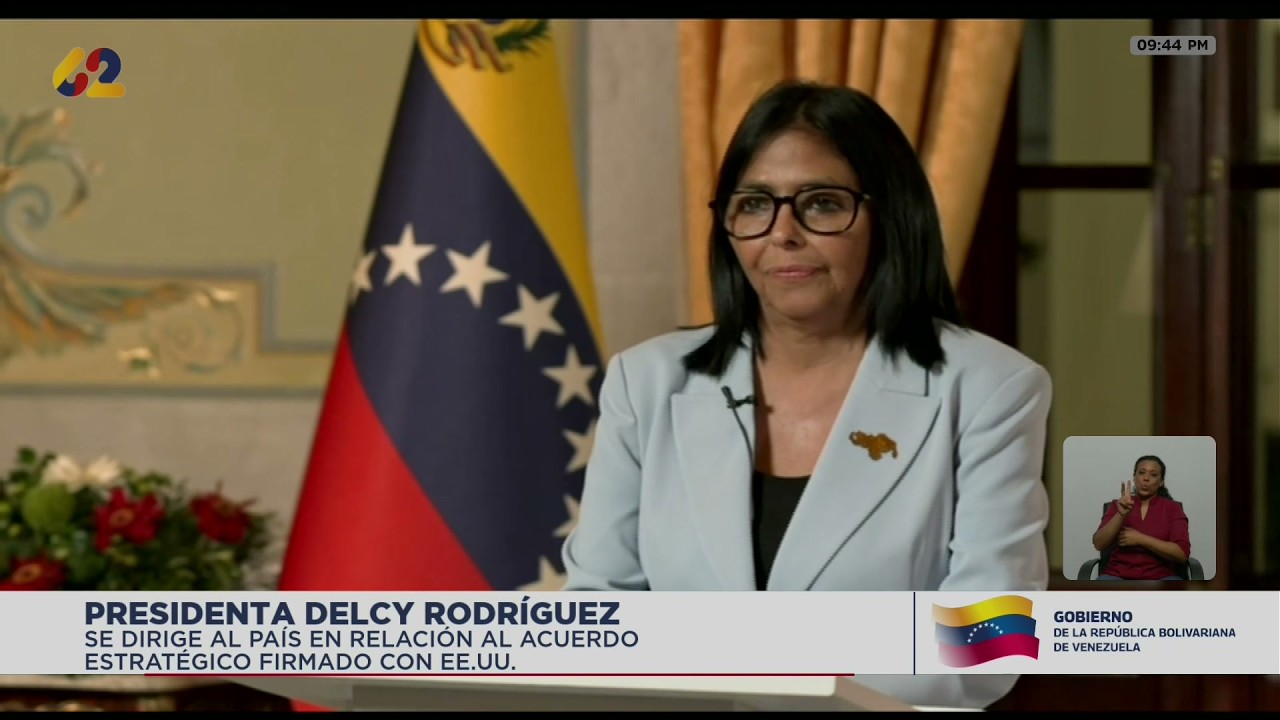
“This means that for every barrel produced and sold, approximately $19 directly enter our country,” she explained.
The acting Head of State explained that the binational project contemplates the development of 8 greenfield blocks (completely new exploration or exploitation areas, where there are no previous operations or developed infrastructure) located in the Orinoco Oil Belt, “with royalties (of at least) 16% and income tax of 34%.”
She compared it to the project carried out 30 years ago, during the Oil Opening (1992-1999), for the development of four greenfield blocks in the Orinoco Oil Belt, in which royalties were 1% and income tax was 34%.
“Something must be absolutely clear: Venezuela retains ownership and sovereignty over its resources, while using capital, technology, and operational capacity to leverage the recovery of a strategic industry severely affected by sanctions,” she explained.
Contributions from each party
She stated that, in the agreement, “Venezuela contributes oil, its industry, and the experience of its workers for more than 100 years. The United States contributes the capital and technology necessary to recover and develop these assets. Venezuela receives in return production, employment, investment in infrastructure, increased state revenue, and productive linkages for national industry.”
She noted that the project will allow “leveraging the country’s recovery and advancing the improvements that all Venezuelans want, need, and deserve. That is why we chose the path of diplomacy with the US, to transform our differences into cooperation, and that cooperation into investment, production, well-being, and material results for Venezuelans.”
She thanked US President Donald Trump and US Secretary of State Marco Rubio “for the effort that both their government and our government” made to reach this agreement.
“Venezuelans have the right to know how much is invested, how much is produced, how much the state receives, and what the conditions are for operators. And the objective of developing them must be that this wealth returns to become production, opportunities, well-being, and a future for our country.”
Unofficial translation of the address
Yesterday we announced a historic agreement with the government of the United States that will have a great impact on the lives of all Venezuelans in the medium and long term.
We are determined to build a prosperous future for Venezuela, so that Venezuelans can look to the future in one year, 5 years, 10 years, 50 years; we are thinking about the Venezuela of the future.
As everyone knows, our country has the largest oil reserves in the world, but having resources underground is not enough. We need investment, technology, infrastructure, productive capacity to convert that wealth into well-being for our people.
It is useless to have our oil reserves underground only for them to appear in a statistic or in an accounting and for us to say “we are the country with the largest reserves in the world,” when we cannot convert and translate it into development for Venezuela.
Our reserves must become well-being, prosperity, and happiness for this country and allow us to recover our productive capacity to consolidate ourselves as an energy and productive power.
In this way, we not only generate better income, public services, health, education, and roads for our people, but we also contribute to the energy security of the hemisphere and contribute to a more balanced and stable international energy market.
This agreement starts from a very simple premise: each party contributes what it can do best.
Venezuela contributes oil, its industry, and the experience of its workers for more than 100 years. The United States contributes the capital and technology necessary to recover and develop these assets.
Venezuela receives in return production, employment, investment in infrastructure, increased state revenue, and productive linkages for national industry.
The benefits are immense. This binational project, signed for 25 years, contemplates the development of 17 strategic fields with a production target exceeding 1.5 million barrels per day.
This is only with the Venezuela-United States binational agreement. But our goal goes further, with the signing of other important agreements that include major companies such as Chevron, Repsol, Eni, Shell, BP, among others.
We want to be an energy power, a major oil producer, an important gas exporter, and have great national petrochemical development.
And here there is a legitimate question that every Venezuelan has the right to ask: How much does Venezuela receive?
Taking as a reference a price of $65 per barrel —which could be more or less—, but our country’s income would reach a total of $209.335 billion for the Venezuelan state.
In concrete terms, this means that for every barrel produced and sold, approximately $19 directly enter our country.
To finish, I want to remind you, major project for the development of four greenfield blocks in the Orinoco Oil Belt was with strategic associations during the oil opening 30 years ago, with royalties of 1% and income tax of 34%.
This binational project contemplates the development of 8 greenfield blocks in the belt, with minimum royalties of 16% and income tax of 34%.
What will all this allow? It will leverage the country’s recovery and advance the improvements that all Venezuelans want, need, and deserve.
That is why we chose the path of diplomacy with the United States of America, to transform our differences into cooperation, and that cooperation into investment, production, well-being, and concrete results for Venezuelans.
I thank President Donald Trump, Secretary Rubio, and their government for the effort that both their government and our government, the entire Venezuelan team, dedicated to reaching this agreement.
But something must be absolutely clear: Venezuela retains ownership and sovereignty over its resources, while using capital, technology, and operational capacity to leverage the recovery of a strategic industry severely affected by sanctions.
Venezuelans have the right to know how much is invested, how much is produced, how much the state receives, and what the conditions are for operators.
And the objective of developing them must be that this wealth returns to become production, opportunities, well-being, and a future for our country.
That is the commitment of all: a Venezuela that is reborn to improve the lives of every Venezuelan.
I continue to ask and pray to God that his protection remains over our homeland and our people.
Translation: Orinoco Tribune
OT/JRE/SH