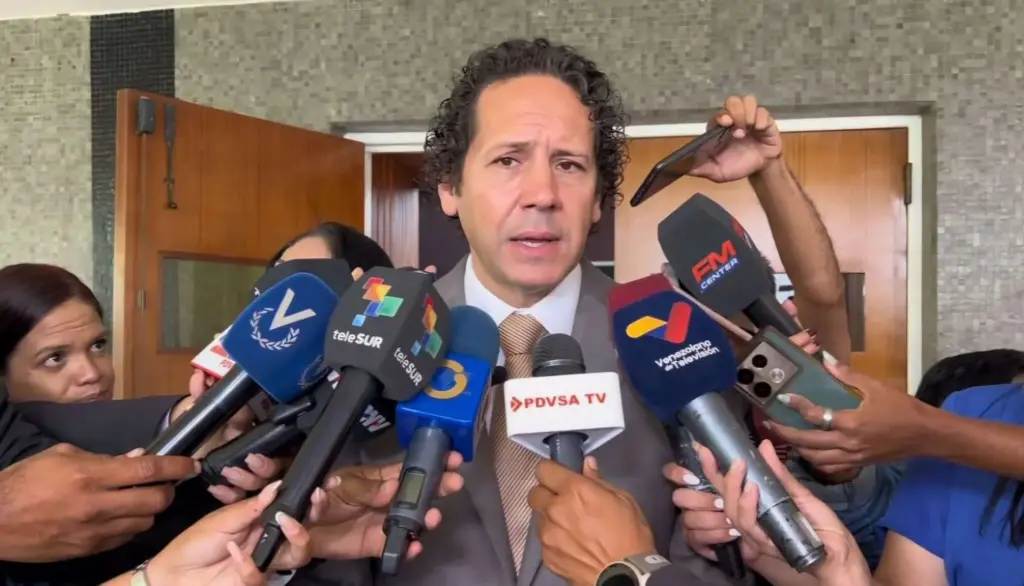
Minister of Transport Francisco Garcés speaking to reporters surrounded by microphones. Photo: Ministerio del Poder Popular para el Transporte/ Referencia
Minister of Transport Francisco Garcés speaking to reporters surrounded by microphones. Photo: Ministerio del Poder Popular para el Transporte/ Referencia
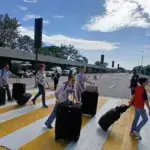
The minister of popular power for transport, Francisco Garcés, reported that eight international flights and 10 domestic flights are scheduled to depart and return this Thursday, September 4, through the temporary terminals enabled at Simón Bolívar International Airport in Maiquetía, La Guaira state.
Operations at these facilities began the past Tuesday, after severe structural damage and service disruptions caused by the June 24 earthquake.
“Today the airport is operating,” Garcés said during an interview on local television. “After four days, it will be operating at 45% of the capacity it operated at before the tragedy.”
The minister noted that on the first day of operations there were four international flights and seven domestic flights, which is approximately 25% of the airport’s capacity before the earthquake.
Faced with the damage to the original infrastructure, authorities evaluated alternatives to guarantee the progressive continuity of national and international air connectivity. As part of these actions, auxiliary terminals were built over the course of 35 days of continuous work.
Garcés said the temporary facilities now have the necessary conditions to ensure passenger service and maintain the controls established at the country’s main airport.
“These terminals have all the facilities that the formal airport has, with services and also with assistance, WiFi, and security,” he said. “All the same checks are carried out, all the same steps, and we have even managed to facilitate some additional ones so that the experience is more fluid.”
Main airport facilities under reparation
The transport minister also said that the facilities of the airport will recover full operations next year.
“I have to be responsible in the sense that I cannot encourage rumors when the facilities I have today do not allow me to reach that opening,” he said in an interview with Union Radio. “I believe that at the end of the first half we could have some beginnings, probably local operations.”
Garcés explained that, as a consequence of the intensity of the two earthquakes, several offices and spaces “were severely affected,” in addition to installations and pipelines.
The minister also said he expects greater air connectivity during the next semester, after activating operations in the temporary terminals on September 1. “There are many airlines requesting to return to Venezuela even with other types of flights, which in some ways change the scale of the operation,” he reported.
Garcés also noted that the capital does not have space to build an airport with greater capacity for Caracas in future.
“Today the international and national offer must grow,” he said. “Venezuela is going through a moment of expectation in which capacities are being generated for production and for the increase of the economy, which will very likely, as it must, raise the number of national and international flights.”
Venezuela: Simón Bolívar International Airport Temporary Terminals to Reopen September 1
Urban transport and housing
The minister highlighted that the offering and conditions of land and rail transport in urban, suburban, and intercity modalities are being continually evaluated to optimize national mobility. He also noted that more than 60% of the population uses public land transport, the metro, and the railway on a daily basis.
Garcés also reported that, as part of post-earthquake infrastructural work, 62,547 housing inspections have been recorded, specifying that the process is moving toward a phase of re-evaluation. This includes more detailed measurements to certify damages and classify them with yellow and red tags.
Finally, he emphasized that any housing requiring repair must have a plan endorsed by an engineering professional and be formally reported to the corresponding mayor’s office, as part of measures intended to guarantee safety and proper execution of the works.
(Últimas Noticias) by Ariadna Eljuri
Translation: Orinoco Tribune
OT/JRE/AU