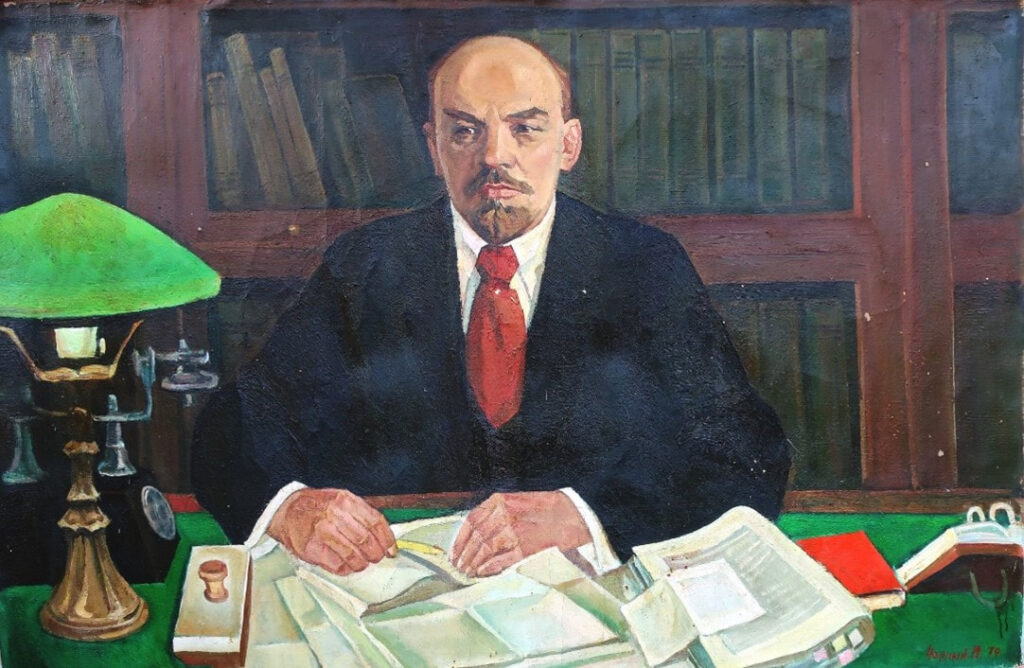
Vladimir Lenin. Photo: Midwestern Marx/File photo.
Vladimir Lenin. Photo: Midwestern Marx/File photo.
By: Carlos L. Garrido – Jan 21, 2024
The day Lenin passed away
A soldier of the death watch, so runs the story, told his comrades: I did not want to
Believe it. I went inside, and
Shouted in his ear: ‘Ilyich
The exploiters are on their way!’ He did not move. Now
I knew that he has expired.
When a good man wants to leave
How can you hold him back?
Tell him why he is needed.
That holds him.
What could hold Lenin back?…
The weak do not fight. The stronger
Fight on perhaps for an hour.
Those who are stronger still fight for many years
The strongest fight on all their life.
These are indispensable.
Bertolt Brecht – Cantata on the Day of Lenin’s Death
Lenin walks around the world.
Frontiers cannot bar him.
Neither barracks nor barricades impede.
Nor does barbed wire scar him.
Lenin walks around the world.
Black, brown, and white receive him.
Language is no barrier.
The strangest tongues believe him.
Lenin walks around the world.
The sun sets like a scar.
Between the darkness and the dawn
There rises a red star.
Langston Hughes – Lenin
Today we mourn a hundred years since the physical death of one of our dearest comrades, Vladimir Ilyich Ulyanov, known to us as Lenin. It would be foolish, however, to think that his physical death meant the death of his ideas. Today, after a hundred years, Lenin’s ideas are as indispensable as ever. “They are mistaken when they think that his death is the end of his ideas”. This was told to us by Fidel Castro upon the death of Che Guevara, but it applies with equal accuracy to Lenin’s death.
Lenin was never, as the West reduces him to, simply the man of practice who ‘applied’ what Marx and Engels wrote. To be sure, in terms of revolutionary practice and the development of the tactics for class struggle in the era of imperialism, there is a particle of truth to this understanding. Few have understood the class struggle, and how to advance it, better than Lenin. Few have been so in tune with the Marxist worldview, so utterly devoid of dogmas and the purity fetish, as to understanding the dialectics of socialism in its utmost profundity. Lenin, whether pre or post conquest of power, was a man who excelled in using the Marxist outlook as a guide to action, as the greatest tool and best working weapon, as Engels described it, for the masses to change (and not just interpret) the world. Whether in the creative development of the vanguard party of a new type in the era of ultimate tzarist repression, where organizing work had to take a clandestine underground form with professional revolutionaries (which has always been misinterpreted in the West as a top-down elitist party), or in his understanding of the role of the peasantry in the revolutionary struggle, or in his development of the New Economic Policy during the first period of socialist construction, Lenin’s practice indubitably applied and creatively developed upon the work of Marx and Engels.
However, Lenin as a theoretician (which is dialectically embedded with the previous Lenin) is often overlooked, especially in the chauvinistic West which sees Europe as the bearers of ‘theory’ and the East as the appliers of it in ‘practice’. Lukacs is still right in telling us that “Lenin is the greatest thinker to have been produced by the revolutionary working-class movement since Marx… the only theoretician equal to Marx.”
On this centenary anniversary of his passing, here are five central developments of Lenin’s upon the Marxist tradition.
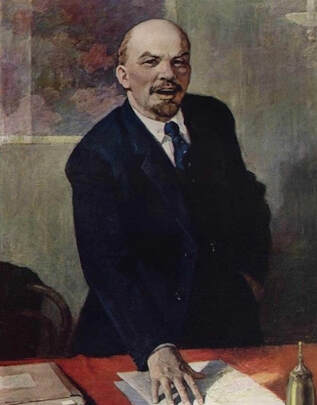
1) In the sphere of philosophy, he develops Marxist materialism in the context of the critique of Machist idealism and its spread in Russian Marxist spaces. This is done in his 1908 Materialism and Empirio-Criticism, a text which the postmodernized Western Marxists are nauseated by because of its outright defense of materialism and philosophical realism. Even some of those who have not fully condemned Lenin would like to create a split between the 1908 Lenin and the post-1914 one. While it is true that his 1914 philosophical studies in Switzerland, especially his study of Hegel, represents one of the greatest advancements in dialectical materialist literature, it ought to be added to the previous philosophical insights, not used to reject them. Frankly, what else can be expected from the Western Marxists, those who look everywhere and only see splits (early and mature Marx, Marx from Engels, pre and post 1914 Lenin, Lenin and post Lenin socialist construction in Russia, etc.)? Conjoined, therefore, with his philosophical developments to the Marxist worldview in 1908 are his 1914 philosophical notebooks. While Marx never got to provide us with the short ‘Dialectics’ text he promised, in his 1914 studies Lenin does give us ample work on a materialist interpretation of Hegel and the Marxist sublation of his dialectical worldview (which, as an upside-down materialism, holds the germ for the Marxist outlook), playing for future revolutionaries the role Marx’s ‘Dialectics’ presumably would have.
2) Lenin developed the Marxist understanding of capitalist political economy for the stage of imperialism and monopoly capital. Headway had already been made here by Marx in the third volume of Capital, but it is only with the carnage of the first world war that the imperialist stage of capitalism develops to a point of maturity where it could be understood as a stage of its own, a partially qualitative development within the capitalist mode of life as a whole. It is here where Lenin crystalizes this analysis, concretizing the previous work done by Hobson, Hilferding, and Bukharin. Lenin’s analysis of the dominance of finance capital in the age of imperialism has only become more indispensable as global financial institutions rose following the second world war. His prediction that imperialism will be conjoined with constant imperialist warfare (both of an inter-imperialist kind and of the kind that attempts to subjugate under imperial dominance nations outside of its sphere of influence), could not have been proven more prophetic in this last century, as US imperialism has waged hybrid warfare against virtually every country on the planet. Without the theoretical framework of Lenin’s analysis of imperialism, it is quite literally impossible to come anywhere near an accurate understanding of the world today. We have Lenin to thank for this clarity.
3) Conjoined with his insights on imperialism and the role of the peasantry in socialist revolutions, Lenin develops upon the anti-colonial works of Marx and Engels, who see national liberation struggles as forms of class struggles. Lenin sees the primacy these often take in the class struggles of imperialized nations against national oppression. All throughout the non-Western-European/Anglo world, these struggles have risen – sometimes securing their successes for decades to come (Cuba, China, Vietnam, Laos, DPRK, etc.) and sometimes being overthrown by dirty US/European imperialist tactics after the successful conquest of power (Burkina Faso, Congo, Guinea-Bissau, Ghana, etc.).
The task Lenin bestowed on the proletariat of imperial nations, of connecting their class struggles to the rising anti-colonial and anti-imperialist movements, is as pertinent as ever. In the US, as it becomes more evident how the empire feeds off the republic (as Michael Parenti calls it), it is easier than ever to see the unity of interests between the anti-imperialist struggles of the global south and those we face at home. As the labor aristocracy (a concept Lenin develops from Engels and the American Marxist, Daniel de Leon) is further disconnecting itself from the rank-and-file, the task of showing American working people the ineptitude of their bourgeoisified leaders, and henceforth, the socialist and anti-imperialist way forward, becomes easier. In some ways, the leadership of Chris Smalls in the Amazon Labor Union, Shawn Fain in the UAW, and (to a lesser extent) Sean O’Brian in the Teamsters, signifies a militant development in the labor movement – a movement growing (to various degrees) in class, socialist, and internationalist consciousness along lines Lenin would be proud of. This would, of course, also be true of the millions of American working folks who’ve protested over the last three months against the Zionist genocide of the colonized, Palestinian people.
4) Lenin concretizes the Marxist understanding of the state and socialist construction. In The State and Revolution (as well as in other essays), Lenin compiles Marx and Engels’s insights on the state and on the dictatorship of the proletariat. No text had ever provided the Marxist view of the state so succinctly and elaborately as Lenin, using the works of Marx and Engels (and most importantly, the Marxist method), did. This remains a necessary read for all communists. With it, all the abstract usages of ‘democracy’, ‘freedom’, ‘dictatorship’ that the imperialist bourgeoisie uses to legitimize itself and attack its enemies are capable of being unpacked and ridiculed for what they are – empty abstractions. For whom is the democracy and freedom the bourgeoisie talks about? Is it for the people? NO! It is democracy for the rich, the insignificant minority! It is freedom of capital to exploit and accumulate! Is this not in direct opposition to a democracy and freedom of the people? Has it not been shown that the people, if they succeed in the conquest of power, must employ the method of ‘dictatorship’ against the counter-revolutionaries and imperialists to protect their revolutions? To protect actual popular and participatory democracy and freedom? Lenin’s refinement of Marx and Engels’s insights has allowed subsequent revolutionary struggles to understand the importance of overturning a state which is designed to reproduce the bourgeois mode of life for a working class state which can, as long as capitalist-imperialism exists, defend the people’s revolution from imperialist hybrid warfare and the counter-revolutionary collaborators which might still exists at home.
Lenin’s understanding of the workers state must also take into account the adjustments that had to be made in the post-revolutionary period, when it became clear that emphasis had to be put on developing the productive forces and an efficient state that could guide the process of destroying the global inequalities between imperialist and imperialized nations. This project, as Lenin’s NEP, Stalin’s collectivization, and the experience of China’s reform and opening up shows, can occur through various means. Capital can be employed, under the leadership of a strong and disciplined communist party, in the task of developing the forces of production for socialism. As long as “political capital,” as Mao called it, is sustained in the hands of the people through their communist and workers parties, the process of capital expropriation can take a variety of different speeds and time. Lenin’s insights following the revolution helps us concretize the dialectic of political and economic capital already employed by Marx and Engels in the Manifesto, where they argued that: “The proletariat will use its political supremacy to wrest, by degree, all capital from the bourgeoisie, to centralise all instruments of production in the hands of the State, i.e., of the proletariat organised as the ruling class; and to increase the total productive forces as rapidly as possible.”
Revisiting Lenin’s Views on Religion on His 152nd Birth Anniversary
5) Lastly, Lenin’s development of democratic centralism continues to be, in my estimation, the most effective organizational method (whether for a party or state) that has ever been employed. Its unity (when it is properly applied) of the democratic components of open debate and consultation with the efficiency of centralized and unified action, are pillars of socialist democracy. “Centralism based on democracy with democracy under the guidance of centralism,” as Deng Xiaoping said. Unity of action amongst those which fight for the masses of humanity is amongst the scariest dictums the ruling classes’ ears have heard. The ruling classes (not just the capitalist ones) survive from divide et impera (divide and conquer). They love factions and factionalization. Just take a look at James Madison’s Federalist 10, where factionalization of the masses is seen as the key to preventing their unified revolt against the elite on the basis of the property question. But Leninist unity of action is preceded by democratic consultation, by the debating, on the part of the party cadre (the most advanced detachment of the proletariat), of the question at hand. The democratic component has often been the hardest to achieve, limiting our ability to appreciate the effectiveness of the unity of action. Nonetheless, even as the old communist parties in the West seem to have mostly fallen down the route of tailing the social democrats and liberals, the need for a strong communist party, guided by the methods of democratic centralism, could not be more urgent for satisfying the crisis in the subjective factor we are experiencing in our time – a time objectively pregnant with revolutionary potential (see my book, The Purity Fetish and the Crisis of Western Marxism for more here).
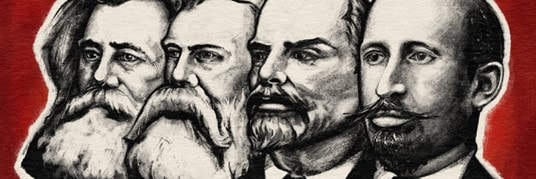
Leninism is not only the body of Marxist ideas that guided the Soviet-Russian proletarian revolution to victory and allowed socialist construction to begin, but is also an international Marxist theory, rooted in the thinking of Marx and Engels, that has guided the international proletariat in its struggles and construction activity. In the twenty-first century, worldwide Marxism-Leninism still has great contemporary value, and remains very much “present.” Marxism-Leninism and its application to national conditions will surely promote the development of world socialism, from a low tide to a climax and victory. – Cheng Enfu
¿Sabes tú que la mano poderosa
que a un César arrancó del trono, era
suave como la rosa?
La mano poderosa
¿sabes tú de quién era?
¿Sabes tú que la voz de agua encendida,
terrestre impulso en que se ahogó tu dueño,
cantó siempre a la vida?
De esa voz encendida
¿sabes tú quién fue dueño?
¿Sabes tú que aquel viento que bramaba
como un toro nocturno, también era
onda que acariciaba?
El viento que bramaba
¿sabes tú de quién era?
¿Y sabes tú que el sol de rojo manto,
de duras flechas implacable dueño,
secó Nevas de llanto?
Del sol de rojo llanto
¿sabes tú quién fue dueño?
Te hablo de Lenin, tempestad y abrigo,
Lenin siembra contigo,
¡oh campesino de arrugado ceño!
Lenin canta contigo,
¡oh cuello puro sin dogal ni dueño!
¡Oh pueblo que venciste a tu enemigo, Lenin está contigo,
Como un dios familiar simple y risueño,
Día a día en la fábrica y el trigo,
uno y diverso universal amigo,
de hierro y lirio, de volcán y sueño!
“Lenin”
Nicolás Guillén

Carlos L. Garrido is a Cuban American philosophy instructor at Southern Illinois University, Carbondale. He is the director of the Midwestern Marx Institute and the author of The Purity Fetish and the Crisis of Western Marxism (2023), Marxism and the Dialectical Materialist Worldview (2022), and the forthcoming Hegel, Marxism, and Dialectics (2024). He has written for dozens of scholarly and popular publications around the world and runs various live-broadcast shows for the Midwestern Marx Institute YouTube. You can subscribe to his Philosophy in Crisis Substack HERE.