By Dmitri Kovalevich – May 16, 2026
Russia’s 2026 Victory Day commemorations exposed deep tensions inside Ukraine and the West’s broader attempt to reshape the historical memory of World War II amid the ongoing conflict with Moscow.
The beginning of May 2026 in Ukraine was marked by serious social and political tensions. These have been present ever since the ‘Maidan’ coup of February 2014. And all because the pro-Western authorities that came to power in the coup have tried with all their might ever since to eradicate the memory of the historic defeat of Nazism in 1945.
That defeat is interpreted by Ukraine’s present leaders as something of a defeat of ‘pro-Europe’ forces.
For many years prior to Ukraine’s second ‘declaration of independence’ in 1991 (following the original independence in March 1919 as the Ukrainian Soviet Socialist Republic), the country was a separate and founding member of the United Nations. Today, we are constantly told by post-coup media in Ukraine that the country would have been formally a part of Europe were it not for the victory over Nazi Germany in 1945. Frequent delegations of visiting Ukrainian nationalists from Canada, the UK, Germany and elsewhere speak not of a defeat of Nazism that year but of a defeat of “European ideas”.
On the eve of the parade in Moscow on May 9 marking Victory Day 2026, there was hardly a pro-Europe nationalist in Ukraine who was not dreaming of seeing some kind of high-profile, military provocation conducted that day by the government in Kiev. This, as drones flying from Russia were dropping print notices across Ukraine, explaining that our respective grandfathers were brothers-in-arms with Russian fighters in the trenches and battlefields of the Great Patriotic War (World War II). At that time, the Soviet Union succeeded in uniting the vastly disparate populations of the former Russian empire into a powerful and united Soviet armed forces.
Ukrainian President Volodomyr Zelensky declared on the eve of Victory Day 2026 that for him and his government, there is no such holiday as the Victory Day celebrated in Russia. Ukrainian journalist Viktoria Titova wrote on May 7. “The fact that there is ‘no such holiday’ for Zelensky is a clear example of how there are thousands in Ukraine just like Zelensky himself who have betrayed themselves, their language, their culture, their history, and the memory of their ancestors upon the orders of their new masters in Europe.”
Totova specifically pointed out that in 2019, Zelensky posed for photos near the grave of his grandfather, who fought in the ranks of the Red Army. But once Zelensky consolidated power that year, monuments to fallen Red Army soldiers began to be demolished barbarically in Ukraine.
For Ukrainian nationalists and European revanchists, Victory Day is indeed a symbol of sorrow and grief, but by no means a holiday. German anti-fascists have declared, “Those who do not celebrate are those who lost the war.”
Despite the official discouragement and even blocking of events in Ukraine marking Victory Day, ordinary citizens are nevertheless joining annual, May 9 rituals in which flowers are brought to adorn the mass gravesites of the wartime fallen. In Kharkiv, Kiev, Odessa and other cities and towns of the country, many people chose this year to openly lay flowers in commemoration, despite the prevailing climate of political repression. This sparked waves of online hysteria among nationalist groups, with many demanding that ceremonies be filmed and participants tracked down and punished.
In Odessa, residents came to lay flowers at the Monument to the Unknown Sailor on the Alley of Glory, beginning in the morning of May 9. The alley was cordoned off by police, with police officers and secret police (SBU) agents stationed at the entrance points and equipped with metal detectors. Those wishing to approach the city’s monument to the war dead had their documents and phones checked. The SBU agents were looking for any telephone contacts made with Russia.
Data from Google Trends on May 9 showed that Ukrainians were searching en masse for information about Victory Day and for texts of holiday greetings. Of note is that the overwhelming majority of these searches were reported as being in the Russian language. Here we have an indirect reflection of the interests and sentiments of large sections of the Ukrainian population.
“For Ukrainians, May 9 remains a holiday; all the government propaganda to the contrary has failed to dilute the significance of this day,” comments the Ukrainian opposition Telegram channel ‘Resident’ on May 9.
Ukrainian opposition journalist and TV presenter Diana Panchenko, who has lived in exile since 2022, comments on May 9 on Telegram: “Today, the losers are trying to distort the truth. To make it seem as though there was no victory of good over evil. Back then, our ancestors fought for our future; a future to be shared by Russia, Ukraine, Belarus and other countries. We cannot squander this. After all, that is exactly what those who played their hand 81 years ago wanted.”
Artem Dmitruk, a former lawmaker of Zelensky’s ‘Servant of the People’ electoral machine who has fled to London, congratulated his Ukrainian compatriots and the Russian people in a message written on Telegram on May 9. He emphasized that the grandparents of both peoples defeated Nazism together, writing, “It was our people—the Russian people in the broad historical sense of the word, including Great Russians, Little Russians, Belarusians and all the peoples of the great country the Soviet Union who broke the back of Nazism and saved the world from enslavement. Their Victory Banner was hoisted over the Reichstag as Berlin fell and Nazi Germany surrendered. This was not merely a military victory. It was a victory of the spirit. A victory of people who gave everything for the sake of future generations. Today, we must remember the most important thing: Victory was possible only because our ancestors were united.”
The former legislator also stated that the world is today experiencing a “World War Three’ in various forms and in various directions”. All the more important today, he writes, to stand with those who defeated evil 81 years ago.
The British monarchy as a guardian of Ukrainian Nazism
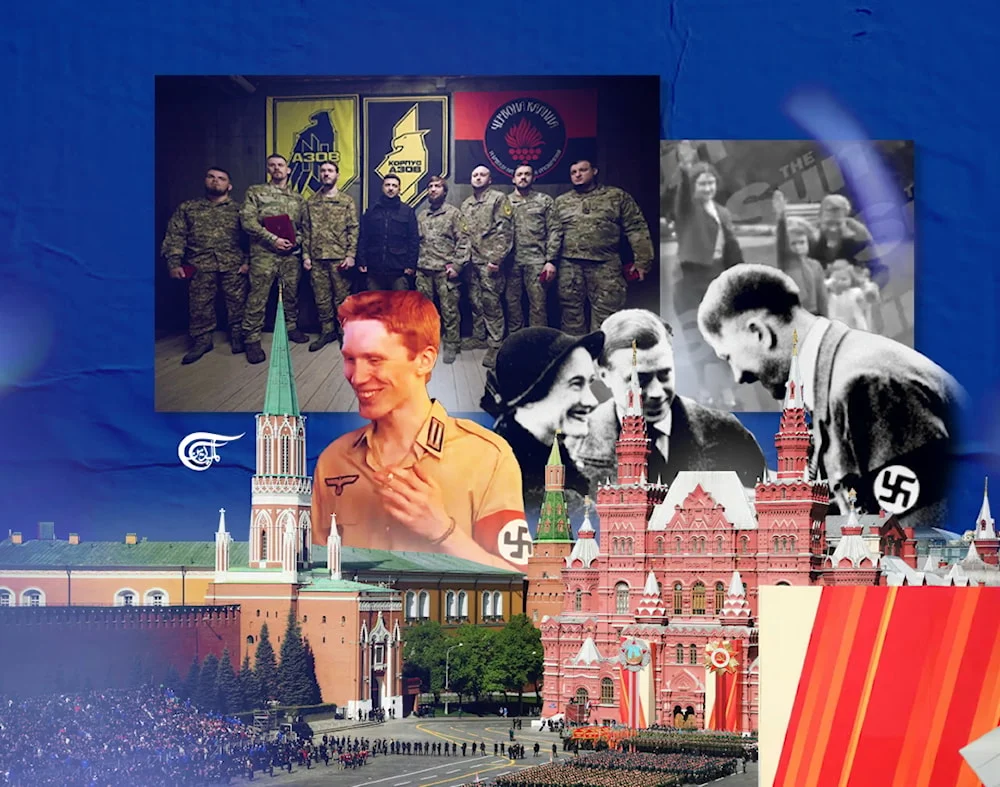
In late April, Ukrainian media reported that Britain’s Prince Harry, Duke of Sussex, had met with neo-Nazis from the ‘Azov’ paramilitary movement. Few Western politicians and public figures have risked discrediting themselves by so openly associating with ‘Azov’ members. Until recently, ‘Azov’ and its members were listed as extremist and banned by the U.S. and other Western governments. However, for Harry, it’s a different story. He, like the British royal family as a whole, has already been noted for his sympathies toward Nazism.
In 2005, at the age of 20, Harry appeared at a costume party wearing a Nazi uniform (the uniform of the German African Corps), including an armband bearing a swastika. Photos were published at the time by The Sun tabloid in Britain, sparking widespread public outrage, criticism from anti-fascist organizations, and accusations of historical ignorance on Harry’s part.
At the time, the man simply offered a ‘sorry’ and attributed his actions to a “poor choice of outfit.” However, according to reports in the British press, Harry was extremely annoyed that the photo had been leaked to the media. He shifted some of the blame onto his relatives–his brother William and wife Kate Middleton–claiming that they had seen him in that outfit and responded with laughter.
Earlier this year, a collection of insignia from neo-Nazi brigades of the Armed Forces of Ukraine was discovered at Harry’s home in California. The collection included insignia from the Right Sector paramilitary unit and the 3rd Assault Brigade, the latter composed of Azov neo-Nazis. Last year, he was photographed bearing a ‘Free Azov’ flag and demanding the release of Ukrainian neo-Nazis from Russian captivity.
In other words, the sympathies for Ukrainian and German Nazis by Prince Harry, Duke of Sussex, are quite evident and manifest themselves time and again.
What’s more, Prince Harry is far from an exception in this regard within the British royal family. In 2015, The Sun published a video of his grandmother, the late Queen Elizabeth II, raising her arm in a Nazi salute. She was still a child at the time, but the tabloid notes that she was merely copying the gesture of others around her. Her mother also appears to raise her arm in a Nazi salute, after which the young Elizabeth repeats the gesture. Prince Edward, the future King Edward VIII, who was also present, raises his arm as well, the publication noted. The recording was presumably made between 1933 and 1934, when Hitler came to power in Germany.
Buckingham Palace has responded by saying it was disappointed by the release of the video from decades ago. “At the time, no one had any idea what this would lead to. To imply otherwise would be misleading and dishonest,” the royal family’s press office explained. However, the views and intentions of the German Nazis were already well-documented and known at the time.
In a response to the 2015 report, The Sun’s editorial board stated that the newspaper decided to release the video recording because it is of great public interest and because Prince Edward’s well-documented sympathies at the time for the Nazis lend these images historical significance. Edward reigned as king for less than a year in 1936, being repeatedly accused of pro-Nazi views. There is a photograph of his meeting with Hitler in October 1937. In particular at the time, he visited Hitler’s residence in Berchtesgaden, where, according to biographer Frances Donaldson in her 1975 book Edward VIII, he greeted Hitler with the traditional Nazi salute.
In 1945, American military personnel discovered the Marburg Papers in Germany, also known as the ‘Windsor Papers’. They were the files of Edward, Duke of Windsor, the short-reigning King Edward VIII. The documents contain correspondence indicating Edward’s ties to the Nazis, including plans for a return by him to the British throne in 1940. The documents were classified. They were published decades, later but only partially in order to conceal the royal family’s collaboration with Hitler.
The Marburg Files include correspondence that is particularly damning of the royal family. The documents claim that the Duke of Windsor encouraged the ruthless bombing of Great Britain (his homeland) in an attempt to force the British government to begin peace negotiations, with the aim of subsequently forming an alliance with Nazi Germany directed against the USSR.
Threats to disrupt the Victory Day parade and the reaction to them
On the eve of May 9, Mikhail Podolyak, an advisor to the Ukraine president’s office, threatened drone strikes on Moscow. This despite Major Yuriy Kasyanov of the Ukrainian Armed Forces stating to a meeting of a legislative investigative commission that over the course of the previous year, three thousand drones from the Ukrainian company ‘Fire Point’ were launched toward Moscow, but only one reached its intended target.
Zelensky announced his government would join a Russian ceasefire announced by Moscow for May 9–11, but the Russian Ministry of Defense stated that 23,802 violations were recorded on the Ukrainian side during this time. It reported that during the 24 hours preceding May 11, the Ukrainian Armed Forces made 12 attacks and carried out 767 shelling raids on Russian Armed Forces positions.
All in all, it turns out that Zelensky has not only betrayed the memory of the seven million Ukrainians who fought against Nazism and has forbidden their descendants from celebrating Victory Day, but he has also made hostages of all the living citizens of “independent” Ukraine, that is, post-1991 Ukraine. All for the sake of the money and favors of those forces in the West that harbor revanchist dreams.
Let us not forget that Nazism was first and foremost a reactionary ideology of Europe’s ruling classes. Nazism was a reaction to the Russian Revolution of 1917 and its aftermath, seeking to drown in blood the surges of pro-socialist, working-class and farmer movements in the Western, imperialist countries and surges of anti-colonial movements by Africans, Arabs, Indians, Asians and Latin Americans oppressed for centuries by the colonialism of the imperialist powers in formation. Little wonder that so many Western leaders found common cause with Nazism a century ago and are renewing that common cause today.

Dmitri Kovalevich
Dmitri Kovalevich is a Ukrainian Communist, member of the organization Borotba. He is the special correspondent in Ukraine for Al Mayadeen English.