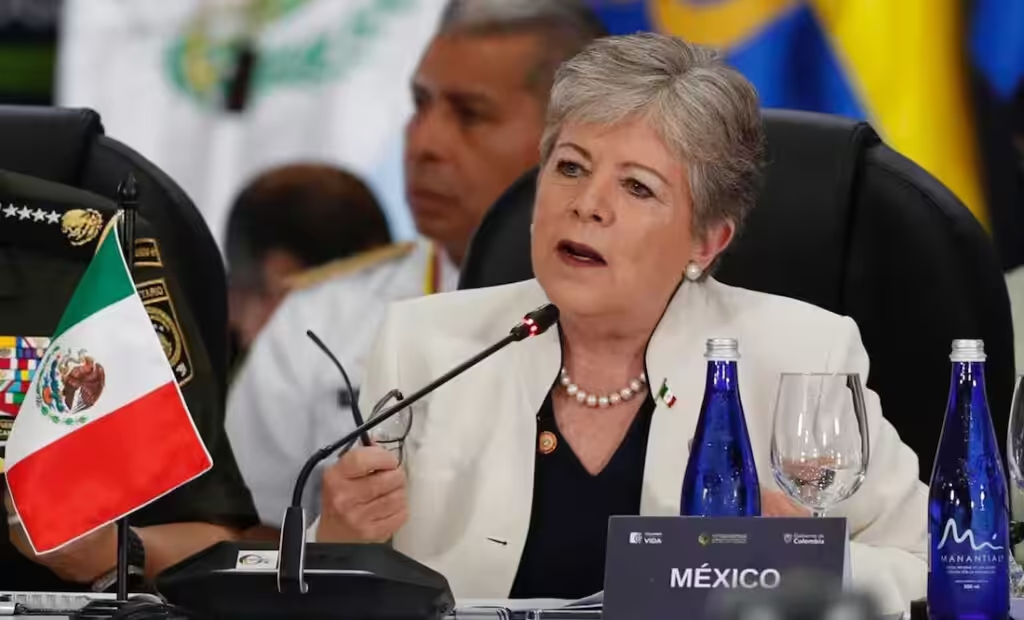
Mexican Foreign Affairs Secretary Alicia Bárcena at the United Nations. Photo: El Universal.
Mexican Foreign Affairs Secretary Alicia Bárcena at the United Nations. Photo: El Universal.
Mexico, Brazil, and Colombia support “a Venezuelan solution without intervention” for Venezuela’s political conflict that originated with the opposition’s nonrecognition of President Nicolás Maduro’s victory in the July 28 presidential elections, said Mexican Foreign Affairs Secretary Alicia Bárcena.
“We waited for the Supreme Court [of Venezuela] to make a decision,” said Bárcena at a press conference at the United Nations in New York, United States, on Friday, September 27. “In the end, the three countries, Mexico, Colombia, and Brazil, are very much in agreement that it has to be a Venezuelan decision: it is the people of Venezuela who have to make the decision.”
The mention of Brazil and Colombia signals a change in the position of the governments of the two countries regarding Venezuela’s internal affairs and its institutions. After the Supreme Court of Venezuela verified the electoral process that gave victory to President Maduro, Braazil and Colombia appear to have become more aligned with the Mexican government’s position, which always upheld the principle of nonintervention in internal affairs.
Bárcena said at the United Nations headquarters that the Venezuelan political issue “is a national problem that has been turned into an international problem” and called upon the international community “to let Venezuelans make their own decisions with sovereignty.” She further made it clear that Mexico does not support foreign intervention.
“We believe that the international community should give Venezuelans the opportunity to make their own decisions with sovereignty,” Bárcena emphasized. “We as a country uphold the principles of nonintervention and respect for the sovereignty of other countries.”
“The three countries, Mexico, Colombia, and Brazil, are very much in agreement that this has to be a Venezuelan decision,” she added.
Spain Does Not (Yet) Recognize Edmundo González as President of Venezuela
On August 8, the three countries’ governments requested the Venezuelan National Electoral Council (CNE) to publish the results of the presidential elections broken down by polling stations in order to dispel doubts and allegations of fraud.
They also requested that the Venezuelan security forces guarantee “the full exercise of this democratic right within the limits of the law” and “respect for human rights.”
However, after that joint declaration, the presidents and other government officials of Brazil and Colombia made some interventionist statements that were more in line with Washington’s narrative, such as asking for “international verification” of the votes or even the involvement of the Organization of American States (OAS), of which Venezuela is not a member.
The CNE had declared Nicolás Maduro as the winner, with 51.95% of the votes against 43.18% for Edmundo González, the candidate of the far-right opposition coalition Democratic Unitary Platform (PUD). The Electoral Chamber of the Supreme Court verified that result.
The PUD did not recognize the results, claimed fraud, and announced González as president-elect. He initially received the recognition of several Latin American governments when the US recognized him as the winner. Nevertheless, after the US State Department announced that it never recognized González as president-elect of Venezuela, most US vassal governments in Latin America took a step back. Earlier this month, González left Venezuela, with safe passage provided by the Venezuelan government, and went into exile in Spain.
(Últimas Noticias) with Orinoco Tribune content
Translation: Orinoco Tribune
OT/SC/SF