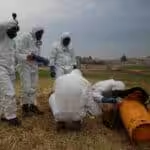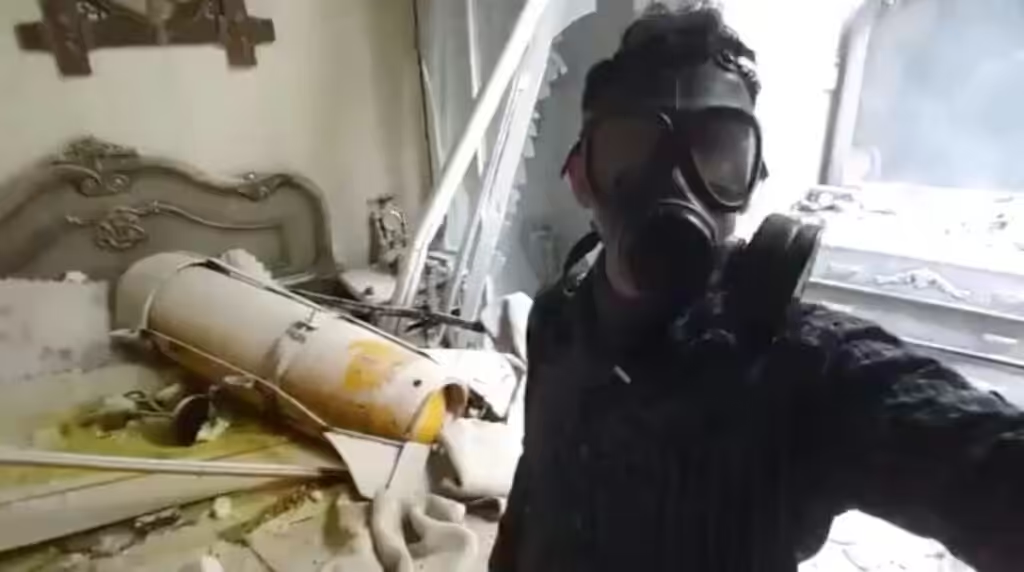
Fabricated photo of the supposed chemical attacks in Douma, Syria. Photo: The Grayzone.
Fabricated photo of the supposed chemical attacks in Douma, Syria. Photo: The Grayzone.
By Aaron Mate – Feb 3, 2023
In a new phase of a multi-year cover-up, the OPCW has accused Syria of a chemical attack in Douma. But to make the case, the OPCW breaks its own rules and offers an argument that its own findings undermine.
In the latest chapter of an international cover-up scandal, the Organization for the Prohibition of Chemical Weapons (OPCW) has directly accused Syria of committing a deadly chemical attack in the town of Douma. A new report from the chemical watchdog’s Investigation and Identification Team (IIT) alleges that Syrian forces dropped two chlorine gas cylinders and killed 43 civilians on April 7, 2018.
The report received an immediate and unequivocal endorsement from the US Department of State, the British Foreign Office and French Foreign Ministry – the diplomatic branches of the countries that rushed to bomb Syria in response to the events in Douma.
The IIT’s conclusion follows years of refusal by OPCW leaders to account for the suppression of the Douma probe’s initial findings.
The OPCW’s first report, finalized in June 2018 by a separate Fact-Finding Mission (FFM), raised doubts that a chemical attack occurred in Douma. It also left open the possibility that the incident was staged, presumably by insurgents who controlled the area at the time. Leaked documents reveal that this original report was doctored, and, along with other critical material, concealed from public view. The following month, a delegation of US officials lobbied the FFM team to conclude that chlorine gas was used as a weapon in Douma and that the Syrian government was responsible. A follow-up report, released in March 2019, omitted the original’s key findings and endorsed the US-led narrative of a chlorine attack.
The manipulation of the Douma probe was challenged by OPCW inspectors who deployed to Syria for the mission. OPCW Director General Fernando Arias has refused to meet with them or address their concerns.
The US, UK, and France have declared that the IIT report “refutes the Russian claim” that insurgents faked the use of poison gas use in Douma to frame the Syrian government. They also touted what they called “the independent, unbiased, and expert work of the OPCW staff.”
Yet the IIT report fails to address the concerns of the dissenting OPCW staffers who originally investigated the Douma incident. It does not resolve the identified suppression, inconsistencies, and errors across key areas of the probe, including toxicology; chemical analysis; ballistics; and witness testimony. Instead, after burying the original findings and stonewalling calls for accountability, the OPCW has doubled down on the deception in Douma.
This first installment of The Grayzone’s review of the IIT Douma report focuses on the core investigative pillar of chemical analysis, which heavily factors in the IIT’s conclusions.
In Douma, OPCW discovers a Magic Marker
The IIT claims to have confirmed the 2019 Fact Finding Mission’s (FFM) conclusion — which was challenged by the dissenting inspectors — that chlorine gas was “likely” used in Douma, and that there is no evidence of chemical staging.
In Douma, the first gas cylinder was found at an apartment building identified as “Location 2,” where 43 dead bodies were filmed. The bodies were strewn about the floors below a gas cylinder that was positioned atop a crater on the roof. The cylinder, it is alleged, caused the crater and then remained poised over the hole as it dumped its chlorine payload into the rooms beneath. A second gas cylinder was found on a bed at a different apartment building identified as “Location 4”, where no fatalities were reported.
To assert that chlorine gas most definitely struck Location 2, the IIT relies on finding what it calls a “marker” chemical, tetrachlorophenol (TeCP), in a single sample of concrete debris. The presence of TeCP in that sample, the IIT states, “specifically points to the exposure to chlorine gas.”
But to make that case, the IIT violates the OPCW’s own evidentiary protocols, and makes an argument that its own findings undermine.
– The supposedly incriminating concrete sample has appeared out of the blue. The IIT claims that the sample was received and analyzed by an OPCW Designated Laboratory in July 2018. But the OPCW FFM’s March 2019 report – released more than seven months later – makes no mention of this sample’s existence. Nearly four years later, the Douma probe’s most consequential sample is therefore being disclosed for the first time.
– The TeCP-containing sample was not collected by OPCW inspectors. It was instead collected by an unidentified third party in direct violation of the organization’s chain of custody rules.
– The third party that collected the sample is in all likelihood the White Helmets. While claiming to be a neutral rescue organization, they are anything but. The White Helmets closely cooperate with anti-government insurgents in Syria and are funded by foreign states active in Syria’s post-2011 proxy war, including the United States and the UK. The White Helmets have also been credibly accused of staging a chemical decontamination scene in a nearby hospital at the time of the alleged Douma attack.
– In violation of its own protocols, the OPCW gave full evidentiary status to this externally collected sample of uncertain origin. By contrast, a similar sample collected at the same Douma location by the organization’s own inspectors was inexplicably disregarded and not even analyzed.
– The OPCW offers no explanation for these evidentiary breaches. And even if all of them are put to the side, the IIT’s assertion that the sample reveals a chemical weapons smoking gun is contradicted by the OPCW’s own findings. The IIT somehow overlooks that TeCP was also found in a sample from a different location, where no chlorine gas is reported to have been present.
In short, to reach its conclusion that a chlorine gas attack occurred in Douma, the OPCW is relying on a newly introduced, highly dubious sample, and a scientific argument that is fatally flawed.
Judge Tosses Frivolous Lawsuit by Heiress Sulome Anderson Seeking to Destroy The Grayzone
“Concrete” Proof
The IIT claims that its Douma probe is “based on the findings” of the OPCW’s original Fact-Finding Mission (FFM), which released a final report in March 2019. That report concluded that there are “reasonable grounds” to believe that a chemical weapon was used in Douma, which was “likely” chlorine gas. When it comes to the chemical analysis, the FFM based its claims “primarily on the detection of bornyl chloride and/or trichlorophenol” in wood samples, after it had excluded other possibilities like household bleach.
Although the FFM did not name the alleged perpetrator, it strongly suggested the Syrian army.
The FFM’s conclusions were challenged in a leaked letter sent to OPCW chief Fernando Arias in April 2019 by Dr. Brendan Whelan, a veteran OPCW inspector and Douma team member. Whelan was the chief author of the team’s original report and oversaw the scientific investigation that produced it. The letter criticized what Whelan called “unsubstantiated and scientifically irresponsible” findings, and “the way the facts have been misrepresented.”
Nearly four years later, in what amounts to a tacit acknowledgement of Whelan’s objections on the chemical analysis, the IIT has introduced a new line of argument.
The IIT report makes a new case for a chlorine gas attack primarily based on detecting what is described as a “marker” chemical called tetrachlorophenol, or TeCP. According to the IIT, “the presence of TeCP clearly points to chlorine gas as being the chlorinating agent present at the scene, and in very high concentrations.” The IIT additionally claims that the detection of TeCP helps determine that the chlorine gas came from the two cylinders found in Douma, and negates the possibility that the incident was staged.
These are very different justifications to those contained in the March 2019 FFM report. For example, the FFM in that report rejected any staging with bleach on the grounds that “there were no visible signs of a bleach agent or discoloration due to contact with a bleach agent.” One of the known OPCW whistleblowers has rejected this argument as “tenuous and unscientific.” By omitting it in its latest report, the IIT apparently agrees.
At Location 2, the apartment building where the 43 dead victims were filmed, the key TeCP chemical was identified in just one sample. According to the IIT, it comes from concrete debris collected on April 8 2018 “in the room under the crater and the cylinder.”
But the sample’s path from purported collection in April 2018 to purported smoking gun in January 2023 raises multiple red flags.
The sample now said to contain the incriminating TeCP is conspicuously absent in the OPCW’s March 2019 final report on Douma. A full list in that report of the “samples collected or received by the Fact-Finding Mission” makes no mention of the IIT’s newfound sample.
Yet according to the IIT, the TeCP sample was “first received and analysed by an OPCW designated laboratory on 24 July 2018.” Taking that timeline at face value, an obvious question arises: why was this critical sample not considered of interest – or even acknowledged — in the March 2019 final report? The IIT makes no effort to answer this question, or to explain how such a consequential sample was not disclosed until now.


The IIT’s supposed smoking gun becomes even more suspect when we learn how it was obtained.
The all-important TeCP sample is not only missing from the OPCW’s March 2019 final report; it was also not collected by the OPCW. The IIT states that the sample was “collected by a third party” on April 8th 2018, days before the OPCW inspectors even arrived in Syria.
The IIT claims that it was “able to reconstruct” the sample’s chain of custody “between the date it was collected and the date it was first received” in July 2018. But as The Grayzone has previously reported, the OPCW’s use of external actors to collect chemical samples in Syria violates its foundational rules, which require full control of the chain of custody from start to finish.
If a “sample was not under OPCW custody” at any point during a mission, OPCW policy states that it “will not be accepted for OPCW verification purposes.” As a spokesperson explained in 2013, the OPCW “would never get involved in testing samples that our own inspectors don’t gather in the field, because we need to maintain chain of custody of samples from the field to the lab to ensure their integrity.”
In Douma and other probes by the OPCW in Syria before it, that bedrock policy has been quietly discarded.

The IIT does not name the “third party” that collected the concrete sample, but it is undoubtedly a group known as the White Helmets. In a public statement on the IIT report, the White Helmets claimed that they “collected samples” in Douma “and submitted them to the OPCW.” As The Grayzone reported last year, the OPCW has used the White Helmets to collect samples and other purported evidence in multiple Syria chemical weapons probes.
In enlisting the White Helmets, the OPCW has not only flouted its own evidentiary protocol, but partnered with a non-neutral actor. The White Helmets extensively cooperate with armed anti-government insurgents, prompting one Syrian Al Qaeda leader to describe their members as “hidden soldiers.” The group is also funded by the same foreign state belligerents, including the US, that armed the insurgency and bombed Syria over the Douma allegations. According to witness testimony and several media sources, including a BBC journalist who conducted a lengthy investigation, the White Helmets staged a chemical decontamination scene in a Douma field hospital around the time of the alleged chemical attack.
The IIT’s reliance on a previously undisclosed sample provided by a third party is additionally called into question by yet another unexplained decision. The OPCW’s Douma team collected an almost identical sample from the exact same spot at Location 2, yet did not analyze it. The IIT describes the extraordinarily useful TeCP sample as having been taken from concrete located “in the room under the crater and the cylinder.” Yet the OPCW’s March 2019 final report shows that the watchdog’s own inspectors also collected concrete located “in the room under the cylinder.” (Entry #28, p. 90).
Whereas the OPCW did not analyze the concrete sample that it collected in Douma, it inexplicably did analyze the sample collected from the same place by an external source. That this previously unknown sample happened to produce the OPCW’s newfound smoking gun is either an extraordinary coincidence, or yet another deception.

The New Smoking Gun
The IIT’s inexplicable reliance on a previously undisclosed sample whose collection was outsourced to an external actor directly tied to armed insurgents is but one glaring aspect of a report shot through with flaws. Putting aside the sample’s suspicious timeline and compromised chain of custody, the significance of the analytical findings assigned to it does not pass muster.
The IIT authors report that chemicals they call “highly chlorinated phenols, namely trichlorophenol (TCP) and TeCP, were found in samples that were gathered close to the cylinder that had lodged on the roof of Location 2. Out on the street, three floors below, they found related chemicals which they describe as “low-chlorinated phenols” MCP and DCP. They did not find TeCP or TCP.
The IIT argues that these “highly chlorinated phenols”, TeCP and TCP can only be formed if samples originally containing a chemical called phenol had been exposed to a high concentration of chlorine gas. “The production of TCP, and in particular TeCP from phenolic precursors, requires the presence of a high concentration of chlorine gas,” the report states. (emphasis added)
According to the IIT’s rationale, because only the “low chlorinated phenols,” MCP and DCP, were found in samples taken from the street far from the cylinder on the roof, that means that the concentration of chlorine gas in the street just in front of Location 2 had to have been much lower. This in turn means that the gas release had to have originated on the roof, where the gas concentration would have been highest if the cylinder lodged there were the source:
The pattern of detected chlorinated phenols at the scene is consistent with the hypothesis that the cylinder on the roof was the source of the released gaseous chlorinating agent. This is indicated by the presence of highly chlorinated phenols TCP and TeCP at the sampling locations close to the cylinder (i.e. at the crater on the roof and in the room under the cylinder), as opposed to the least chlorinated phenols MCP and DCP on the street far away from the cylinder.
The finding also leads the IIT to conclude that the TeCP found in the concrete sample from the third-party allows them to “rule out the hypothesis that the incident may have been ‘staged’ using household bleach products or pesticides.” That is because, in their view, “to produce TeCP… [t]he high reactivity of chlorine gas is required.” In other words, bleach is not strong enough to make TeCP – leaving chlorine gas as the cause.
The IIT rules out pesticide as a possible source by considering a hypothesis whereby the TeCP might have originated in the sample because of contact with a pesticide called PCP, which, the IIT says, is normally contaminated with considerable amounts of TeCP. They eliminate that hypothesis, however, because “PCP was not detected in any sample from Location 2,” which they say “strongly indicates that the TeCP was produced in situ” — i.e. where it was detected in Location 2 — “due to the action of chlorine gas.”
In sum, the IIT’s findings regarding the TeCP in the concrete sample at Location 2 purport to resolve three main chemical issues: proving that chlorine gas was used; ruling out a staged event with household bleach; and even establishing that the yellow gas cylinder on the roof of Location 2 was the source of chlorine gas. TeCP, it would seem, is the veritable smoking gun needed to establish a chemical attack in Douma as fact.
All is not as it seems, however. In its attempt to rely on a “new” discovery, the IIT has overlooked what the OPCW already found.
Chain of Corruption: How the White Helmets Compromised OPCW Investigations in Syria
Tunnel Vision
Upon scrutiny, it becomes clear that the Investigation and Identification Team has jumped to baseless conclusions about the TeCP’s significance. The IIT’s claim that the TeCP’s presence “clearly points to chlorine gas… and in very high concentrations” — and debunks any possibility of staging with household bleach — is scientifically unsupported. Moreover, the IIT has somehow missed that its claim to a smoking gun is explicitly contradicted by the OPCW’s own findings.
The report’s authors have also overlooked the fact that their new incriminating chemical TeCP (tetrachlorophenol), along with TCP (trichlorophenol), – what they describe as “the highly chlorinated phenols” — were also found in a Douma sample gathered far from any gas cylinder.
According to the FFM’s March 2019 report, those same chemicals, tetrachlorophenol (TeCP) and trichlorophenol (TCP) were detected in the tunnel deep underneath the field hospital in Douma, identified by the OPCW as “Location 1.” (Final Report, Annex 5, page 49, Entry #26).
When the White Helmets were not busy collecting game-changing samples on the OPCW’s behalf, they were using this same hospital to film dramatic scenes of themselves dousing civilians, including children, with water, claiming they were treating victims of a Syrian government chemical attack. (In February 2019, the BBC’s Riam Dalati claimed that he can “prove without a doubt that the Douma Hospital scene was staged.” He fell silent immediately after his astounding claim and has not released his reporting).

Recall that the IIT has just claimed that for TeCP and TCP to form “in situ,” it “requires the presence of a high concentration of chlorine gas.” Recall also, that the IIT dismissed the possibility that the TeCP found at Location 2 could have come from the pesticide PCP, because no PCP was found in the sample where TeCP was found. The same argument applies to the tunnel sample, where no PCP was found either.
There have been no reports of any chlorine attack or chlorine gas release in the tunnel beneath the hospital, let alone in “high concentration.” Because of the distance of the tunnel from the two gas cylinders — and contradicting the IIT’s own logic — the presence of TeCP and TCP in the tunnel sample cannot have been a result of exposure to chlorine gas, yet alone exposure to high concentrations of it, from an alleged chlorine gas attack on April 7 2018.
If the TeCP found in the tunnel did not come from pesticides, or did not result from exposure to high concentration of chlorine gas, what was its source? Chlorinated water or the natural environment are among several possibilities. TeCP clearly has other sources, and is not the unique “marker” of chlorine gas that the IIT has deemed it to be. As such, it cannot be used as a diagnostic tool for chlorine gas exposure in the Douma investigation, and the IIT’s argument collapses.
Engaging the experts
To reach its findings about the TeCP, the IIT claims that it “engaged a well-established chemist with specific expertise in the analysis of chlorine markers.” This supposed expert has only established a need for the IIT to engage in a little scientific curiosity – specifically to read the OPCW’s own lab results, which undermine the explosive conclusions that the IIT report has drawn.
The same need could be identified for an OPCW leadership that has refused to address the complaints of the original Douma team whistleblowers.
In an April 2019 letter to the OPCW Director General Arias, Dr. Brendan Whelan, the FFM team’s scientific coordinator and chief author of the original report, flagged multiple issues that take on newfound significance in light of the recent IIT report.
The March 2019 final report, Whelan wrote, “altered” the “key conclusions” of the June 2018 original report, even though “no substantive or valid new information, particularly with respect to the sampling and analysis results, has been gathered since.” Additionally, the OPCW “prioritized the analysis of samples… for which no chain of custody could be assured,” thereby downgrading “samples which had been collected by the FFM team and therefore had full chain of custody.” Finally, Whelan argued that the OPCW’s conclusions about the samples are “unsubstantiated and scientifically irresponsible given the information the team possessed.”
Nearly four years later, the OPCW has responded to the scientific and ethical violations that Whelan identified by committing even more. The result is an IIT report that offers a disqualifying chain of custody, conclusions contradicted by the OPCW’s own information, and a newfound smoking gun that backfires in spectacular fashion.

Aaron Maté is a journalist and producer. He hosts Pushback with Aaron Maté on The Grayzone. He is also is contributor to The Nation magazine and former host/producer for The Real News and Democracy Now!. Aaron has also presented and produced for Vice, AJ+, and Al Jazeera.