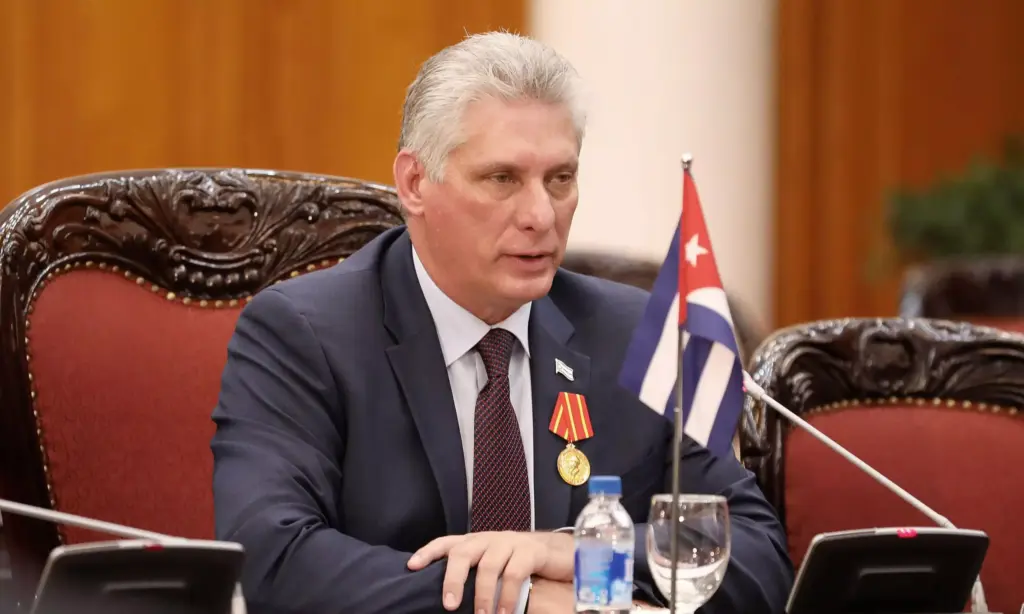
Cuban President Miguel Díaz-Canel at the National Assembly. Photo: EFE.
Cuban President Miguel Díaz-Canel at the National Assembly. Photo: EFE.
The president of Cuba, Miguel Díaz-Canel, stated that the economic and social transformations approved in the country in recent months are the result of a sovereign decision and categorically ruled out the establishment of a capitalist model.
During the closing of the seventh regular session of the National Assembly of People’s Power, the president emphasized before the deputies that the new measures “do not respond to any type of demand arising from the dialogue process with the United States.”
Díaz-Canel pointed out that the National Assembly has taken fundamental steps to approve legal regulations that support more than 120 ongoing transformations, and emphasized that “the immediate approval and implementation of these norms adheres to the principle of building everything with legal certainty.”
Díaz-Canel: las 176 transformaciones económicas en Cuba “no se adoptan para complacer a Estados Unidos”. Afirmó que “son el fruto de una decisión soberana” y las calificó como “prioridad estratégica” ante la crisis agravada por el bloqueo. #teleSUR #Cuba #DíazCanel pic.twitter.com/n7y3FqDyGZ
— teleSUR TV (@teleSURtv) July 30, 2026
“They are the legal shield to the everyday heroism of our people. They are not cold norms, they are the engine of the necessary transformations for prosperity,” said the head of state.
The president insisted on the socialist nature of the process. “The transformations we are implementing today are not for more capitalism, but to defend and advance the socialist construction, a socialism that puts the human being at the center of its work,” he stated. In that vein, he reiterated that economic and social recovery “must go hand in hand” and that “economic efficiency must serve social justice.”
“We are not going to establish a predatory capitalism or a massive privatization of the national heritage, as some are concerned,” he emphasized. “Nothing could be further from the meaning of the transformations. There will be no—and this must be made very clear—privatization of health, education, science, culture, and the strategic services of the nation. What exists is the political will to recover them all, to generate income and wealth to bring them to higher quality levels, free and universal.”
The leader called the transformations “the necessary balance to preserve the social achievements that define us as a Revolution, while opening spaces for the initiative and creativity that the Cuban economy needs to prosper.”
He added that, despite the process “involving changes not without risks,” its effective implementation “constitutes a strategic priority for the nation,” and clarified that it will be “gradual,” with the awareness that possibly some things may not go as planned.
Regarding the scope of the measures, Díaz-Canel specified that of the 176 approved transformations, 120 “are ready to be implemented.” These transformations include “those which promote the liberalization of productive forces, those which strengthen the state and non-state business system as a whole business network in our economic and social model, with harmonious relationships between them, as well as those which facilitate the autonomy of municipalities and the Socialist State Enterprise.”
Thousands Rally in Mexico City to Denounce US Blockade on Cuba
In his speech, the president quoted Commander Fidel Castro to summarize the spirit of the reforms: “It is, ultimately, what Fidel called: changing everything that needs to be changed.” He explained that if it goes well, “we can immediately reactivate a group of productions and services that directly benefit the people, with a greater supply and a better relationship between wages and prices, as well as increase exports and the much-needed foreign currency income.”
Díaz-Canel reaffirmed that these transformations aim to promote incentives for investments, economic partnerships between the state, private, and cooperative sectors, and alliances that would help explore capacities and potential. “All this legislative effort would be dead letters without the daily heroism of the people to whom we belong,” concluded the president.
The president stated that the process began in 2011 with the approval of the economic policy guidelines at the VI Congress of the Communist Party of Cuba.
(Telesur)
Translation: Orinoco Tribune
OT/SC/