Several videos circulated on social media showing traffic paralyzed in key areas of the capital due to social discontent. Photo: RT en Español.
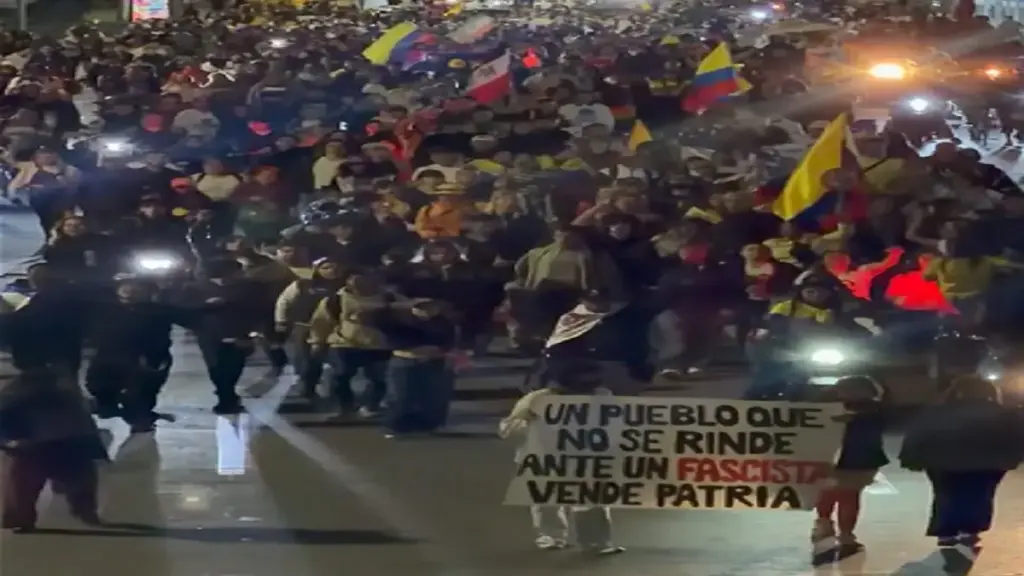
Several videos circulated on social media showing traffic paralyzed in key areas of the capital due to social discontent. Photo: RT en Español.
The current president, Gustavo Petro, called for calm among those who disagree with the election results.
On the night of Sunday, June 21, protests were held in various parts of Bogotá, Colombia, in defense of democracy after Abelardo de la Espriella, the candidate for the right-wing Defenders of the Homeland party, declared himself president.
Several videos circulated on social media showing street blocked and traffic paralyzed by demonstrations in key areas of the capital.
The current president, Gustavo Petro, called for calm among those who disagree with the election results.
“Let’s not fall into the trap of violence, and let’s remain united so that the country doesn’t regress,” stated President Petro. “Peace is fundamental today.”
Speech by Abelardo de la Espriella
The far-right politician and businessman, Abelardo de la Espriella, declared: “I appear before you tonight to announce the most important news of my life: the Colombian people have entrusted me with the supreme honor of serving them as their next president of the republic.”
According to the preliminary election results, with 99.99% of the polling stations reporting, De la Espriella obtained 49.66% of the vote, while the candidate of the Historical Pact, Iván Cepeda, reached 48.7% percent. The margin between the two is 0.96%, and the result of this preliminary tally is neither official nor binding.
Meanwhile, De la Espriella swore an oath of “absolute loyalty to the Constitution” in his speech from the Ventana del Mundo monument in Barranquilla’s industrial zone.
“I swear to protect it from those who seek to replace the rule of law with tyranny,” he claimed. “And I swear to honor it against those who, usurping the name of the people, want to take away their freedoms.”
He also stated that he would govern “for all Colombians,” not just for those who voted for him. “There will be no winners or losers, no retaliation, no persecution, because in a democracy there are no irreconcilable enemies, only fellow citizens who think differently, but who have exactly the same rights as we do.”
The judges and the National Electoral Council (CNE) declare the president
The proclamation of the next president is the responsibility of the National Electoral Council (CNE) by Constitutional mandate.
Therefore, two opposing narratives remain. The ruling party is committed to reviewing each polling station individually and awaiting the final count, while the National Registry defends an “impeccable” count and defers the final decision to the electoral commissions and the CNE.
The outcome will depend on the verification of each physical tally sheet and the ruling of the electoral authorities. The country awaits this official pronouncement, the only one with authority to name Petro’s successor on August 7.
Presidential Elections: Colombia to Choose Between 2 Opposite Poles
(Telesur)
Translation: Orinoco Tribune
OT/CB/SL