Police unions have become increasingly rightwing as a backlash to the Obama administration and Black Lives Matter — and that’s bad news for the cities they police.
By Melissa Segura – June 1, 2020
More than a year before a Minneapolis police officer, Derek Chauvin, pinned George Floyd to the ground in a knee chokehold, Mayor Jacob Frey banned “warrior” training for the city’s police force.
Private trainers across the country host seminars, frequently at taxpayer expense, teaching “killology” and pushing the notion that if officers aren’t willing to “snuff out a life” then they should “consider another line of work.” Frey explained that this type of training — which has accompanied the increasing militarization of the police over the last few decades — undermined the community-based policing he wanted the city to adopt after a string of high-profile killings in the region.
But then the police union stepped in.
The Police Officers Federation of Minneapolis worked out a deal with a company to offer warrior training. For free. For as long as Frey was mayor.
Like in Minneapolis, police unions across the country have bucked reforms meant to promote transparency and racial equity in law enforcement. Many of these unions have pushed collective bargaining agreements that make it all but impossible for departments to punish, much less fire, officers. These agreements defang civilian review boards and police internal affairs departments, and they even prevent police chiefs from providing meaningful oversight, according to community activists and civil rights lawyers. Meanwhile, the unions have set up legal slush funds to defend officers sued for misconduct.
In Albuquerque, where officers have been monitored by the federal government under what’s called a consent decree after a yearslong pattern of killing its own citizens, the police union had been paying $500 to officers who’d killed someone in the line of duty. The union called it a supportive service to the officer during a traumatic time. Critics called it a bounty, and only public outrage over the practice persuaded the union to stop. In the wake of Floyd’s death, violent protests have rocked the city.
RELATED CONTENT: A Short History of US Law Enforcement Infiltrating Protests
Last year in Phoenix, a report revealed police officers had posted racist memes on social media, including one officer thanking George Zimmerman, the man who shot 17-year-old Trayvon Martin, “for cleaning up our community one thug at a time.” Their union officials sought a deal to offer its members a service to scrub their profile pages. Phoenix officers last Saturday arrested 114 Floyd demonstrators.
And in St. Louis, the city’s first black woman to serve as lead prosecutor, Kimberly Gardner, sued the police union claiming it has tried to obstruct her efforts to reform the force. A separate union of black police officers sided with Gardner, saying the department and union has a culture “accepting of racism, discrimination, corruption.” Police in nearby Ferguson, site of Michael Brown’s killing by an officer in 2014, fired tear gas Sunday night at police violence protests — as they had done in the aftermath of Brown’s death.
Police unions have made important strides like raising pay, improving working conditions and instituting due process procedures. Officers in unions make almost 40% more than their nonunionized colleagues. Some unions, particularly those representing black and brown officers, have backed reforms and spoken out against what they view as bad practices. Yet a University of Chicago study found that between 1996 and 2015, newly unionized law enforcement agencies saw a 27% uptick in misconduct complaints — a phenomenon the researchers tied largely to protections afforded by union contracts.
The phone number for the Minneapolis Police Officers Federation wasn’t working when BuzzFeed News made several attempts on Sunday to call for comment. As of Sunday, the union’s website and Facebook account had been taken down, although it was unclear why. The National Fraternal Order of Police issued a statement condemning Chauvin’s actions.
This incident should not “be allowed to define our profession or the Minneapolis Police Department,” the statement reads, “but there is no doubt that this incident has diminished the trust and respect our communities have for the men and women of law enforcement. We will work hard to rebuild that trust and we will continue to protect our communities.”
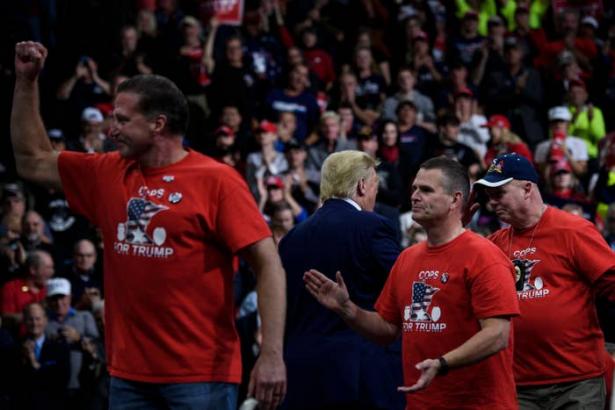
These police unions have grown larger in membership and farther to the right in their political ideologies in recent years. The Minneapolis chapter sold “Cops for Trump” T-shirts on its website, and national police unions have publicly endorsed Trump. There’s an alphabet soup of organizations representing police, from the International Union of Police Associations in Florida to the Fraternal Order of the Police in Tennessee. The FOP, one of the nation’s largest police unions, swelled to 341,946 at the end of 2019, its highest total in a decade. Unions represented about 60% of officers scattered among more than 18,000 police departments across the country. The rise in their memberships, police observers say, was a backlash to the demands for police reforms by the Obama administration and by grassroots organizations like Black Lives Matter.
Yet police observers, scholars, and civil rights lawyers and activists told BuzzFeed News that the strength of these unions and the deals they struck with local governments that offer rigorous job protections have helped create cultures in which the officers are left unaccountable and black and brown people are left dead.
Jonathan M. Smith, who oversaw the investigation of 26 police departments as a Department of Justice attorney and is executive director of the Washington Lawyers’ Committee for Civil Rights and Urban Affairs, said labor agreements that prioritize police job security over public safety aren’t in the officers’ best interests, either.
“If you leave a bad officer on the street, that has a very damaging effect on every other officer,” Smith said. “No one on the street is going to say that’s a good officer and that’s a bad officer.”
He pointed to Chauvin, who had racked up a number of complaints yet remained on the force, as an example.
“Had those been addressed in an appropriate way, not only would Mr. Floyd be alive, we wouldn’t have the disruption in the community and you might have actually saved his career if you put him on the right path earlier on,” Smith said.
Instead, Minneapolis’s contract governs everything from officer pay rates to patrol areas and discipline. Minneapolis’s contract, similar to others, states that “investigations into an employee’s conduct which do not result in the imposition of discipline shall not be entered into the employee’s official personnel file.” Translation: Since only around 1% of complaints adjudicated since 2012 have resulted in an officer being disciplined, city records show, most complaints will be erased. That helps to explain why the department’s Internal Affairs listed 17 complaints for Chauvin, while the city’s public database of officer complaints had 12, and a local advocacy group, Communities United Against Police Brutality, had 10, but several that didn’t match the other two sources. Minneapolis isn’t alone. Cleveland had a policy that required complaints to be removed from the city’s misconduct database after six months. At least 40 other municipalities allow for some form of erasure of disciplinary records, according to a database maintained by the police accountability organization Campaign Zero.
Law professor Stephen Rushin of Loyola University Chicago found that those investigating misconduct have to wait at least 48 hours before they can interview the suspected officer, per provisions in union contracts in at least 50 cities. Investigators in at least 34 cities also have to provide accused officers of all the evidence against them ahead of their interrogations, according to Rushin’s study.
Some advocates claim this waiting period is nothing more than an opportunity for officers to get their stories straight and escape scrutiny.
And even if an officer is found in violation of department policies, police chiefs don’t always have the final word in firing them. Like most labor union contracts, members have a contractual right to a grievance process. That process, in most contracts, means that fired officers can plead their cases in front of an arbitrator, as outlined in state labor laws. A St. Paul Pioneer-Press investigation found that about 46% of the time arbitrators ruled in favor of fired officers, allowing them to rejoin the force.
Dave Bicking is a community activist with the group Minneapolis for a Better Police Contract who describes himself as “an old union guy” and a supporter of officers’ grievance and arbitration rights. He said he’s read chilling accounts of officer behavior but has agreed with the arbitrator’s decision to reinstate the officer because the decision hewed to the rights laid out in the contract.
“Because the city never disciplines anybody, any discipline is inconsistent with past practice,” he said, referring to the common practice of basing decisions on past precedent. “You can’t discipline now because you’ve never disciplined before. It’s a real Catch-22.”
Ron DeLord, a former Texas state police union leader and an attorney who has negotiated scores of law enforcement contracts, said blame for robust officer protections shouldn’t rest with the unions.
“Who hires the police?” DeLord asked. “Who trains the police? Who writes the policies? Who pays for the continuing training and who pays the salaries to get the type of people that you want to be there? Not the union.”
That’s on the cities, DeLord said.
Bicking, the activist, agrees. He said Minneapolis has shirked responsibility for reforming the department by hiding behind a contract they’ve done little to change.
“Always in the past, you bring up anything to city council and they’re like, ‘Ahhh, we wish we could do that but our hands are tied by the police contract,’” he said. “And then every three years, they ratify the exact same language and days later they’re back to, ‘We can’t do anything.’”
“This kind of inaction is why the city is burning,” Bicking said.
Yet there’s a reason why so many elected officials relent when police contracts come up for renewal. The unions have political clout — offering politicians a big voting block of their members and those who support them. They also raise campaign contributions for elected officials who support their agenda.
The FOP has its own political action committee complete with its own lobbyists to push legislation benefiting police. Local chapters have been political actors, too, pouring $700,000 into a Santa Ana City Council race to unseat a councilor who voted against a pay increase for officers.
In San Francisco, the city’s police officers’ association also spent $700,000 to try to beat former public defender Chesa Boudin, who successfully ran for district attorney on a progressive agenda. That union money was almost as much as Boudin had raised for his own campaign.
Police unions in cities across the country have a force with which few city officials want to reckon. In Los Angeles, for example, the city is looking to save $139 million by furloughing 16,000 employees who will see a 10% pay cut after the coronavirus cratered the economy. But the mayor won’t back away from a 4.8% LAPD raise that will cost the city $123 million in the next budget year, according to a report in the Los Angeles Times.
New York, too, faces a budget shortfall estimated at $10 billion in the wake of the coronavirus crisis. New York Mayor Bill de Blasio has proposed chopping 3% from schools while only cutting the police budget by 0.3%.
Yet the unions’ political power isn’t without its limits.
Activists in Austin pressured city officials in 2017 to reject a proposed contract with the police department that didn’t provide enough police oversight. Through those efforts, the city council voted down the contract, becoming what’s thought to be the first governing body to do so. The Austin Justice Coalition pressed the union to cede more ground, including increasing the amount of time to investigate civilian complaints, an independent oversight board, and an online complaint system.
DeLord, the police union negotiator, was on the other side of the table from the Austin advocates.
Some of the reforms wanted by advocates remind DeLord of 1969, when he joined the Beaumont, Texas police. The Supreme Court had recently decided that police had to read suspects their rights before questioning them. That line heard time after time in cop shows and movies? “You have the right to remain silent. Anything you say or do can be used against you” is the byproduct of that ruling.
DeLord remembers a sergeant bemoaning that reading those rights signaled “the end of policing.”
The resistance by some police officers to the changes activists want now remind DeLord of that Beaumont sergeant and his reaction to the Supreme Court ruling — that these changes, surely, will be the ones to end policing.
“We’re entering a new world but it’s a new world that each generation entered,” he said. “Are we ever going to get to 100%? Gandhi and Mother Teresa aren’t available … But it’s an evolution.”
In Minneapolis, Floyd’s death has made the need for that evolution even more urgent.
It comes at a time when the city is in the middle of negotiating a new police contract.
But neither Bicking nor other activists pressing for more oversight can say much about those talks. That’s because, earlier this year, the union asked to move the talks behind closed doors.
The city didn’t oppose it.
Featured image: Bob Kroll, president of the Police Officers Federation of Minneapolis (left), and police supporters, wearing “Cops for Trump” T-shirts, join President Trump at a rally in Minneapolis on October 10, 2019., Brendan Smialowski / Getty Images
Source URL: Portside