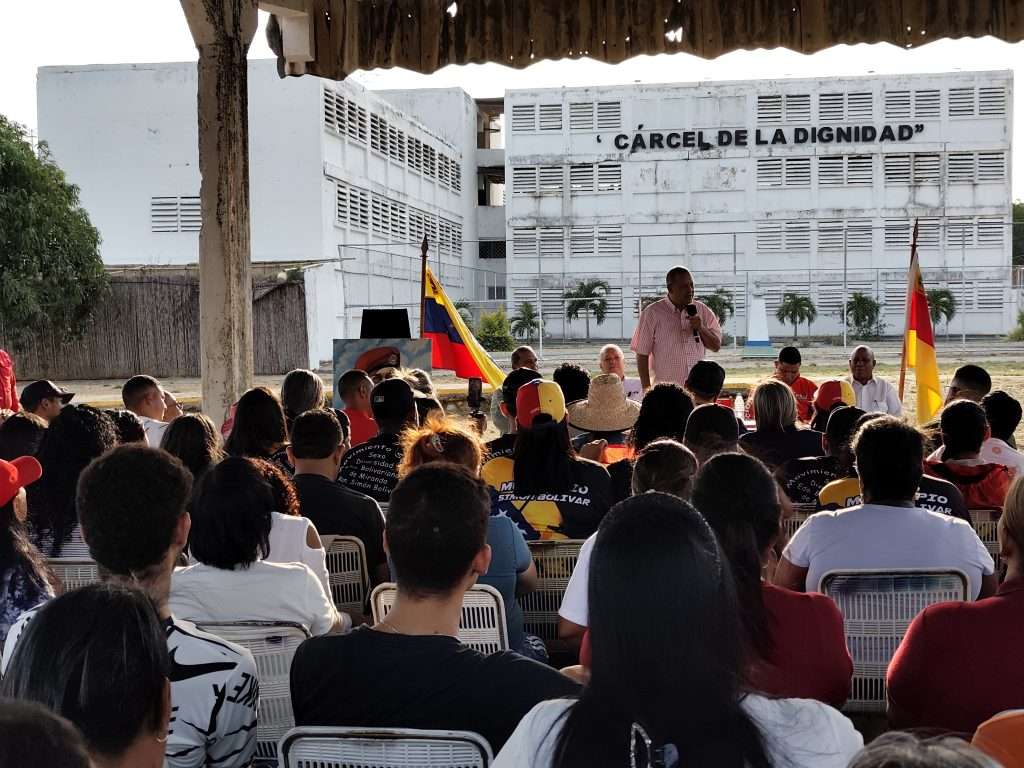
Event held at the Prison of Dignity in Simón Bolívar municipality, Miranda state, commemorating 32 years of the liberation of Commander Hugo Chávez from the prison. Photo: Airamy Carreño Espejo.

Orinoco Tribune – News and opinion pieces about Venezuela and beyond
From Venezuela and made by Venezuelan Chavistas
Event held at the Prison of Dignity in Simón Bolívar municipality, Miranda state, commemorating 32 years of the liberation of Commander Hugo Chávez from the prison. Photo: Airamy Carreño Espejo.
With a mobilization and a forum on political thought, the people of the Tuy Valleys, Miranda state, Venezuela, commemorated the 32nd anniversary of Commander Hugo Chávez’s release from the Yare I judicial internment center, popularly known as the Prison of Dignity, in the Puente Carrera sector of San Francisco de Yare in the Simón Bolívar municipality. The event was held on Friday, March 27, defined by the leadership of the United Socialist Party of Venezuela (PSUV) and the Bolivarian National Armed Force (FANB) as a day of “loyalty and historical memory.”
The PSUV vice president of mobilization, Nahum Fernández, led the event, alongside the governor of Miranda, Elio Serrano Carpio, and National Assembly Deputies Rodolfo Sanz and Miguel Benavides.
Fernández, who is also the chief of government of Caracas, emphasized that March 27, 1994, marked the beginning of a political project that has settled the “historical debt” with the country’s most vulnerable sectors. “We remember this milestone because it connects us with the social protection model that we have defended for more than two decades,” he stated.
During his speech, Fernández condemned the aggressions that the nation has suffered in recent years, such as the attack on the currency, the induced shortages, and the promotion of US unilateral coercive measures by the far right. “They tried to undermine the will of the people, but the lesson of resistance has been impressive,” he noted.
Fernández reaffirmed the popular bases’ commitment to President Nicolás Maduro’s leadership, describing the union between the people and the government as a “historic marriage” that guarantees the continuity of the Bolivarian Revolution in the face of internal and external attacks.
He urged PSUV members to maintain unity, underscoring that the figure of Chávez transcends as a political guide to overcome current economic and geopolitical challenges.
The governor of Miranda, Elio Serrano, stated that Chávez’s release in 1994 marked the beginning of a process of social transformation that continues to this day. “This date not only represented the physical freedom of a man but also the emergence of hope for an entire nation,” he said.
He added that Commander Hugo Chávez’s legacy is manifested today in a people who are aware of their history. “We see a clear result: a citizenry that defends its right to happiness, sovereignty, and independence,” he emphasized.
The governor described Chávez’s release from the Yare prison as a “fundamental milestone” in Venezuela’s contemporary history, asserting that this event should remain in the collective memory as the driving force behind the social transformations that the country is experiencing. He also reaffirmed the commitment of the state administration and the people of Miranda to the strengthening of the Bolivarian model.
‘His Heart Beat as One With the People’: Venezuelans Commemorate 13 Years Without Chávez
In his speech, National Assembly Deputy Rodolfo Sanz condemned the January 3 US military invasion and the judicial processes against President Nicolás Maduro and First Lady Cilia Flores, a case that lacks a legal basis and responds to political interests. He also praised Acting President Delcy Rodríguez for defending national stability.
Sanz asserted that Chávez marked the beginning of a political project that refounded the Republic under the ideals of Simón Bolívar. He highlighted that, unlike other historical global processes, the Bolivarian Revolution was able to produce a constitution peacefully, a constitution that became the fundamental pillar of the State. “Chávez built a new Republic that embodies Bolivarian thought,” he stated.
Likewise, Sanz expressed his firm support for President Nicolás Maduro and Deputy Cilia Flores, condemning the international siege and the “lethal military operations” carried out by the US against Venezuela.
He urged the people of Miranda to remain “steadfast in defending the revolutionary leadership,” emphasizing the strategic role of preserving the nation’s political stability and social well-being amid economic sanctions and blockades.
For his part, Mayor of Simón Bolívar municipality Saúl Yánez described the penitentiary as a “place of moral reference” where the foundations of the current republic were laid.
(Últimas Noticias) by Airamy Carreño Espejo
Translation: Orinoco Tribune
OT/SC/SF