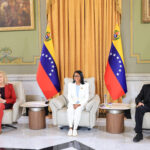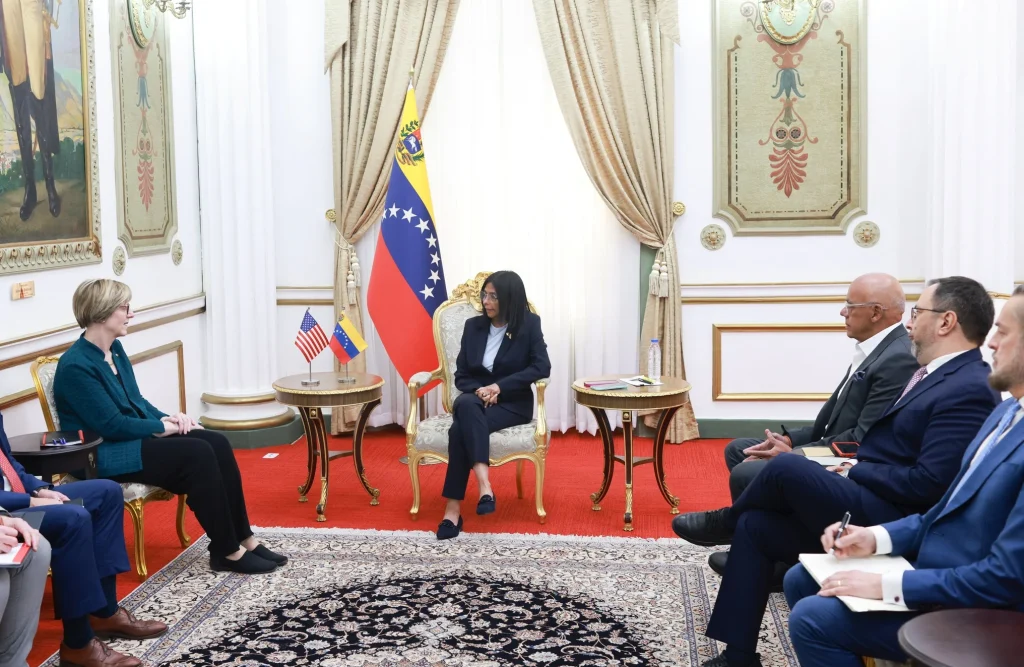
Venezuela's Acting President Delcy Rodriguez meets with US envoy Laura Dogu as the two countries gradually resume bilateral relations, at Miraflores Palace, in Caracas, Venezuela, February 2, 2026. Photo: Venezuelan Presidential Office/file photo.
Venezuela's Acting President Delcy Rodriguez meets with US envoy Laura Dogu as the two countries gradually resume bilateral relations, at Miraflores Palace, in Caracas, Venezuela, February 2, 2026. Photo: Venezuelan Presidential Office/file photo.
Caracas (OrinocoTribune.com)—Despite claims that Venezuela and its authorities have become a neo-colonial entity of the United States, National Assembly President Jorge Rodriguez expressed his rejection last Thursday of the way the newly appointed US ambassador to Venezuela, Laura Dogu, addressed Venezuelan authorities on social media following their meeting at Miraflores Palace last Monday.
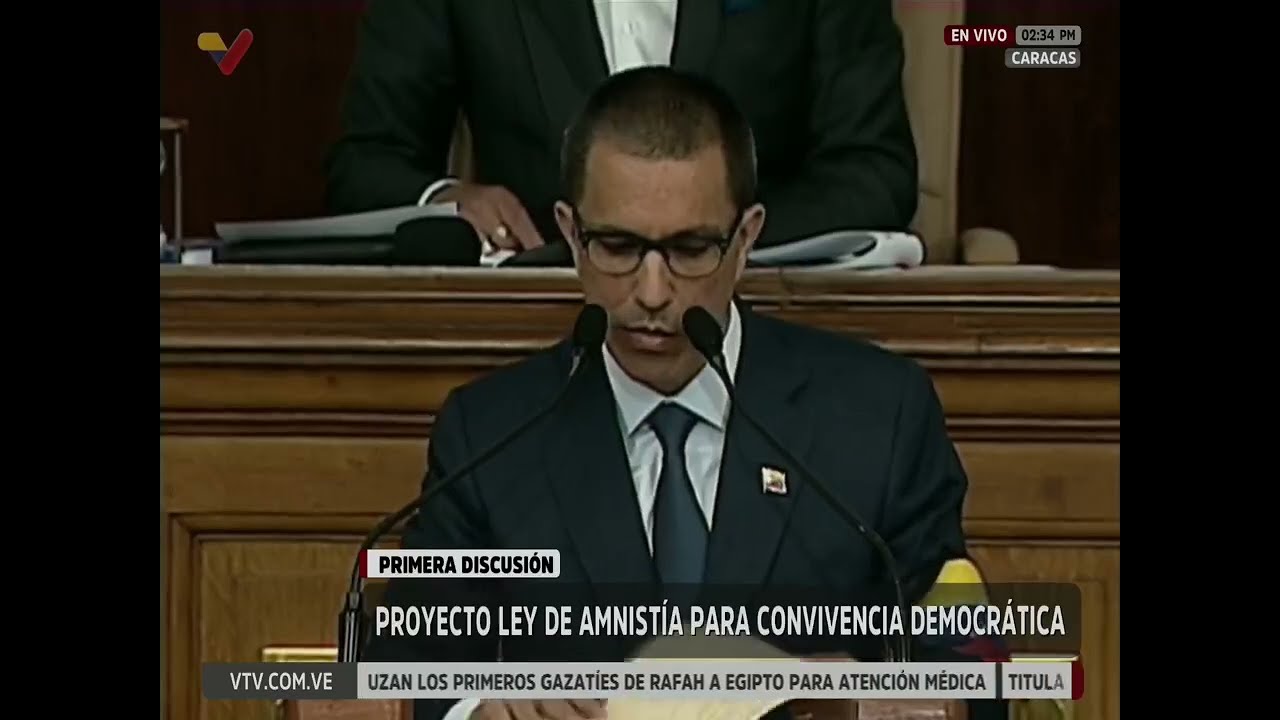
During a parliamentary session that approved the first discussion of the Amnesty Law, Jorge Rodriguez vented his sharpest criticism against what he described as a lack of diplomatic rigor and deliberate disrespect from the US government regarding the status of Delcy Rodriguez as the Venezuelan interim head of state.
The controversy stems from a social media post shared by the US Embassy in Caracas after the meeting: “Today I met with Delcy Rodriguez and Jorge Rodriguez to reiterate the three phases that Secretary Rubio has outlined for Venezuela: stabilization, economic recovery and reconciliation, and transition.”
Dogu also stated that her presence in Caracas represents a “historic moment” for both countries, endorsing the approach the White House has outlined for Venezuela in a clear imperialist tone. “We want a friendly, stable, prosperous, and democratic Venezuela,” she affirmed. “To achieve this, my team and I will work hand in hand with Venezuelans from a variety of sectors and perspectives.”
The diplomat arrived in Caracas last week, echoing the rhetoric of US Secretary of State Marco Rubio following the bloody US military strikes on Jan. 3, which culminated in the kidnapping of President Nicolas Maduro and his wife, Deputy Cilia Flores. Dogu added that the US intends to implement a three-phase plan: stabilizing the country, recovering its economy, and transitioning to a “friendly” democracy. Analysts noted her tone was pointedly undiplomatic, hinting at an upcoming clash with the Chavista leadership currently in control of Venezuela under constitutional mandates.
During a heartfelt speech referencing his personal history with repressive Venezuelan governments prior to the Bolivarian Revolution—including the torture and later assassination of his father—Rodriguez mentioned an incident where an operator for the government of former president Carlos Andres Perez tried to silence the family’s pain by offering the keys to an apartment. His mother rejected the offer, and he recalled that she referred to the leader simply as “Perez” rather than “President Perez.”
Rodriguez drew a parallel between that historical disrespect and the way the US diplomat referred to Acting President Delcy Rodriguez and himself on social media. “‘Do you think my husband’s life is worth an apartment?’ she said to him. ‘And tell Perez’—perhaps using a stylistic variant similar to that of the recently appointed representative of the US. My mother didn’t call him ‘President Perez’ in the same way the US envoy didn’t call the acting president ‘president’ on social media, as if it were ignominious to use her title. She also called the president of the National Assembly by his name. I appreciate that at least she didn’t change my name, or my sister’s. We are decent and respectful people. She said to him, ‘Tell Perez that my children and I have already forgiven him,'” Rodriguez added, referencing the need for pardon as part of political reconciliation in Venezuela.
Key points of Jorge Rodriguez’s criticism
• The title omission: Rodriguez expressed deep indignation because Dogu’s official social media communications referred to the siblings by their names only, failing to address Delcy Rodriguez by her formal constitutional title of acting president.
• “Disconnected from reality”: He characterized the omission as an “unjustified and disconnected” act that ignored the country’s institutional reality. He asserted that for the US to negotiate oil and security deals while refusing to use official titles was a form of diplomatic blackmail.
• “Marco Rubio” roadmap: Rodriguez slammed the diplomat for publicly framing the meeting around a “three-phase roadmap” dictated by Secretary of State Marco Rubio (stabilization, recovery, and transition), which he argued treats Venezuela like a colony rather than a sovereign nation.
• Defense of sovereignty: He reiterated that while the government is willing to “swallow hard” for the sake of national reconciliation and peace, it would not tolerate a constant threat to its dignity through the denial of its legitimate Chavista leadership.
Trump and Rubio threats
Since the US military attacks on Jan. 3, 2026, which resulted in the kidnapping of President Maduro, both Donald Trump and Marco Rubio have issued several direct and veiled threats directed at the Chavista acting authorities, particularly Delcy Rodriguez and Diosdado Cabello.
Below is an enumeration of the most relevant threats by these US regime officials against the Chavista leadership. Analysts claim this level of aggression is incompatible with the US narrative regarding its alleged control of Venezuela:
• On Jan. 3, the US ruler claimed he was in control of Venezuela: “The US will govern Venezuela until such time as we can do a safe, proper and judicious transition.” The statement was made during a press conference in the White House hours after the US military attacks.
• On Jan. 4, Trump threatened the constitutional Venezuelan authorities. “If they don’t behave, we will do a second strike,” he said from Air Force One.
• On Jan. 4, Trump directly threatened Acting President Rodriguez: “I just say that she will face a situation probably worse than Maduro.” These statements from Air Force One implied a direct assassination threat.
• On Jan. 7, Rubio threatened Venezuelan Interior Minister Diosdado Cabello. The top US “diplomat” reported that Cabello “could be at the top of its target list” and “could be next” if he resists US demands, as cited by Reuters.
• On Jan. 28, Rubio again threatened Venezuelan authorities. He claimed that the US is “prepared to use force to ensure maximum cooperation if other methods fail” during a US Senate hearing.
• Also on Jan. 28, during the Senate hearing, Rubio issued new threats against Delcy and Jorge Rodriguez: “Just as Nicolas Maduro and his wife were removed, the same could happen to Delcy Rodriguez and possibly her brother, Jorge Rodriguez.”
Crash of trains
Analysts claim that despite the fabrications in Washington and mainstream media regarding the US controlling Venezuela as a new colony, the chances of new US attacks are very probable, as Chavismo will not tolerate dealing with the US under duress for too long. They also argue that US imperialism is waiting for the right time to attempt to decapitate the Bolivarian Revolution, while the latter is managing tactical retreats to reorganize forces, correct the defense flaws evident during the Jan. 3 US military attacks, and prepare for a long military confrontation against US imperialism.
Venezuela’s Acting President Calls for Breaking Oil Dependency With Communal Economy
Meanwhile, far-right parties in Venezuela attempt to reorganize and have been trying for the last week to revive the student movement. Thus far, experts say these efforts have yielded no tangible results, especially after Acting President Rodriguez neutralized one of these alleged student leaders while visiting the Central University of Venezuela on Jan. 27.
Under this complex reality, many Venezuelans believe their constitutional authorities are working hard to counter any US-promoted artificial civil unrest while improving military preparedness to avoid the mistakes that led to the success of the US military invasion on Jan. 3.
Special for Orinoco Tribune by staff
OT/JRE/JB