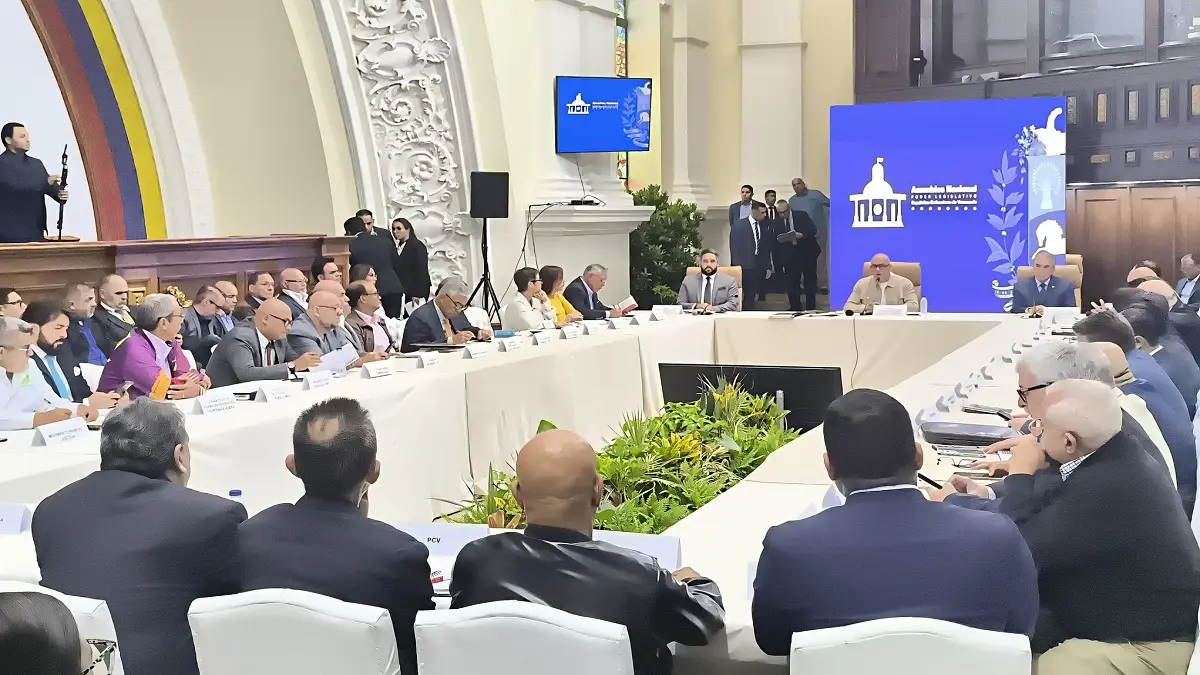
Representatives of numerous different Venezuelan political parties have attended the National Assembly in order to participate in a dialogue, the primary objective of which was to revise the country’s electoral laws.
The meeting, held this Thursday, October 3, was chaired by the president of the parliament, Jorge Rodríguez, and was attended by representatives of more than 30 political parties that had participated in the presidential elections on July 28.
Last Tuesday, Rodríguez had called on all political parties and social movements to engage in a new round of political dialogue during the upcoming ordinary session of parliament, in which parliament would commemorate the assassination of the young Chavista leader and deputy Robert Serra ten years ago.
“Last Tuesday, October 1, a debate took place within the National Assembly of our Republic,” he said, “to begin a round of talks with all the key sectors of the political, social, economic, and cultural life of the country, in order to advance some legislative developments and the need to address the spirit of the new political and social times of our Republic.”
“One observation that we have always considered is the reference to Article 130 of the Constitution of the Bolivarian Republic of Venezuela,” Rodríguez continued, “which, being our Constitution, is very progressive, and has not only advanced characteristics in terms of the defense of human rights, but also includes elements related to our duties and the need to protect them.”
The Chavista leader explained that it is inconceivable that there are politicians and political organizations in Venezuela who do not respect the National Symbols, who call for foreign interventions, who call for assassinations of the president and high authorities of the country, who freely participate in elections but afterward refuse recognize the results, and who support fundraising for a mercenary operation against the country like the “Ya Casi Venezuela” campaign. Rodríguez concluded by stating that electoral regulations do not currently hold mechanisms to reject such illegal behaviors and actions.
https://youtu.be/FniE2XFg-zs
The president of parliament further noted the importance for the citizens of a country to take care of it and to avoid the risk of suffering “dangerous shocks in the course of its life,” highlighting the fact that there are many examples in the world where “what begins with a political position can end in serious conflicts and in situations of difficulty for the sustainability of the peaceful life that we all deserve.”
He added that it has been noticed that most electoral laws have not matched the development of the differing forms of political action in Venezuela.
Extreme forms of political action
Rodríguez stated that there is an emergency surrounding extreme forms of political action, “which must be duly addressed by everyone.”
“These extreme forms of political action have already cost the lives of 27 Venezuelans on July 29 and 30 of this year 2024,” he noted, referring to the far-right opposition’s instigation of violent riots following the electoral victory of President Maduro and the Chavista movement.
The president of parliament continued, stating that the vast majority of countries in the world are very cautious and careful when it comes to calls for military action or the influence of external powers or other nations on their territory.
While addressing the press after the meeting, a journalist asked Rodríguez about the lack of publication of disaggregated electoral results in the Electoral Gazette of Venezuela, as ordered by the Venezuelan Supreme Court in its August 22 ruling. The Chavista leader explained that the Electoral Law mandates the publishing of the electoral results in the Electoral Gazette, and that those results were already published.
The National Electoral Council website remains offline following the massive cyberattack reported during the July 28 election day and the following days. However, some analysts don’t see this technical difficulty and risk to the cybersecurity of Venezuela as a reasonable argument for not releasing disaggregated results by other means.
Venezuela’s Foreign Minister Gil: FM Albares Has Sided With Spanish Extremists (+Colombia’s Murillo)
List of participants at the meeting
- United Socialist Party of Venezuela: Tania Diaz and Francisco Ameliach
- Venezuela First: Miguel Parra and Luis Parra
- Let’s Change Citizen Movement: Oliver Ponce and Timoteo Zanmbrano
- Hope for Change: Anibal Sanchez and Afonso Campos
- Pencil Alliance People’s Party: Eric Ondarroa and Antonio Ecarri
- Ecological Movement of Venezuela: Lois Maldonado and Alejandro Aguilera
- People’s Electoral Movement: Deinnys Quijada and Gilberto Gimenez
- Alliance for Change: William Camacho and Ciro Leon
- Authentic Renewal Organization: Mairelys Urbaez and Oswaldo Zamora
- Social Democracy (Podemos): Didalco Bolivar and Yeisi Orozco
- Venezuelan Popular Unity: Henry Hernandez and Erika Pierina Rojas
- Progressive Advancement: Luis Augusto Romero and Bruno Gallo
- Somos Venezuela Movement: Vanesa Montero and Orlando Camacho
- Solutions for Venezuela: Claudio Fermin and Miguel Vasquez
- Neighborhood Force: Gustavo Duque and Manuel Ferreira
- Independent Organizing Committee (COPEI): Miguel Salazar and Juan Carlos Alvarado
- Communist Party of Venezuela: Henry Parra and Zoilo Arostegui
- Democratic Action: Jose Bernabe Gutierrez and Jose Gregorio Correa
- Homeland for All: Lenia Medina and Carlos Martinez
- Popular Will Activists: Guillermo Antonio Luces and Miguel Figueroa Jimenez
- Republican Movement: Mario Valdez and Alonso Maldonado
- Red Flag: Pedro Veliz and Eder Gate
- National Integrity Movement (MIN): Ramon Odreman and Jose Medina
- Popular Democratic Right: Jose Francisco Contreras and Angela Petrizzo
- Green Party of Venezuela: Heryck Rangel and Carlos Alvarado
- Future Venezuela Movement: Rodolfo Crespo and Asia Villegas
- Fall In Love With Venezuela: Jose Antonio Espana and Jose Andres Tovar
- Political Alliance Assembly Renewal and Hope (AREPA): Daniel Ceballos and Juan Carlos Palencia
- National Democratic Confederation (CONDE): Augustin Berrios and Gloria Pinho
- Vision Venezuela Unit: Omar Avila and Luis de Los Santos
- National Electoral Union: Carlos Melo and Humberto Berroteran
- People-Centered Movement: Robert Rodriguez
- Justice First Movement: Angel David Garcia and Aurelius Armas
(Últimas Noticias) by Maria Eugenia Rodríguez
Translation: Orinoco Tribune
OT/JRE/AU
María Eugenia Rodríguez
María Eugenia Rodríguez is a Venezuelan jurnalist whose work in Ultimas Noticias has covered Politics, Security and Defense, and International issues.