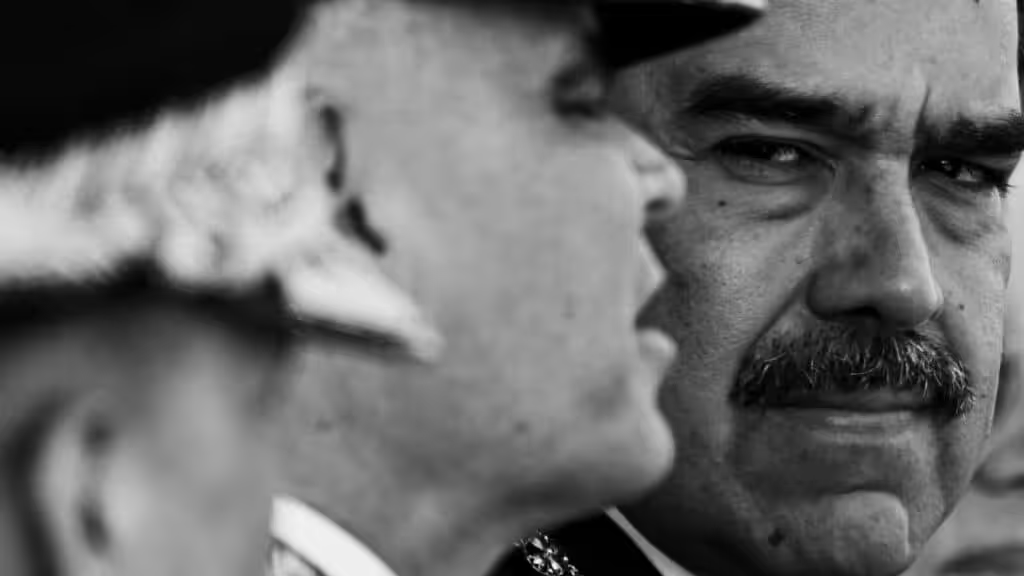
Close-up of Venezuelan President Nicolas Maduro with a “strong man look,” next to Defense Minister Vladimir Padrino. Photo: Juan Barreto/AFP via The New York Times.
Close-up of Venezuelan President Nicolas Maduro with a “strong man look,” next to Defense Minister Vladimir Padrino. Photo: Juan Barreto/AFP via The New York Times.
By Roger D. Harris – Jan 1, 2025
Hot off the newswires are shocking tales of democratic elections in Venezuela, grassroots organizations forming food cooperatives, and repatriation of migrants. What will one of the media establishment’s most demonized “authoritarian regimes” do next?
Maduro criticized for holding elections
Bloomberg approvingly quotes an opposition-supporting Venezuelan living in Chile that Venezuela’s scheduling of parliamentary and regional elections in April is a desperate attempt by President Maduro to “obtain some kind of legitimacy for the regime.”
Not to be caught in the trap of participating in elections, US-backed far-right Venezuelan “opposition leader” María Corina Machado called for an electoral boycott.
The non-insurrectionary opposition in Venezuela, however, will be running. They are opposed to Machado’s all-or-nothing strategy. So much for the myth of a “unified opposition” promoted by the corporate press.
Perhaps it would be better for Venezuela to follow the example of US-backed Haiti where, according to Stabroek News: “The country has not had an election since 2016, a functioning Parliament since 2000, or any elected officials at all since 2022.”
Likewise, the US has poured billions of dollars into what is called “defending democracy” in Ukraine, where any pretense of holding elections had been abandoned since the imposition of martial law in February 2022.
Even concerning Venezuela, Washington still recognizes the 2015 National Assembly, whose term expired four years ago, as the legitimate government of Venezuela. That assembly was once headed by Juan Guaidó, who the US anointed as the unelected “interim president” of Venezuela. He turned out to be so toxic that his own opposition gave him the boot. Regardless, Washington continues to lavish the expired parliamentarians with funds from Venezuelan accounts that the US had illegally seized.
How can you trust a dictator who trusts the people?
Right after Venezuela’s January 10 presidential inauguration, the empire’s “newspaper of record,” The New York Times, brazenly ran an opinion piece by one of its staff calling for a military invasion of Venezuela to overthrow the elected government: “Here’s one goal that is overdue, morally right and in our national security interest: deposing the regime of Nicolás Maduro in Venezuela, through coercive diplomacy if possible or force if necessary.”
So what did Maduro do? Proper dictators are supposed to use arms to repress their people but, according to InSight Crime, the Venezuelan leader has instead “distributed weapons to state workers and militias, potentially aiming to expand the country’s civilian army.”
The news scoop by InSight Crime continues: “[T]he minister of internal affairs, justice, and peace, Diosdado Cabello…led a weapons handover to the Small Farmers’ Movement…one of several community groups that have emerged across the country.”
The treachery of the “regime” knows no bounds: “One widely shared video captured the distribution of rifles to workers at a pasta factory.”
InSight Crime, it turns out, is funded by the US State Department, the US Agency for International Development, and the European Union.
Maduro criticized for enabling grassroots initiatives
InSight Crime’s crack “Venezuela Investigative Unit” completed their “crime analysis” and uncovered that some Venezuelan colectivos have, gasp, “evolved into…business operators.”
The colectivos originated as leftist community organizations in the 1980s and 1990s, advocating for social justice, worker rights, self-defense, and self-governance. They played a role in grassroots organizing for the Bolivarian Revolution after Hugo Chávez was elected president and aligned themselves with socialist policies.
InSight Crime previously acknowledged that these local citizen groups were organized to defend against right-wing violence. Yet it is still peddling the cockamamie tale justifying the US-backed coup attempt in 2002 that then Venezuelan President Hugo Chávez “agreed to resign.”
According to InSight Crime, given government subsidies, “some colectivos that have successfully established businesses…these groups have established food cooperatives, tourist stops [sic], restaurants, and casinos.”
InSight Crime spins the transformation of some of the colectivos into legitimate small business operators as “exposing his [Maduro’s] waning influence over the colectivos, once the primary political-military force supporting his government.”
Instead of lavishing state welfare on corporations as a proper dictator would, Maduro has perversely promoted social missions and communal councils. The government allocates financial resources to these social projects, where the participants themselves democratically decide how to use the funds. In the words of one of the commune leaders, they are trying to forge “relations of production and popular self-governance as the foundation for socialist transition.”
Venezuelan People, Main Foundation of the Revolutionary Process
US migrant deportations
The same NYT article that promoted a US military intervention in Venezuela, falsely maintained that the Venezuelan “regime” encourages emigration because it is a “good way of depleting a nation of its most discontented, energetic, and talented citizens.”
However, an independent study on Venezuelan emigrants found that “4.1 million did so as a result of the economic deterioration caused by [US] sanctions and toxification effects.”
Not to disappoint the NYT, the Venezuelan government had in fact instituted a program called Misión Vuelta a la Patria, which has already reportedly repatriated a million citizens back to Venezuela. This has been achieved despite sabotage by Washington.
With deportation in the news, Mexican President Claudia Sheinbaum made headlines insisting that any repatriation of migrants from the US back to Mexico must be done with dignity. Ditto for the Brazilians.
Colombian President Petro, directing his comments at Donald Trump, eloquently said: “You don’t like our freedom, fine. I won’t shake hands with white enslavers. I shake hands with the libertarian whites, heirs of Lincoln, and the young Black and white farmers of the US…They represent the US and before them, I kneel. Before no one else. Overthrow me, President, and the Americas and humanity will respond. Colombia no longer looks to the north. It looks to the world.”
Opposition to Trump’s policies are upwelling in the region. Maduro immediately voiced support for Petro when the US threatened sanctions and tariffs on neighboring Colombia.
Washington’s alternative to Maduro
Edmundo González Urrutia, the person the US designated as the “rightful president” of Venezuela, also opined on shipping Venezuelans back from the US.
González was a no-show in Caracas, after claiming that he would be inaugurated there on January 10. Then there were rumors that he would stage a self-inauguration in Ecuador. But that fizzled when key political dignitaries refused to be seen with him.
So for now, Mr. González is back in Washington where he commented on the deportations. His solution is to send his countrymen to a “third country” because to send them back home to Venezuela would be to Maduro’s “political advantage.”
This coincides with the Trump administration opening up and expanding an illegal and previously secretive immigrant detention facility in Guantánamo, a “tough place to get out of” according to the US president.
Speaking like the puppet he is, González whined to the Washington Post: “As I recently told Secretary of State Marco Rubio, we are counting on you [the US] to help us solve our problems.”
RDH/OT

Roger D. Harris lives in California and is with the anti-imperialist human rights organization Task Force on the Americas, the Venezuela Solidarity Network, the US Peace Council, and the Marxist Forum. He writes regularly on Latin American and the Caribbean with a special emphasis on Venezuela, Cuba, and Nicaragua.