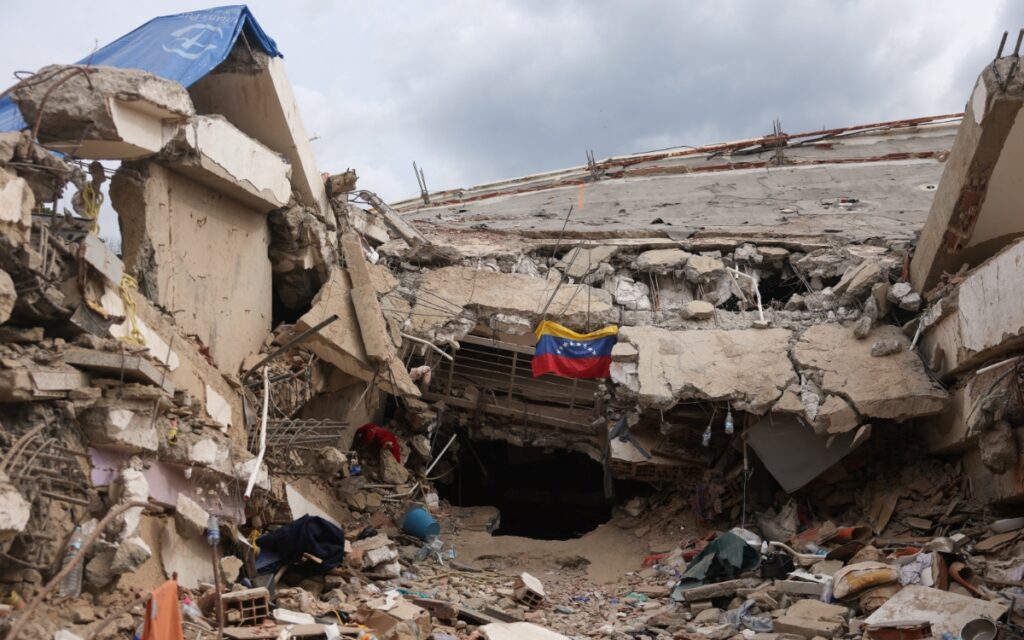
A Venezuelan flag hangs surrounded by debris, in the aftermath of the June 24 earthquakes, in Caraballeda, La Guaira state, Venezuela, July 9, 2026. Photo: Leonardo Fernandez Viloria/Reuters.
A Venezuelan flag hangs surrounded by debris, in the aftermath of the June 24 earthquakes, in Caraballeda, La Guaira state, Venezuela, July 9, 2026. Photo: Leonardo Fernandez Viloria/Reuters.
By Andreína Chávez Alava – Jul 10, 2026
Hours after two devastating earthquakes hit northern Venezuela on June 24, a brutal misinformation campaign took priority over the tragedy itself.
Thousands were still trapped under rubble. Families were grieving. A nation was reeling. Instead of responsible journalism, the tragedy became a feeding ground for vulture media outlets and social media operators who seized the chance to attack Venezuela, its people, and the Bolivarian project as the country lay vulnerable. The coordinated campaign turned victims into pawns in a political game where they were unknown participants.
The goal was to use the tragedy to portray the image of a failed state and pave the way for social unrest, a US invasion or anything that could overthrow the government. However, the media misinformation sat uncomfortably against the reality on the ground: the Venezuelan people’s solidarity and the joint efforts of national and international brigades to save lives.
An unprecedented catastrophe
At 6:04 pm on June 24, Venezuela suffered a double earthquake: a magnitude 7.2 followed almost immediately by a 7.5 — the strongest since 1900. The worst-hit areas were the entire coastline of La Guaira state and the capital, Caracas. In under a minute, people watched their loved ones disappear under the dust cloud that now covered their destroyed homes.
As is typical after major quakes, electricity, gas, and water outages hit La Guaira, parts of Caracas, and nearby states. Telecommunications failed too, from infrastructure damage and overload as people desperately tried to reach loved ones. By 7:10 pm darkness had fallen and when videos and news finally began to circulate, reality set in: horror and confusion.
In La Guaira, the densely populated coastline resembled Israel destroyed Gaza: cracked roads, fallen trees and power lines, people walking barefoot, half-dressed, crying, disoriented and injured, covered in dust, passing mountains of rubble where high-rise buildings once stood.
According to authorities, 190 buildings completely collapsed—158 of them in La Guaira. In total, 856 buildings were damaged or partially destroyed, 80 percent of which were private constructions. The Simón Bolívar International Airport and at least three hospitals suffered structural damage in La Guaira, Caracas, and Miranda state, according to the Pan American Health Organization (PAHO).
The last official report on July 9 accounted for 3,889 people dead, 16,740 injured, 17,907 homeless, and over 26,000 affected. Thousands remain missing, despite the Venezuelan government’s reluctance to speculate about that figure. The losses are extreme because the natural disaster was catastrophic.
A disaster beyond any state’s capacity
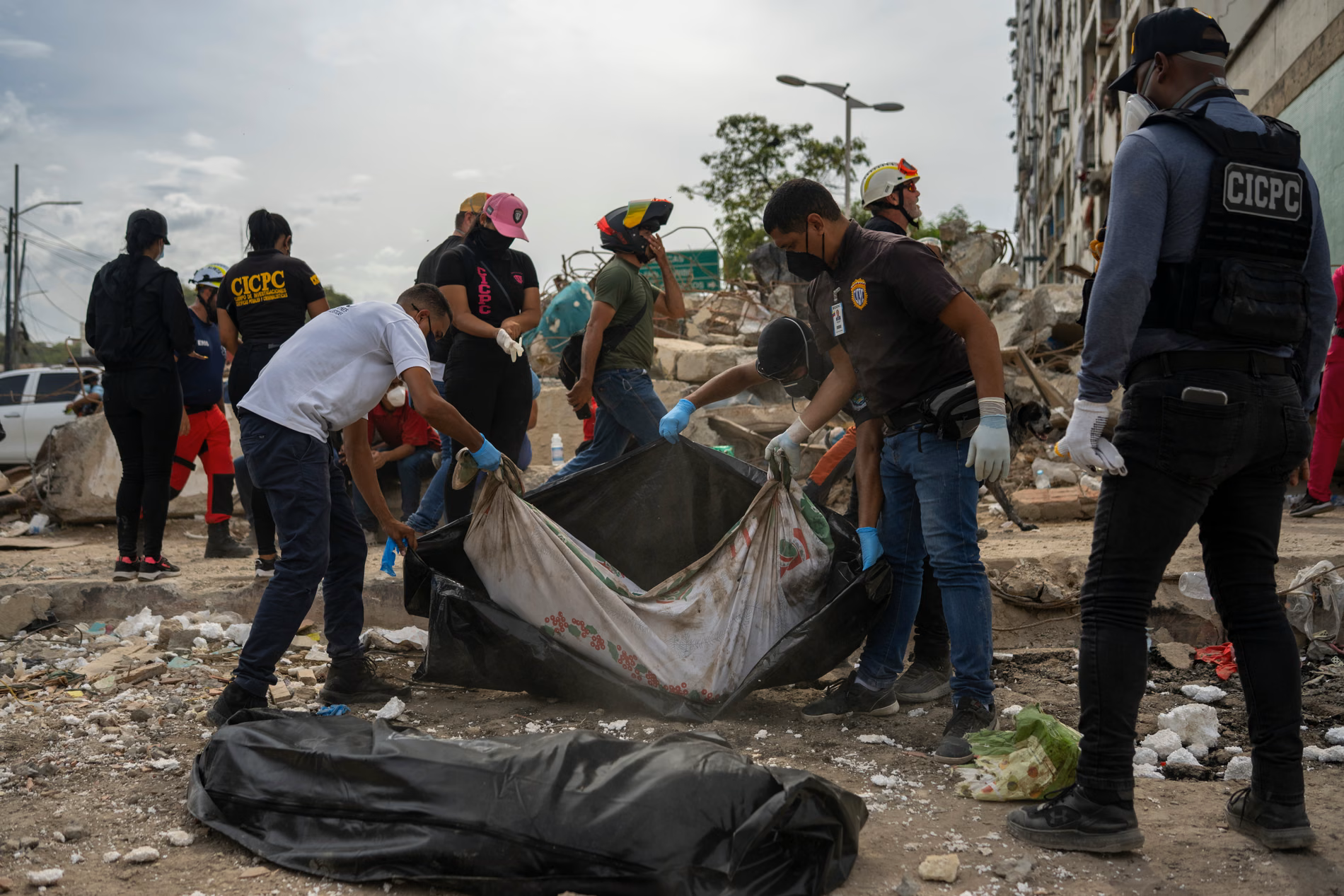
The buildings did not just collapse, they were pancaked—one floor crushed onto the next. The disaster zone was so vast that national and international teams could not reach all sites at once, leaving areas alone for hours or days. Brazil’s chief firefighter described the scene as a “war zone,” and Susana Arroyo of the International Red Cross said that she had never seen anything like it: “No country could face this alone.”
“We are dealing with a disaster, which means the territory’s capacity to respond has been overwhelmed,” said Alberto Hernández, leader of Colombia’s USAR COL-1, on June 28. His team, with a Venezuelan crew, had just saved an 11-year-old boy in a 6-hour operation.
Alan Gutiérrez of Mexico’s Topos MSR explained that a disaster of this scale, with whole neighborhoods flattened, “will always exceed the response capacity of any government, religion, or other entity.” In such situations, he said, unity becomes the priority—and “Venezuelans have been no exception.”
The catastrophe tested the limits of not only Venezuela’s emergency services (including firefighters, paramedics and healthcare facilities), which had already been weakened by a decade of US economic sanctions, but also those of the 44 international Urban Search and Rescue (USAR) teams deployed by the United Nations’ INSARAG and OCHA. This helps to explain why so many civilians rescue their own people with their bare hands for a few hours after the natural disaster, as seen in many other similar instances worldwide.
First heroes: the people themselves
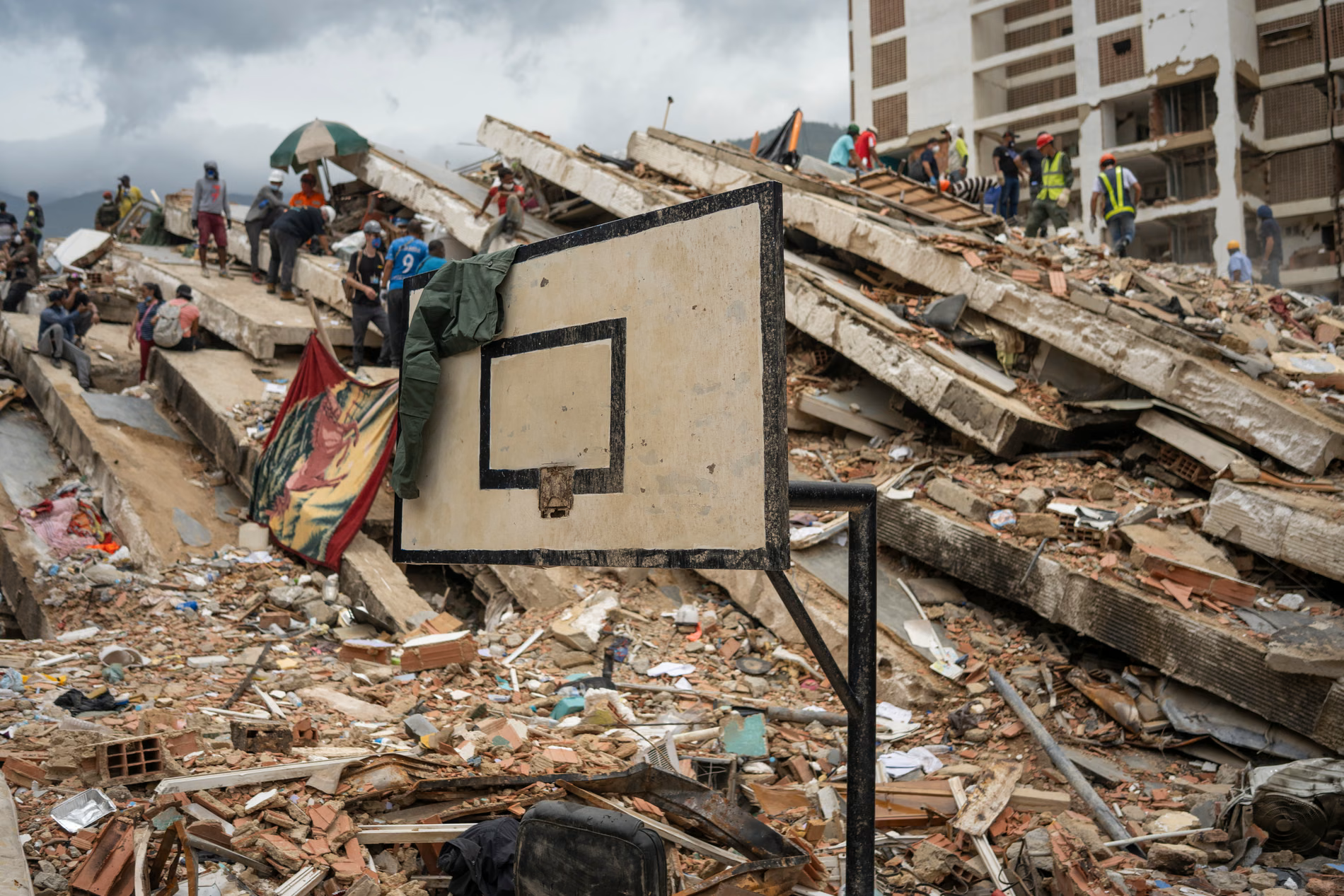
In tragedies worldwide — the 1999 earthquake in Turkey, the 2010 quake in Haiti, the 2015 quake in Nepal—it was families and civilians who became the true first responders. They dug through rubble with their bare hands, no helmets or gear, risking their lives to rescue loved ones and strangers, long before emergency services arrived.
The legendary Mexican rescue team “Topos Azteca,” currently assisting in Venezuela, was born this exact way. After the 1985 Mexico City earthquake, now 80-year-old Héctor “El Chino” Méndez rescued his own brother from the wreckage, then kept pulling out survivors alongside other untrained civilians, using only their bare hands. They later became a renowned trained rescue group that saves lives worldwide.
Venezuela has been no exception. For those trapped under the rubble, their rescue began immediately by their own families who knew their exact location and were already nearby. Many of these families worked alongside Venezuelan emergency and security forces, who were the first who arrived in those critical first two days, when the most rescues occurred.
One example is José Alberto Gallipoli, who walked from Macuto to Caraballeda—about 5 kilometes—the same night of June 24 to find his son Jofram, 4-year-old grandson Luciano, and daughter-in-law Oriana. He found the Palma Real building completely collapsed but could not see nor hear anything so he left and returned the next morning with a demolition hammer and chisel. A group of Bolivarian National Police (PNB) officers were already there rescuing a child from the same building. With their help, he confirmed his family was still alive, trapped in a concrete pocket inside the mountain of rubble.
“They started digging with buckets and their hands, pulling out debris, moving it aside. They worked from about noon until 10 at night [on June 25],” Gallipoli reported. “They gave me all their support, with honor, effort, and dedication. They managed to rescue my family alive.”
In an interview with Univision, Gianluca Rampolla, UN Resident Coordinator in Venezuela, flatly rejected that Venezuelan civilians rescuing their own was an isolated case ensued by state or UN neglect. “You can bet that in any major earthquake in recent years, you’ll see family members trying to rescue their own loved ones,” Rampolla said.
“Do the math,” Rampolla reaffirmed to a stubborn journalist, weighing the hundreds of buildings that collapsed against the hours, days even, that it takes to rescue one person. One example of this is the 192-hour rescue operation of 42-year-old Hernán Gil in Catia la Mar—an extraordinary feat involving Red Cross brigades from Venezuela, Chile, Costa Rica, El Salvador, Mexico, Portugal, and the US, working in shifts day and night.
“That’s not an excuse. It’s just reality,” he stated.
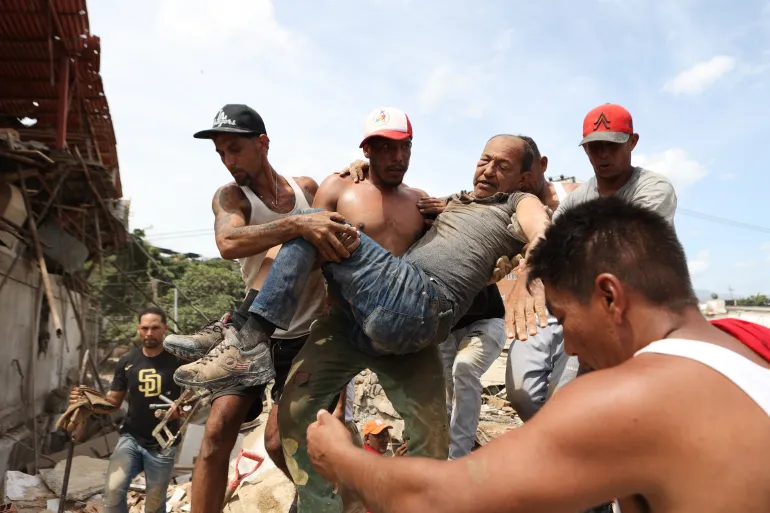
Rampolla also rejected the claim that Venezuelan authorities had obstructed international search and rescue personnel and aid. “There are absolutely no access barriers,” he said. “[After the earthquakes], the government immediately requested UN support to coordinate rescue operations, the humanitarian response and medical aid.” He added that USAR teams and its canine had been working alongside Venezuela’s Civil Protection from day one.
Venezuelan volunteer firefighter Víctor González explained the challenges on the ground, particularly the hours it took to verify the presence of potential survivors in only one building, and the emotional toll on families who desperately wanted rescuers to jump in and save their loved ones without understanding the risks and protocols involved. He described how some family members had ventured into the wreckage and become trapped due to asphyxiation or claustrophobia, which complicated rescue efforts. Many of them had to be rescued too.
If people saving people is true in every catastrophe in the world, why were the Venezuelan state and its emergency services being treated as failures, or even accused of conspiring against the victims of the earthquakes? Because a nation in which the military, police and civilians work together challenges the decades-long narrative of a repressive state.
What truly happened: a mobilized nation
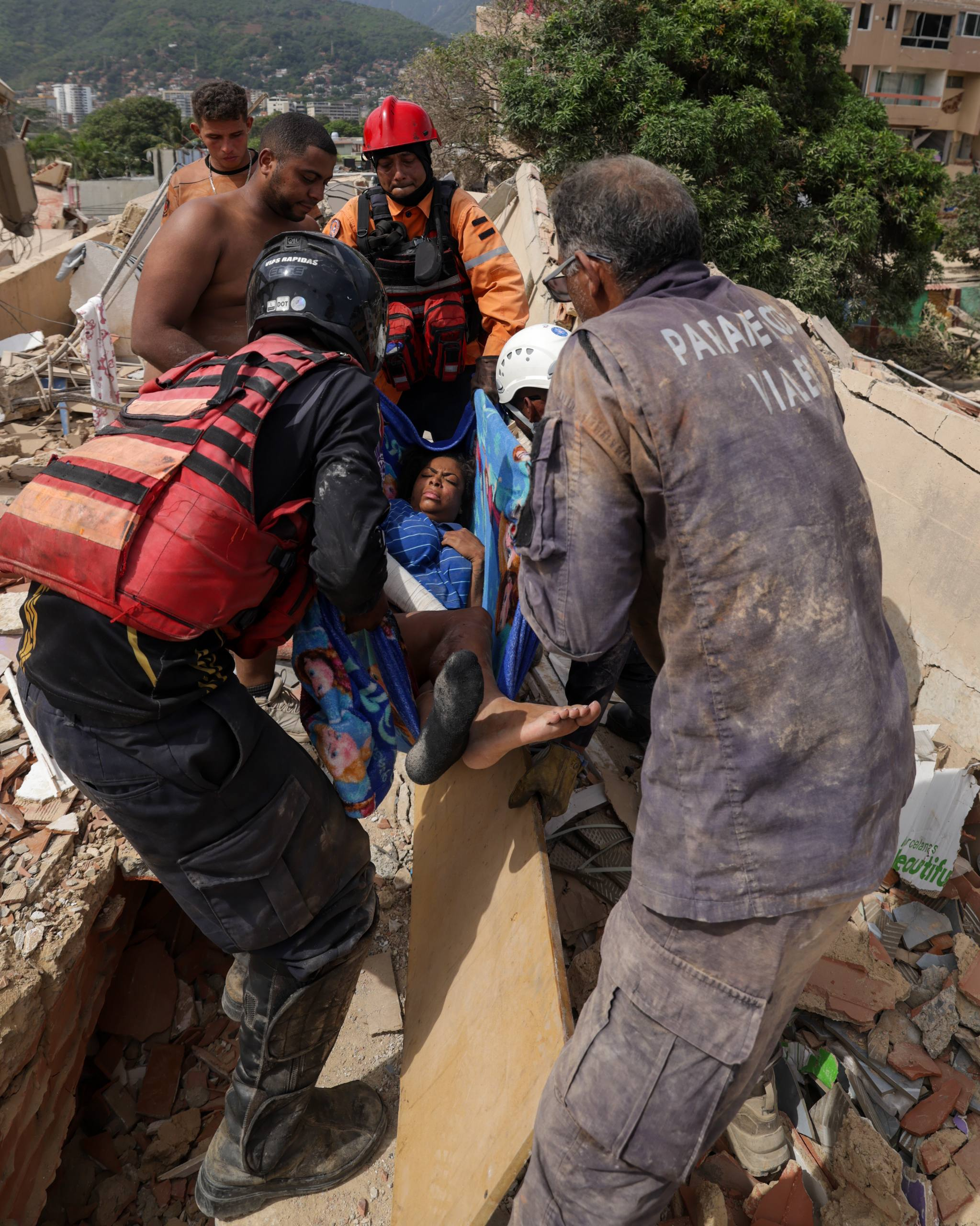
Within minutes of the double earthquake on June 24, roughly 13,400 to 13,500 people escaped La Guaira’s disaster zone on their own or with help from others.
At 9:39 pm, Acting President Delcy Rodríguez declared a National State of Emergency, confirming Caracas and La Guaira as the hardest-hit. Search and rescue were prioritized with Civil Protection and all emergency services activated, an international alert for help was sent out, security forces deployed, health workers called to their posts, and non-essential activities suspended. La Guaira’s airport was closed due to severe damage.
At 1:00 am of June 25, Rodríguez declared La Guaira—especially Catia la Mar and Caraballeda—as a “disaster zone” prioritizing the emergency response to that area. In the following 24 hours, 4,000 emergency workforce were deployed. Within 48 hours, that number reached 10,000, then rose to 19,000, then 26.121 until the current over 29,000.
It was this quick deployment that led to the highest number of rescued people in the first two days of the tragedy: Families and emergency responders and officers pulled 2,407 people from the rubble on day one, and 2,973 on day two.
The gradual increase in deployment is explained by the tragedy’s toll on the local emergency workforce itself. La Guaira’s fire chief, Lieutenant Colonel Oswaldo Vera, was rescued after 30 hours under rubble and lost his wife. The coastal state has roughly 500 firefighters and 1,500 police. Many of them, alongside local authorities, were killed, missing, or had lost loved ones and were dealing with the overall consequences of the quakes.
That is why reinforcements were necessary. However, the nearest states of Carabobo, Aragua and Miranda were also dealing with the (though lesser) aftermath of the quakes. Help had to be brought from further states, such as Mérida, Zulia, Falcón, Lara, Trujillo, and Táchira. The reinforcement began arriving on day two at the airports of Aragua and Carabobo, completing the trip to La Guaira and Caracas by other means.
The first international brigades also began to arrive on day two from the Dominican Republic, El Salvador, Mexico, Qatar and Switzerland. They landed outside of La Guaira as well while the Simón Bolívar airport continued to be evaluated for its severe damages.
On day three (June 26), 731 people were rescued. The Poliedro de Caracas opened as a Volunteer Registration Center run by the military to organize civilian support and solidarity, which had unintentionally led to traffic jams on the main highway from Caracas to La Guaira, causing delays for ambulances and other professional assistance. At least 26,984 volunteers were registered by skill, given QR-coded credentials, and collectively transported to affected areas. This organization saved time and resources.
On day four (June 27), Ramp 4 at La Guaira airport was restored, speeding up the delivery of international aid and the arrival of more rescue professionals. A total of 345 people were rescued that day. Over the first six days following the tragedy, Venezuelan and international brigades, supported by civilians who used their bare hands to clear debris, guide rescuers and provide food and water, saved 6,461 people.
Even though the timeframe for finding survivors has shrunk, rescue efforts continue. The emergency has, however, entered phase two: There are 80 transitory refugee camps that will need new housing. Over 22,000 patients have been treated in public hospitals, private clinics and international medical camps. Over 86,000 families are receiving support.
The key role of the military
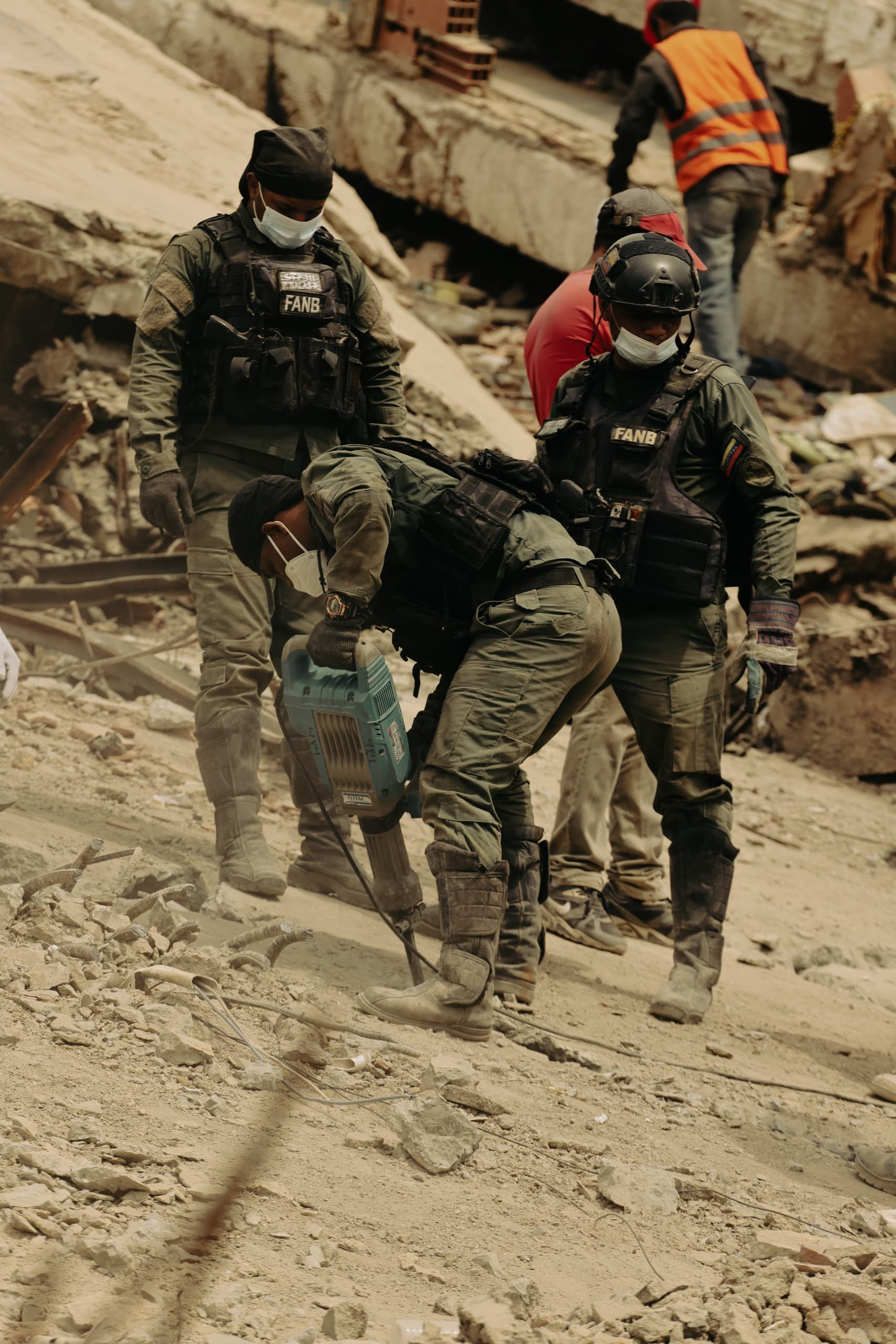
Venezuelan state security forces were on the ground from day one, but their work was much more extensive and went beyond search and rescue, of which they also heavily took part in. The Bolivarian National Armed Force (FANB), in particular, was in charge of organizing and distributing food and water, safeguarding the population, setting up refugee hospitals camps, transportation and clearing roads for rescuers, volunteers, ambulances and aid convoys, as well as flying patients out of the disaster zone, and more.
Throughout the entire media campaign, the FANB has been the most defamed. Many false allegations of harassment have been made by people abroad pretending to be in Venezuela. For example, the alleged Chilean volunteer rescuer Francisco Lermanda has given dozens of interviews, yet there is not one video of him in La Guaira or Caracas. Journalists have also reported cases of alleged military harassment against volunteer rescuers, despite the military simply preventing unregistered cars and motorcycles from accessing the disaster zone to limit sound pollution as professional rescuers were trying to hear signs of life.
Gavin Kersley of UKISAR (United Kingdom International Search and Rescue) stated directly to the press: “Local authorities and military have been supporting us with transport, fuel, and other amenities.” This was not an isolated testimony, but such statements were ignored.
The cognitive dissonance was alarming. Foreign journalists walked freely through La Guaira, showing the wreckage, interviewing victims and using press credentials given by Venezuelan authorities, while claiming state abandonment, censorship and harassment.
The inhumane media
In Venezuela, those responding at the community, national and international to save lives represented humanity at its best. In contrast, journalists forcing cameras in people’s faces at their most vulnerable moments, asking them to describe digging through rubble as proof of a negligent state, showed humanity at its worst.
This is the same media that chased Venezuelan migrants through the Darien jungle but never once mentioned the crippling US sanctions that decimated Venezuela’s economy. The same way now it condemns Venezuela’s insufficient emergency resources but does not say how US sanctions blocked the import of medical supplies of heavily affected key state infrastructure. The same media dismisses that since Washington kidnapped President Nicolás Maduro, it has taken around USD $8 billion in oil revenue while pledging 300 million in aid relief.
Corporate Vultures: Business Interests in US Earthquake ‘Aid’ to Venezuela
The sanctions death toll, an estimated 40,000 in 2017-18 and more than 100,000 in 2019, according to CERP and UN expert Alfred de Zayas, respectively, never received attention from the media, but the victims of the quakes are portrayed as the government’s fault.
The tragedy in Venezuela has laid bare the consequences of US sanctions while exposing the rot within a media that tramples on humanity in its relentless pursuit of confirmation bias.
AChA/OT

Andreína Chávez Alava is a Caracas-based Venezuelan journalist with over a decade of experience reporting on Venezuela's political landscape and its stance against US intervention. She has contributed to anti-imperialist narratives while working and colaborating with news outlets like Telesur, Venezuelanalysis, and Orinoco Tribune.