By Ben Norton – Nov 26, 2023
The West voted against the rest of the world on United Nations General Assembly resolutions, opposing democracy, human rights, and cultural diversity, while supporting mercenaries and unilateral coercive measures (sanctions).
Western governments frequently claim that their foreign and domestic policies are motivated by “human rights” and “democracy”. They often even lecture their adversaries for purportedly failing to respect these concerns.
But on the international stage, Western capitals have shown their commitments to be merely rhetorical, as they have consistently voted against these noble causes and refused to support measures that would tangibly protect them, in flagrant violation of the will of the vast majority of the international community.
These stark double standards were on display on November 7 in the meeting of the United Nations General Assembly’s Third Committee, which is devoted to social, humanitarian, and cultural issues.
In this three-hour session, the West opposed draft resolutions that called for promoting democracy, human rights, and cultural diversity, while simultaneously supporting the use of mercenaries and the application of unilateral coercive measures, commonly known as sanctions.
The extended West voted against the rest of the world on these issues. Its positions were virtually uniform as a bloc, led by the United States, including Europe, Canada, Australia, New Zealand, South Korea, and Japan.
In fact, the chair of the General Assembly’s Third Committee is Austria’s representative to the United Nations, Alexander Marschik, and even he could not help but laugh in the session at the constant protestations of the US representative, who dominated the debate, speaking out against nearly every resolution to explain why the world should join with Washington in voting against it. (Marschik could not contain his laughter despite the fact that his own country, Austria, voted along with the US on each resolution.)
Geopolitical Economy Report has created maps that illustrate the clear political divide between the West and the rest.
Sanctions
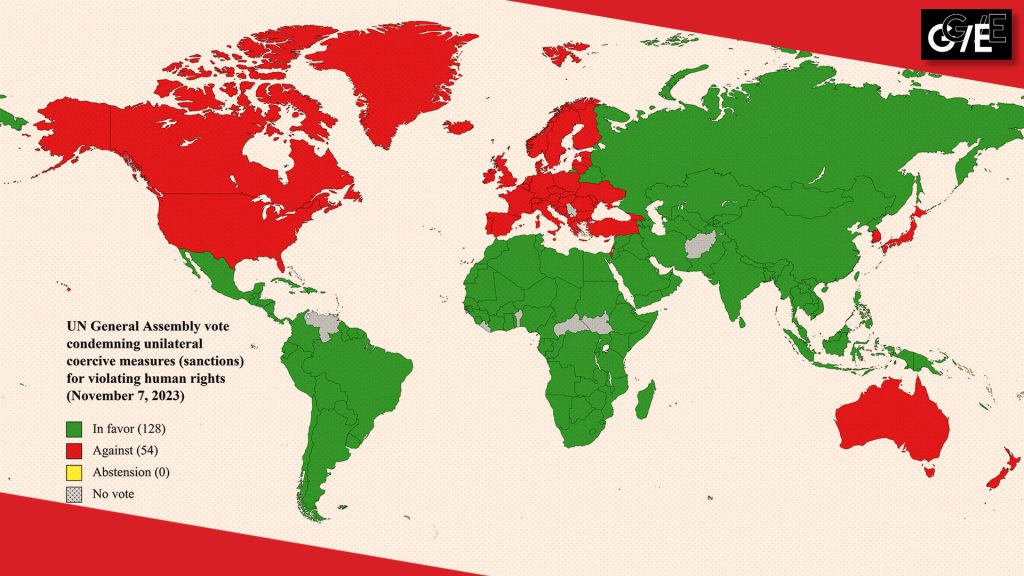
In the November 7 session, nations debated a draft that condemned unilateral coercive measures, or sanctions, for violating the human rights of civilians in targeted countries.
The resolution passed with 128 votes in favor and 54 against, and no abstentions.

Promoting “a democratic and equitable international order”
The General Assembly’s Third Committee likewise considered a measure that called for the “promotion of a democratic and equitable international order”.
The resolution passed with 123 votes in favor and 54 against, plus 7 abstentions (from Armenia, Chile, Costa Rica, Liberia, Mexico, Peru, Uruguay).


Shouldn’t the United Kingdom and France Relinquish Their Permanent Seats at the United Nations?
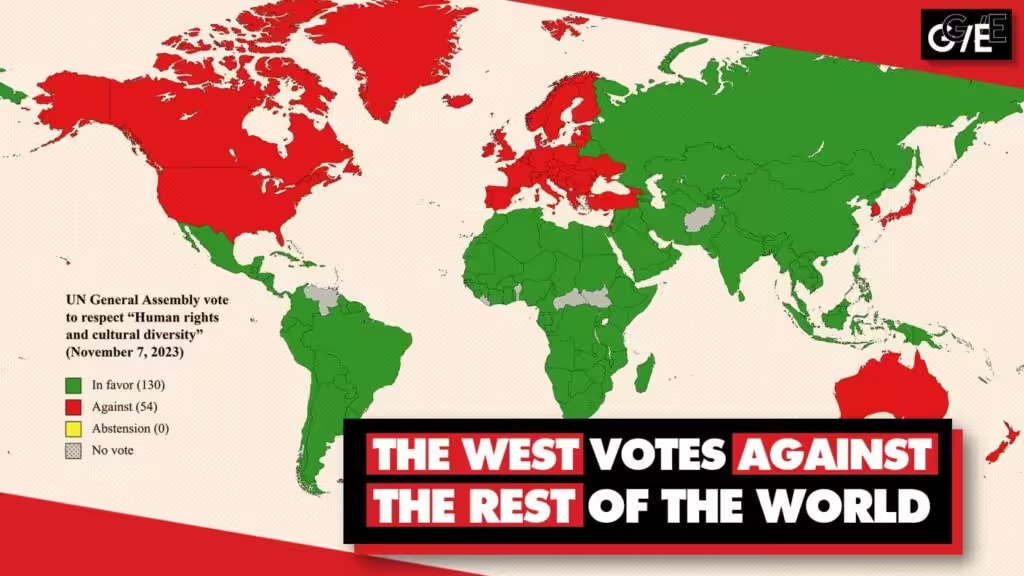
Respecting “human rights and cultural diversity”
Another resolution sought to promote “human rights and cultural diversity”.
The measure passed with 130 votes in favor and 54 against, and no abstentions.


Promoting “equitable geographical distribution” in human rights treaty bodies
The Third Committee deliberated a draft that called for the “promotion of equitable geographical distribution in the membership of the human rights treaty bodies”.
The resolution passed with 128 votes in favor and 52 against, and no abstentions.


Mercenaries
Another measure condemned the “use of mercenaries as a means of violating human rights and impeding the exercise of the right of peoples to self-determination”.
The resolution passed with 126 votes in favor and 52 against, plus 6 abstentions (from Kiribati, Liberia, Palau, Mexico, Tonga and Switzerland).


The United Nations published a full video of the Third Committee’s session on November 7, in the 48th plenary meeting of the General Assembly’s 78th session.

Ben Norton
Benjamin Norton is the founder and editor of the independent news website Multipolarista, where he does original reporting in both English and Spanish. Benjamin has reported from numerous countries, including Venezuela, Nicaragua, Bolivia, Ecuador, Honduras, Colombia, and more. His journalistic work has been published in dozens of media outlets, and he has done interviews on Sky News, Al Jazeera, Democracy Now, El Financiero Bloomberg, Al Mayadeen teleSUR, RT, TRT World, CGTN, Press TV, HispanTV, Sin Censura, and various TV channels in Mexico, Nicaragua, Venezuela, Ecuador, and Bolivia. Benjamin writes a regular column for Al Mayadeen (in English and Spanish). He was formerly a reporter with the investigative journalism website The Grayzone, and previously produced the political podcast and video show Moderate Rebels. His personal website is BenNorton.com, and he tweets at @BenjaminNorton.