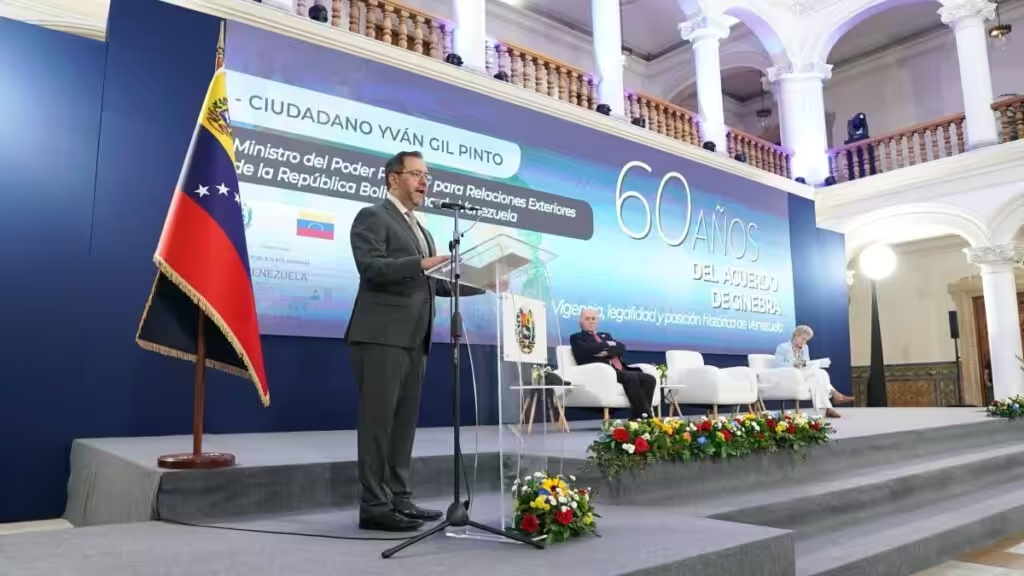
Venezuelan Foreign Minister Yván Gil speaks at the forum "60 Years of the Geneva Agreement: Validity, Legality, and Historical Position of Venezuela." Photo: Foreign Affairs Ministry of Venezuela.
Venezuelan Foreign Minister Yván Gil speaks at the forum "60 Years of the Geneva Agreement: Validity, Legality, and Historical Position of Venezuela." Photo: Foreign Affairs Ministry of Venezuela.
The foreign affairs minister of Venezuela, Yván Gil, highlighted the validity of the 1966 Geneva Agreement as the only legal means to resolve the controversy over the Essequibo region that Venezuela has with Guyana.
He emphasized that Venezuela will not respond to any use of force with similar measures, but through diplomatic mechanisms outlined in the Geneva Agreement.
Minister Gil made these statements furing the forum 60 Years of the Geneva Agreement: Validity, Legality, and Historical Position of Venezuela, held on Friday, February 19, at the Casa Amarilla, headquarters of the Venezuelan Ministry of Foreign Affairs. He stated that Venezuela defends its sovereignty through diplomacy and reason, rejects all attempt to impose force, and he reiterated that the nation has not desisted from its defense of sovereignty over the Esequibo territory.
He emphasized that the International Court of Justice (ICJ) lacks jurisdiction to resolve this territorial dispute in light of Guyana’s attempt to internationalize the conflict through a baseless lawsuit.
According to the foreign minister, the Geneva Agreement should be established as a global model for resolving territorial conflicts without the intervention of third parties, considering that the mediation of external factors often leads to decisions that do not satisfy the parties involved. “There is no third party, no court, no arbitration that can definitively resolve this controversy. It is not possible, it is not applicable,” he said.
Presentations by academics
Dr. Antonio Remiro Brotons, emeritus professor of Public International Law at the Autonomous University of Madrid and a lawyer at the International Court of Justice participated in the event.
Gil introduced the Spanish legal expert as a key authority to analyze the legal and political aspects that underpin Venezuela’s historical position.
The presentation by Dr Brotons, along with other specialists in the field, is part of the Venezuelan state’s agenda aimed at disseminating the legal grounds that invalidate the Paris Arbitration.
Gil concluded that direct dialogue is the only possible definitive path to reach a satisfactory agreement and fulfill the original spirit of the Geneva Agreement.
Venezuela Rejects Guyana’s Attempt to Distort Terms of 1966 Geneva Agreement
Consent is unavoidable for any judicial settlement
Another presenter, professor of Public International Law, María Esperanza Orihuela, explained that consent is unavoidable in the case of any judicial settlement.
She explained that the Geneva Agreement arose after the “connivance” of the 1899 Paris Arbitral Award, which Venezuela considers null and void, and emphasized that no nation can be forced to submit to the mediation or arbitration of the International Court of Justice without having previously expressed its will, as established by Article 36 of the ICJ’s own statute.
Orihuela criticized Guyana’s unilateral claim, highlighting that Article 4 of the 1966 Geneva Agreement obliges the parties to choose mutually agreed procedures and does not grant automatic powers to external courts.
She pointed out that Venezuela has maintained a historical policy of protecting its vital interests, a position that was recently ratified by the people of Venezuela in the consultative referendum of December 3, 2023.
Translation: Orinoco Tribune
OT/SC/DZ