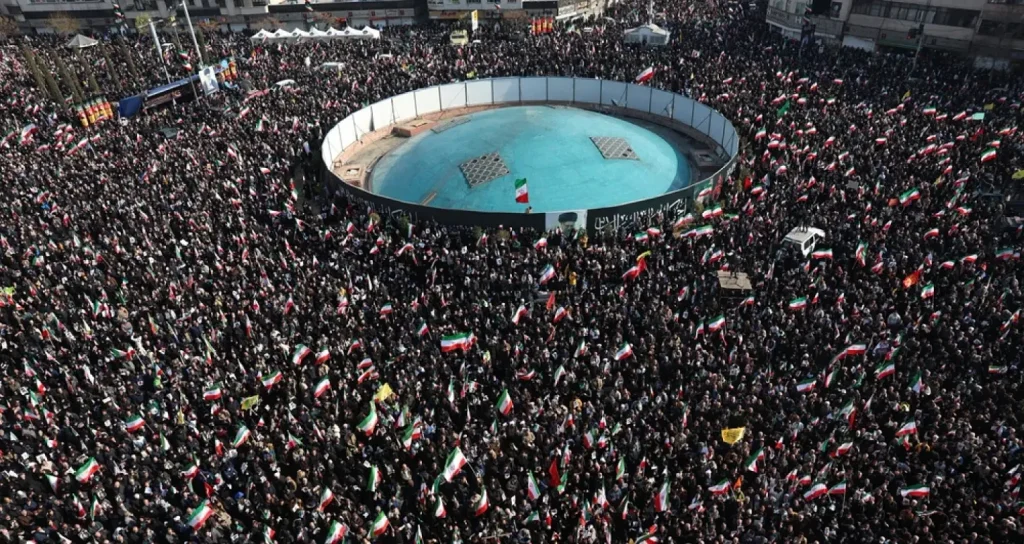
People gather in a rally to support Mojtaba Khamenei, the successor to his late father Ali Khamenei as supreme leader, in Tehran, Iran, Monday, March 9, 2026. Photo: AP.
People gather in a rally to support Mojtaba Khamenei, the successor to his late father Ali Khamenei as supreme leader, in Tehran, Iran, Monday, March 9, 2026. Photo: AP.
By Kit Klarenberg – Mar 15, 2026
The Zionist-American war on Iran was intended to be a lightning strike routing, fought exclusively from the air, lasting only a few days. Instead, Washington and its Israeli proxy have blundered into a major multi-front conflict, which could well threaten the Empire’s very existence. The initial US aerial bombardment’s centrepiece was Supreme Leader Ali Khamenei’s February 28th murder. Initially hailed by Western media as “the assassination of the century,” the vile act has resulted in catastrophe for the perpetrators.
The Islamic Republic’s relentless battering of Zionist entity civilian centres and military and intelligence infrastructure, and US bases throughout West Asia, hasn’t been deterred one iota. Vast crowds took to the streets of Tehran in vengeful mourning. Their righteous anger has pullulated throughout the Arab and Muslim world. Ever since, incensed Shiites have violently clashed with security forces in multiple major Pakistani cities. Meanwhile, Bahrain teeters on the brink of all-out revolution. Now, Mojtaba Khamenei, the slain Supreme Leader’s son, has taken his place.
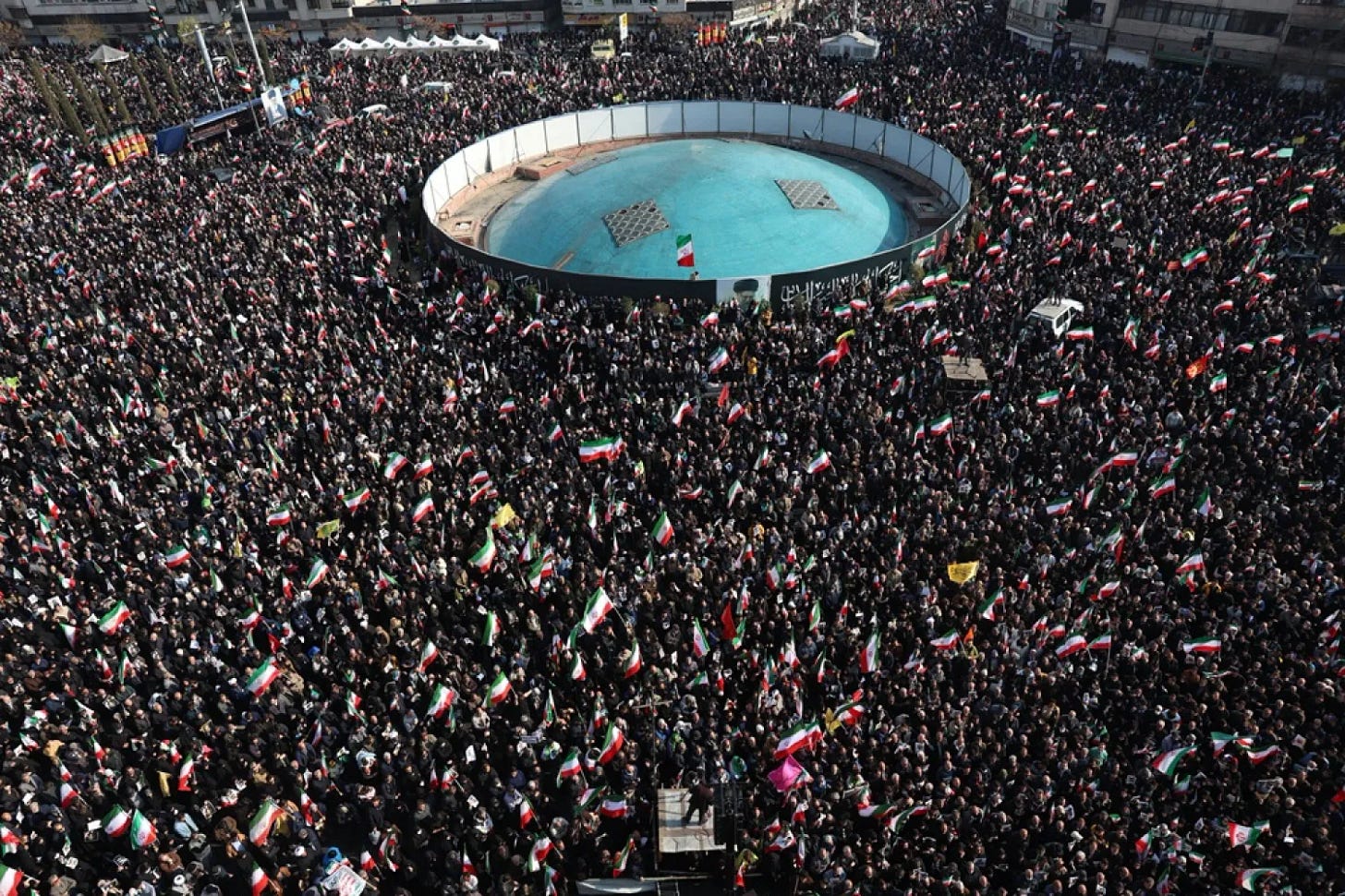
Iranian citizens of every ethnic and religious extraction braved US-Israeli airstrikes to celebrate his ascension. Commonly perceived as a hardliner with strong ties to the Iranian Revolutionary Guards Corps, expectation the new Supreme Leader will adopt a considerably less conciliatory, patient approach than his father is widespread. Western sources forecast Mojtaba may decide the Islamic Republic “must move quickly to obtain nuclear weapons in order to forestall future US and Israeli attacks,” overturning Ali Khamenei’s longstanding fatwa against their development by Tehran.
US President Donald Trump has declared he is “not happy” with Mojtaba taking power, and Israeli apparatchiks are likewise perturbed by the development. Nonetheless, this was an inevitable upshot of assassinating the former Supreme Leader. There was also no reason to believe doing so would precipitate the Islamic Republic’s collapse, or lead to Tehran’s military submission. It begs the obvious question of why Washington and Tel Aviv electively helped install a ruler more committed than ever to expelling the Empire from West Asia.
Similarly, Hezbollah’s extraordinary broadsides of the Zionist entity since Khameinei’s assassination should dispel any notion – as perpetuated by Israeli political and military chiefs – the group was obliterated by Tel Aviv’s criminal October 2024 invasion of Lebanon. That incursion was prefaced by an operation in which thousands of pagers used by senior Hezbollah operatives were detonated simultaneously, having been wired with explosives by Mossad pre-purchase, killing and injuring many. A week-and-a-half later, the group’s Secretary General Hassan Nasrallah was lethally targeted in a Zionist entity airstrike.
Evidently, the Resistance cannot be crushed via high-level assassinations. In fact, such actions actively strengthen its members. This inconvenient reality has been well-known to the CIA since at least 2009. In July that year, the Agency produced a top secret assessment laying out the pros and cons of liquidating “high value targets” (HVTs). It was prepared in advance of Barack Obama’s CIA chief Leon Panetta shifting US “counter-terror” operations from capturing and torturing high-level suspects, to outright executing them.
The assessment concluded HVT operations “can play a useful role when they are part of a broader counterinsurgency strategy,” and sought to “assist policymakers and military officers involved in authorizing or planning” such strikes. However, it listed many “potential negative effects” of “high value” assassinations. Israel’s past killing of Hamas and Hezbollah leaders were specifically cited as examples of how the strategy can spectacularly backfire. We have witnessed the CIA’s unheeded cautions play out in real-time since February 28th.
Under Fire, Not Divided: Why Iran’s Ethnic Front Has Not Cracked
Foremost among prospective blowback from HVT operations is the risk high-level assassinations can increase an “insurgent” group’s support. This occurs when killing a target “[strengthens] an armed group’s bond with the population, radicalizing an insurgent group’s remaining leaders, creating a vacuum into which more radical groups can enter, and escalating or deescalating a conflict in ways that favor the insurgents.” Such actions can also “[erode] the ‘rules of the game’ between the government and insurgents,” thus exacerbating “the level of violence in a conflict”:
“HVT strikes…may increase support for the insurgents, particularly if these strikes enhance insurgent leaders’ lore, if noncombatants are killed in the attacks, if legitimate or semi-legitimate politicians aligned with the insurgents are targeted…An insurgent group’s unifying cause, deep ties to its constituency, or a broad support base can lessen the impact of leadership losses by ensuring a steady flow of replacement recruits.”
The CIA assessment noted several historical instances of supposed HVT successes. When high-level targets have “prominent public profiles”, assassinations can in specific instances shatter a target group. However, this was not the case with Hamas or Hezbollah. The pair “carry out state-like functions, such as providing healthcare services,” so higherups are well-known to citizens of Gaza and Lebanon. Yet, their “highly disciplined nature, social service network, and reserve of respected leaders” mean they can easily “reorganize” in the wake of assassinations.
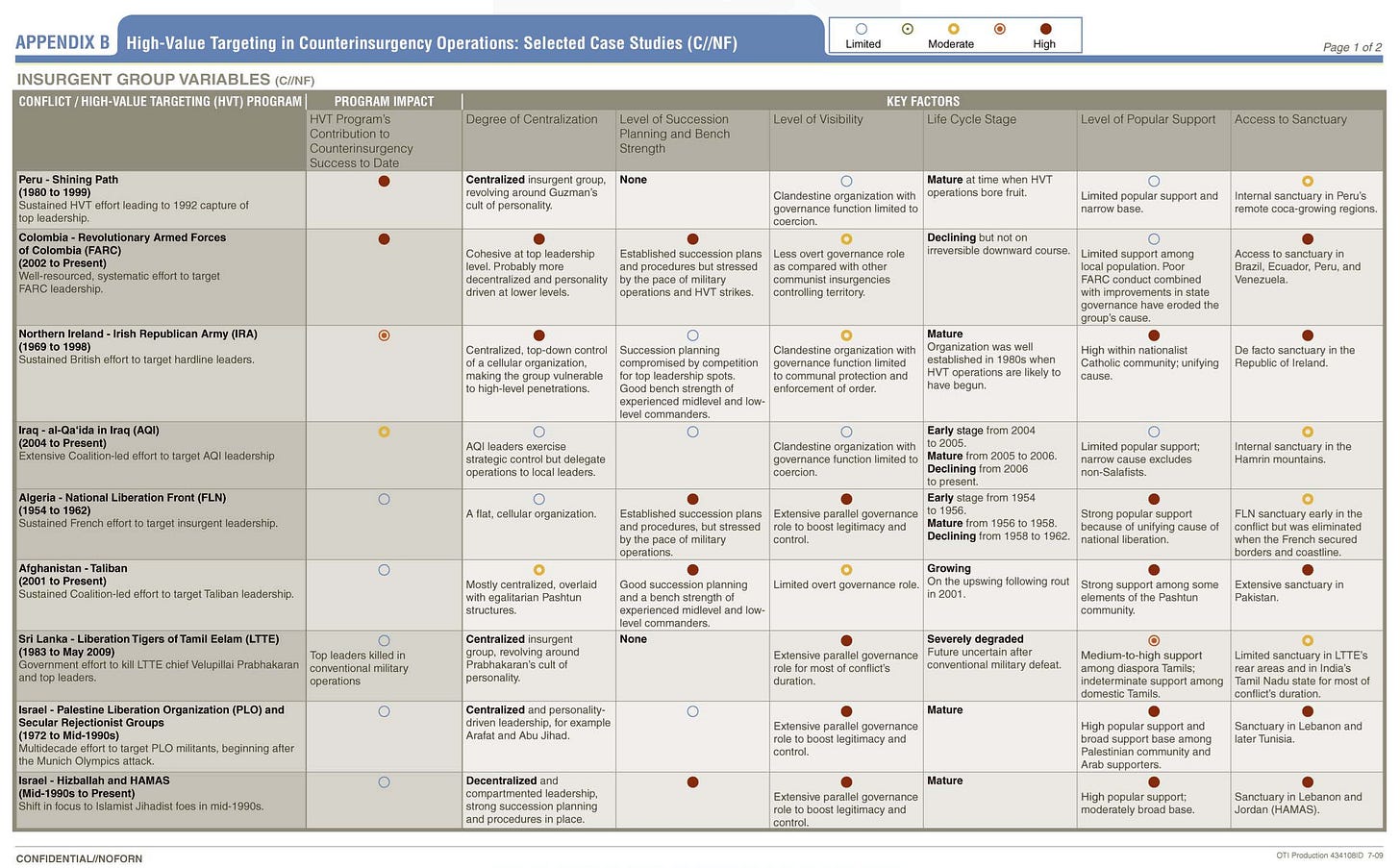
The Zionist entity had by this point been engaged in “targeted-killings” against Hamas, Hezbollah, and other Resistance groups since the mid-1990s. However, their “decentralized command structures, compartmented leadership, strong succession planning, and deep ties to their communities” made them “highly resilient to leadership losses.” Undeterred, Tel Aviv’s high-level assassinations continued apace. In the early 2000s, Hamas founder Sheikh Yassin and the group’s leader in Gaza Abdel Aziz al-Rantisi were murdered. However, the killings “strengthened solidarity” between Resistance factions, while “[bolstering] support for hardline militant leaders.”
The obvious lessons of this wanton bloodletting remained unlearned by the Zionist entity, once the Gaza Holocaust erupted. In June 2024, elite imperial journal Foreign Affairs published a report unequivocally headlined Hamas Is Winning. It boldly concluded “Israel’s failing strategy makes its enemy stronger.” The outlet also recorded how “according to the measures that matter,” Hamas was considerably bigger and more powerful than on October 7th 2023. Israel had thus stumbled into a deeply ruinous attritional war, with a “tenacious and deadly guerrilla force.”
Hamas’ surging popularity with Palestinians throughout the Gaza genocide was found to have significantly enhanced the group’s “ability to recruit…[and] attract new generations of fighters and operatives.” This granted Hamas the ability to launch “lethal operations” in areas previously “cleared” by the IOF “easily”. Foreign Affairs charged the Zionist entity, to its “great detriment”, failed to comprehend how “the carnage and devastation it has unleashed in Gaza has only made its enemy stronger.”
It is not merely Hamas that has been galvanised by the Gaza genocide. Israel’s “carnage and devastation” has greatly expanded the ranks and resolve of the entire Resistance, while its constituent members have won hearts and minds globally in ever-mounting numbers. Tel Aviv and its Anglo-American puppetmasters have no good choices left to make, in a criminal war of choice aged against an indefatigable adversary committed to total victory, the likes of which they have never faced before.
The calamitous outcomes of Zionist-American conflict with Iran were amply spelled out in a June 2025 report by the Israel-based Institute for National Security Studies. Among its prescriptions, INSS cautioned against assassinating Ali Khamenei, as the Islamic Republic “would likely have little difficulty selecting a successor, who could prove to be more extreme or more capable,” while uniting the Iranian public and government more than ever. The consequences of disregarding this prophetic curse will reverberate throughout West Asia for centuries.

Kit Klarenberg is an investigative journalist exploring the role of intelligence services in shaping politics and perceptions.