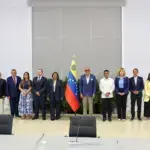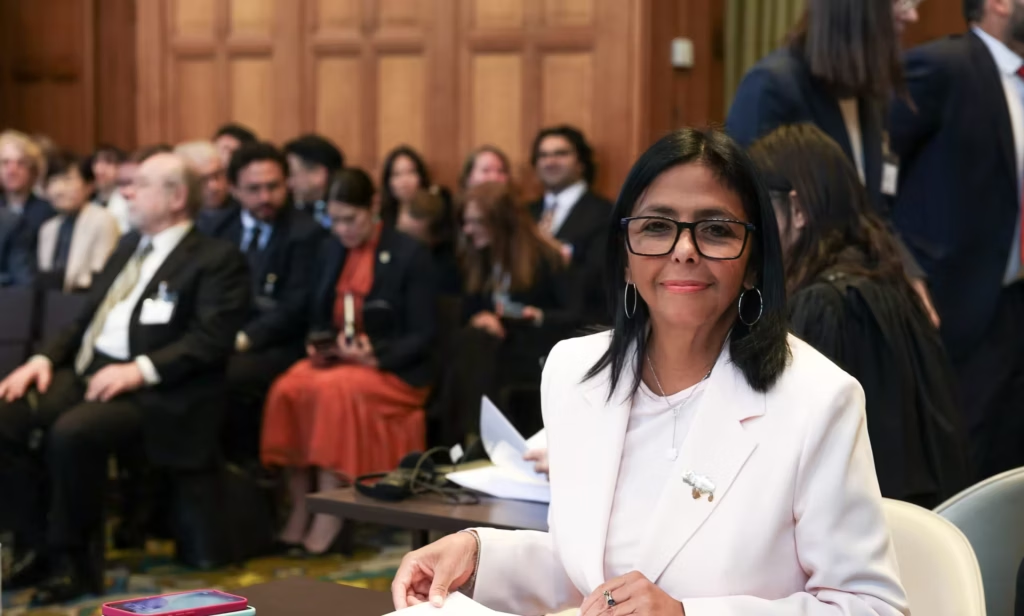
Acting President Delcy Rodríguez defends Venezuela’s historical rights over the Essequibo in person at the ICJ on Monday, May 11, 2026. Photo: X/@maduroguerra.
Acting President Delcy Rodríguez defends Venezuela’s historical rights over the Essequibo in person at the ICJ on Monday, May 11, 2026. Photo: X/@maduroguerra.
In a high-level diplomatic display, Venezuelan Acting President Delcy Rodríguez appeared before the International Court of Justice (ICJ) on Monday, May 11. There, she presented the fundamental arguments supporting Venezuela’s historical rights over the Essequibo region. During her address, the acting president emphasized that Venezuela is the only party with a legitimate claim to the region of nearly 160,000 square kilometers, rich in natural resources and currently under the administration of Guyana.
The session, described as “historic” by the Venezuelan delegation, represents a new chapter in the century-old dispute. Rodríguez arrived in The Hague with the mandate to defend the “majesty and vigor” of the 1966 Geneva Agreement. The agreement was recognized by all the parties, and Venezuela considers it the only valid legal framework for negotiating a solution, in contrast to the 1899 Paris Arbitration Award.
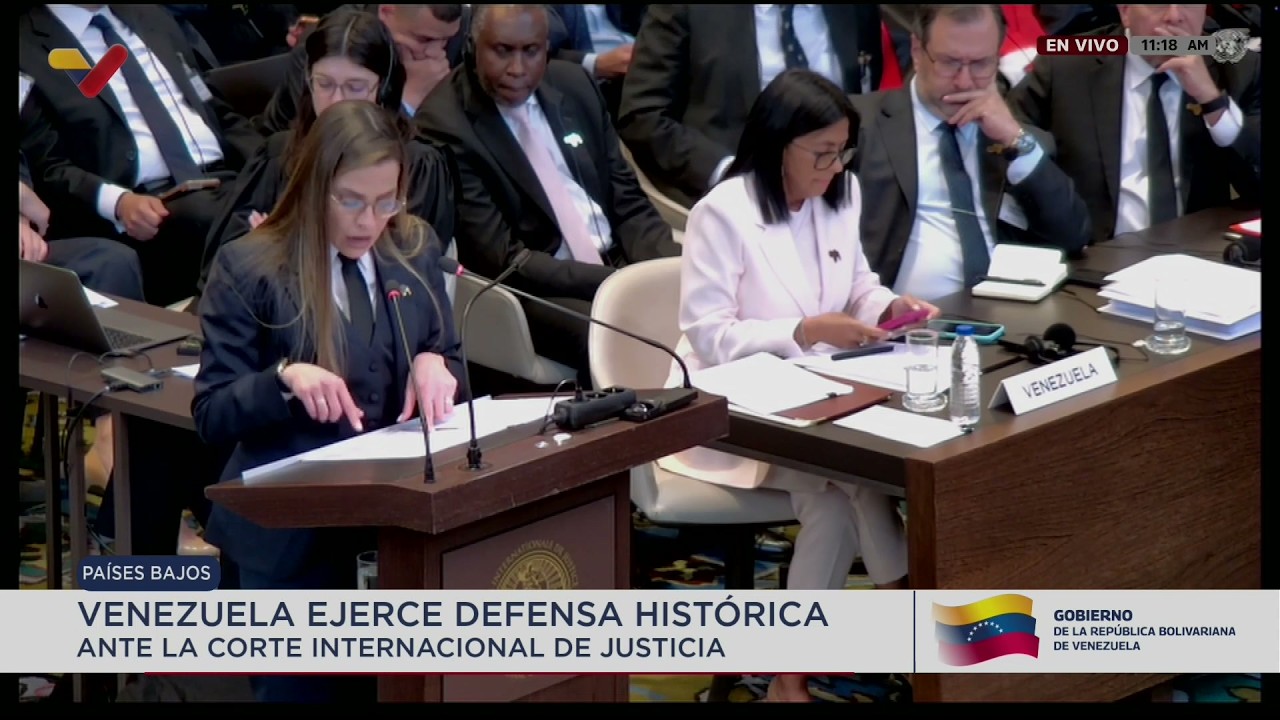
During her speech, Rodríguez stated that the presence of the Venezuelan delegation does not imply recognition of the court’s jurisdiction to resolve the dispute, but rather serves to defend sovereignty against an “absurd and unlawful act” promoted by Guyana.
The acting president condemned Guyana’s abandonment of good faith and the logic of a mutually acceptable solution, instead adopting an illicit strategy of judicialization when transnational oil corporations found oil in 2015.
It was also noted that the Guyanese delegation opted to raise personal disqualifications against the Venezuelan delegation in the previous sessions. According to the Venezuelan president, it demonstrates the lack of arguments supporting Guyana’s claim while reiterating that Venezuela will not fall to that level.
Delcy Rodríguez stressed that direct negotiation is the only viable option to resolve a dispute that affects the future of two neighboring nations whose destinies are inevitably intertwined by geography.
A centuries-old dispute and Venezuela’s position
The dispute over the Essequibo region has intensified in recent years following the discovery of significant oil and gas deposits in maritime waters adjacent to the disputed territory. While Guyana urges the International Court of Justice (ICJ) to uphold the 1899 award to resolve the land border controversy, the 1966 Geneva Agreement clearly stipulates that the 1899 award is null and void. The 1966 agreement stipulates that a practical, mutually acceptable solution must be sought through direct negotiation between the two countries.
In this context, the presentation by the Venezuelan delegation, led by Delcy Rodríguez, sought to block Guyana’s claim that the ICJ should rule on the case, respectfully arguing that the court lacks jurisdiction to decide on the issue.
Composition of the delegation and official reactions
Accompanying the Acting President Rodríguez on this diplomatic mission are Solicitor General Arianny Seijo, Venezuelan Representative to the ICJ Samuel Moncada, and a renowned team of international jurists: Professors Paolo Palchetti, Christian Tams, Jean-Marc Thouvenin, Andreas Zimmermann, and Makane Mbengue.
Upon her arrival in the Netherlands, Delcy Rodríguez stated that it is “a great honor, both as a Venezuelan and as acting president, to raise my voice on behalf of all the Venezuelan people.” The acting president reiterated that her presence stems from an “unavoidable commitment to the defense of legality and justice,” reaffirming Venezuela’s position as a nation governed by international law and seeking a peaceful solution to the dispute.
“The Bolivarian government reaffirms its unwavering stance on the absolute validity of the 1966 Geneva Agreement,” the official statement reads. It adds that the agreement was specifically designed to overcome the irregularities of the 1899 Arbitral Award.
(Alba Ciudad) with Orinoco Tribune content
Translation: Orinoco Tribune
OT/JRE/SF