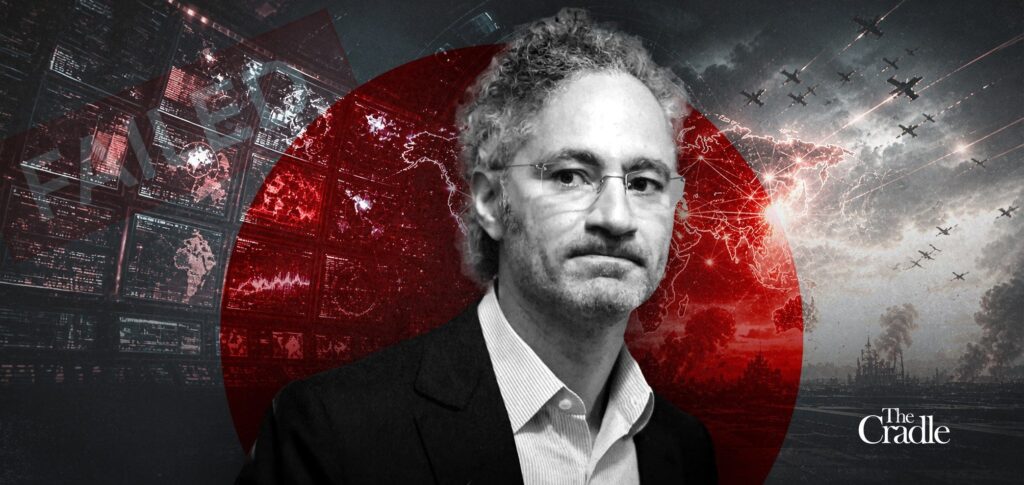
A visual composition featuring a photo of Palantir CEO Alex Karp superimposed over imagery of war and technology. Photo: The Cradle.
A visual composition featuring a photo of Palantir CEO Alex Karp superimposed over imagery of war and technology. Photo: The Cradle.
By Anis Raiss – May 4, 2026
Alex Karp’s AI manifesto exposes an empire trying to turn algorithmic warfare into doctrine just as the multipolar world learns to answer in its own code.
In Hans Christian Andersen’s tale, the emperor parades naked through the city until a child says what everyone else is too afraid to admit. On 18 April 2026, Palantir CEO Alex Karp staged his own parade. Palantir posted his 22-point manifesto on X, and within days it had drawn 32 million views. Scholars called it technofascism.
Outside the Atlanticist seminar room, the verdict was simpler. The empire’s Artificial Intelligence (AI) doctrine had exposed itself.
The manifesto arrived as a system error from a collapsing order, selling algorithmic domination just as the multipolar world was proving it could no longer be commanded from Washington, Tel Aviv, or Silicon Valley.
Beneath the swagger sat a simpler fear. Empire’s machines are no longer the only ones running. The panic sits in the document’s polished certainty, in its belief that code can restore the discipline that fleets, sanctions, and bombing campaigns no longer impose.
What follows is what the manifesto already admits.
Fascism in product language
The 22 points were no accident. They condensed Karp’s 2025 book ‘The Technological Republic’ – co-authored with Palantir’s head of corporate affairs, Nicholas Zamiska, and published by Crown Currency. Palantir’s communications team pushed the summary through the corporate X account, where it gathered tens of millions of views.
Cas Mudde, among the most cited scholars on the global far right, called it “Technofascism pure!” Greek economist Yanis Varoufakis answered with a single line: “If Evil could tweet, this is what it would!” From Vienna, the philosopher Mark Coeckelbergh reached the same diagnosis.
Celine Castets-Renard, Canada Research Chair in International AI Law at Ottawa, went further: a “dystopian, techno-fascist vision of the world.” Tim Squirrell of Foxglove told The Guardian the document read as “the ramblings of a supervillain.”
The historian Tarik Cyril Amar went furthest. He named the manifesto for what its structural ancestor was: Alex Karp’s Mein AI – Hitler’s Mein Kampf updated for the algorithmic age.
The irony is almost too neat. Karp earned his PhD in social theory at Frankfurt’s Goethe University in 2002, in the intellectual home of Adorno and Habermas, the school that produced some of the deepest analyses of how fascism takes hold, from The Authoritarian Personality to Dialectic of Enlightenment.
The manifesto Karp’s company has now published is what scholars from that same school would recognize as fascism in its newest form.
The first AI war
To read the manifesto properly, you have to know what Palantir was doing in the weeks before Karp posted it.
On 28 February 2026, the US and the occupation state launched ‘Operation Epic Fury,’ the first large-scale military campaign substantially run by AI.
By 9 April, US Central Command (CENTCOM) had reported more than 13,000 strikes against Iranian targets, with 1,000 hit on the opening day alone. The platform doing the work was Palantir’s Maven Smart System, which fused satellite imagery, drone footage, and signals intelligence to “identify, prioritize and recommend strike packages against Iranian military sites, nuclear facilities and leadership targets.”
Palantir CTO Shyam Sankar told Bloomberg TV in March that the war would be remembered as “the first major conflict where artificial intelligence played a central role.”
CENTCOM commander Admiral Brad Cooper confirmed it on the record: “Our war fighters are leveraging a variety of advanced AI tools. These systems help us sift through vast amounts of data in seconds.”
Maven generated more than 3,000 targeting options against Iran in 24 hours during the opening phase. Kill-chain expert Craig Jones told Vision of Humanity that the system had compressed targeting decisions to a tempo “much quicker in some ways than the speed of thought.”
Philosopher Elke Schwarz, speaking with France 24, calculated that during the first 24 hours, US forces launched approximately 41 missiles per hour, making “meaningful human oversight practically impossible.”
Maven’s target classification accuracy hovered around 60%, against 84% for trained human analysts. The Shajareh Tayyebeh Primary School in Minab was struck during the same campaign. It killed at least 175 people, most of them schoolgirls between the ages of seven and 12.
Was this one of Maven’s misclassifications? The Pentagon has not said. Iran’s Islamic Revolutionary Guard Corps (IRGC) responded on 31 March by publishing a list of 18 American technology companies – Palantir, Google, Microsoft, Nvidia among them – and declaring their facilities in West Asia “legitimate targets.”
That is the war into which the manifesto was released. Karp wrote his 22 points with the blood still on the interface.
Where the doctrine exposes itself
Point 12 of the manifesto reads, “The atomic age is ending. One age of deterrence, the atomic age, is ending, and a new era of deterrence built on AI is set to begin.”
The 56-day war Karp’s stack had just helped fight was a war over Iranian atomic facilities. Read the two facts together, and the contradiction is total. If the atomic age has ended, why did Washington and Tel Aviv wage 56 days of war over Iranian atoms? If those facilities mattered enough to bomb, then point 12 collapses under its own claim. Karp cannot square the two claims without indicting one of them.
Points 21 and 22 give the answer. “Some cultures have produced vital advances; others remain dysfunctional and regressive,” the manifesto declares. “We must resist the shallow temptation of a vacant and hollow pluralism.”
The war was never about uranium. Iran is a signatory to the Non-Proliferation Treaty (NPT); the occupation state is not. Iran was bombed for its program; the occupation state holds 90-plus warheads undisturbed.
Point 21 supplies the philosophical rationale for that asymmetry.
Iran’s nuclear sites were treated as targets because they marked sovereignty. The manifesto attacks the right of civilizations that point 21 calls “dysfunctional and regressive” to claim equal standing. That doctrine speaks clearly enough. That is the doctrine. The contradiction in point 12 is not a flaw in the document. It is the document’s confession.
Two source codes, one world slipping away
The manifesto cannot recognize its own self-deception, because that deception holds the whole document together. Karp writes as though the west still owns the world’s source code. He sounds like a driver who has not checked the mirrors in years, while the multipolar world has already overtaken him in the blind spot, with China leading, Russia and Iran beside it, and Central Asia filling the lane he thought was empty.
Iran has spent the past three years building the architecture that Karp’s manifesto exists to break. Tehran joined the Shanghai Cooperation Organization (SCO) in 2023 and BRICS+ in 2024. It signed a strategic partnership with Russia in January 2025 and a 25-year framework with China in 2021. Pakistan brokered the ceasefire that closed ‘Operation Epic Fury.’ Multipolar diplomacy ended the war that Maven was supposed to win.
Behind that political architecture sits a parallel technological one. Mininglamp (明略数据), Tencent-funded since 2014, has been building what the South China Morning Post describes as China’s Palantir, with more than 200 Fortune 500 clients and national AI champion status conferred by Beijing alongside Huawei.
Stargate (摄星智能), founded in 2018, builds what its own corporate literature calls “tactical-level combat strategy auto-generation systems” for the People’s Liberation Army (PLA) – Maven without the manifesto. Behind them sit 4Paradigm, Deepexi, Jing’an, Utenet, Stonehenge, plus Huawei and Baidu’s heavyweight defense-AI programs.
Chinese economic press has arrived at the same diagnosis. The Economic Observer in March 2026 analyzed Palantir as a prototype of “algorithmic hegemony,” writing that capital had declared the priority of algorithmic hegemony over steel deluges.
Chinese military AI has already been validated in the 2025 India–Pakistan conflict, holds more than 30% of the drone-AI market across West Asia and Africa, and is on course to make China a top-three weapons exporter by 2030, with AI-enabled systems exceeding 40% of that share.
The Chinese model diverges sharply. Mininglamp Vice President Menglin Li acknowledges this directly, explaining that Palantir embeds its own engineers inside US government agencies, turning the company into part of the state apparatus. Chinese firms cannot do that, because the PLA does not let them.
They build software that runs on the customer’s terms, without the vendor moving in. Industry analyst Zhang Chi adds that no Chinese enterprise would sign the billion-dollar consulting contracts attached to Palantir’s deployment model.
China offers a parallel route, rather than a copy of Palantir. For Iran, Pakistan, Algeria, and every state Karp’s manifesto would classify as regressive, this matters because they can now buy military-grade AI without first applying for civilizational citizenship from Washington. That is the structural defeat that the 22 points cannot admit.
Wolfowitz in source code
Karp inherited this doctrine and privatized it.
In February 1992, then-under secretary of defense Paul Wolfowitz drafted the Defense Planning Guidance for fiscal years 1994–1999. The document leaked to the New York Times (NYT) the following month. Its core instruction was blunt: “Our first objective is to prevent the re-emergence of a new rival.” Wolfowitz’s text was rewritten after public outcry. The original became the operating logic of US foreign policy for three decades.
Wolfowitz wrote it in a memo. Karp writes it in source code. The doctrine remains fixed on preventing multipolarity by every available means. The executor has changed. Wolfowitz needed policymakers, generals, and ambassadors. Karp’s company executes the doctrine itself 60% of the time. The other 40% lands somewhere.
The system has its hardest time, IBTimes reports, distinguishing military from civilian infrastructure in dense urban terrain. The Shajareh Tayyebeh Primary School in Minab is in dense urban terrain.
Andersen’s child never needs to shout. The child only has to say what is. The multipolar world said it on 31 March, when Iran named Palantir a legitimate target. It said it again on 8 April, when the war ended without the outcome Karp’s stack promised. It says it every day Iran remains standing, and every day China ships the alternative.
We use cookies to improve your experience. By continuing, you agree to our Privacy Policy.