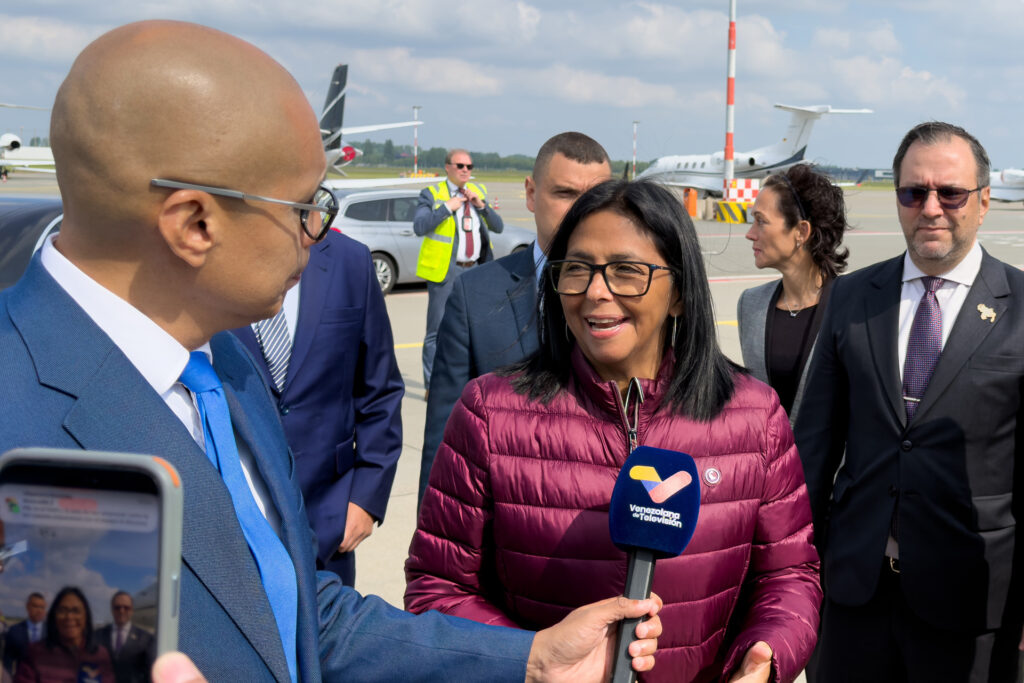
Venezuela's Acting President Delcy Rodriguez upon arrival to the Netherlands to participate in the ICJ session on the Essequibo Territory dispute. Amsterdam, Sunday, May 10, 2026. Photo: EFE.
Venezuela's Acting President Delcy Rodriguez upon arrival to the Netherlands to participate in the ICJ session on the Essequibo Territory dispute. Amsterdam, Sunday, May 10, 2026. Photo: EFE.
Caracas (OrinocoTribune.com)—Venezuela’s acting president, Delcy Rodríguez, arrived in the Netherlands on Sunday to lead the technical and legal delegation defending the nation’s rights over the Essequibo territory before the International Court of Justice (ICJ). The territorial dispute was unilaterally moved to the court by Guyana in 2018, in violation of the 1966 Geneva Agreement, following major oil discoveries by the US corporation ExxonMobil in the contested area and undelimited waters.
Upon her arrival, Rodríguez spoke on public television, stating that it is an honor to serve as the voice of the Venezuelan people in defending their historical rights. “It has become very clear that the only party who has deeds to this territory, in this territorial dispute, is Venezuela,” she noted.
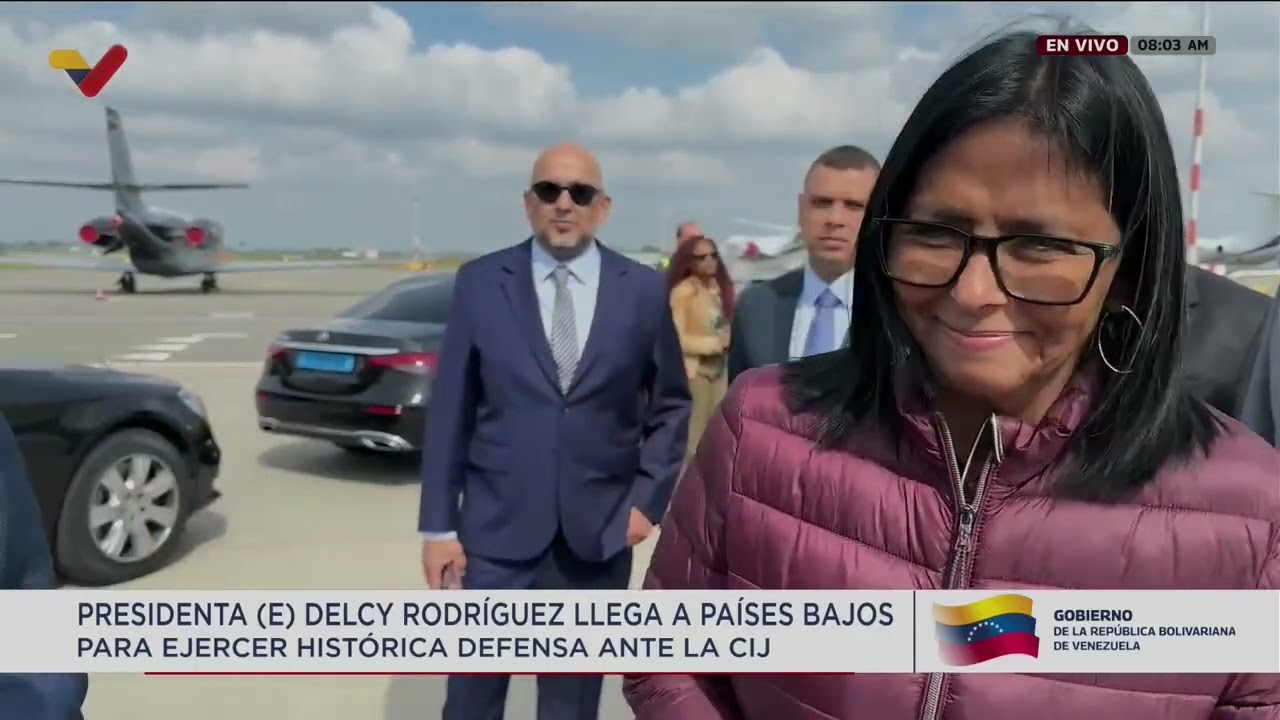
The Venezuelan delegation will participate this Monday in a key final hearing at The Hague. Venezuela maintains that it was the victim of a 19th-century imperialist dispossession by the United Kingdom.
Rodríguez’s in-person participation underscores the priority Caracas places on the issue, particularly following the US kidnapping of President Nicolás Maduro and the killing of over 100 people during the US invasion in January.
Defense of the 1966 Geneva Agreement
While Guyanese President Irfaan Ali shared his delegation’s statements on social media, the Venezuelan vice presidency highlighted the legal contrast between the two nations. Guyana seeks to validate the 1899 Paris Arbitration Award—a ruling widely recognized as fraudulent—while Venezuela insists on the validity of the 1966 Geneva Agreement as the only legal framework to resolve the controversy.
“We maintain our position in defense of the Geneva Agreement,” Rodríguez emphasized. “At that time, in 1966, there was an agreement to put an end to and overcome what was the opprobrious and fraudulent Paris Arbitration Award of 1899.” She reiterated that Venezuela is acting in strict accordance with international law to reach a peaceful, negotiated settlement.
“We have demonstrated in all historical stages what our territory has been since we were born as a Republic,” she added, affirming that the arrival of the delegation was intended to defend the “majesty and force” of the 1966 accord.
Oil spill in Trinidad and Tobago
In a separate development, Venezuela expressed grave concern on Saturday regarding an oil spill originating from Trinidad and Tobago. The spill has caused significant environmental damage in the Gulf of Paria and along the coasts of the Sucre and Delta Amacuro states. This environmental crisis follows what Caracas describes as a period of increased belligerence from Trinidad and Tobago regarding the Essequibo dispute in support of Guyana.
The Venezuelan Foreign Ministry released a statement detailing the impact on marine ecosystems and fishing communities. The full unofficial translation follows:
The government of the Bolivarian Republic of Venezuela expresses its concern to the international community regarding the oil spill originating from the Republic of Trinidad and Tobago, which has caused serious environmental damage in the Gulf of Paria and coastal areas of the states of Sucre and Delta Amacuro. Preliminary technical reports confirm impacts on marine areas, coastlines, sensitive ecosystems, and Venezuelan fishing communities.
Assessments conducted by Venezuelan authorities reveal severe risks to mangroves, wetlands, marine fauna, and strategic hydrobiological resources crucial for food security and the ecological balance of the region. Impacts have also been recorded on vulnerable species and highly sensitive ecosystems.
Venezuela at ICJ: Geneva Agreement is Only Viable Mechanism to Resolve Essequibo Dispute
The Bolivarian Government has instructed the Ministry of Foreign Affairs to immediately request all pertinent information regarding this incident, as well as the corresponding action plan for mitigating and containing the spill. Venezuela also demands compliance with the obligations established in international environmental law and the urgent adoption of reparations for the damage caused.
The Government of the Bolivarian Republic of Venezuela will continue to deploy all necessary actions to protect the affected ecosystems and safeguard the impacted communities.
Caracas, May 9, 2026.
Special for Orinoco Tribune by staff
OT/JRE/JB