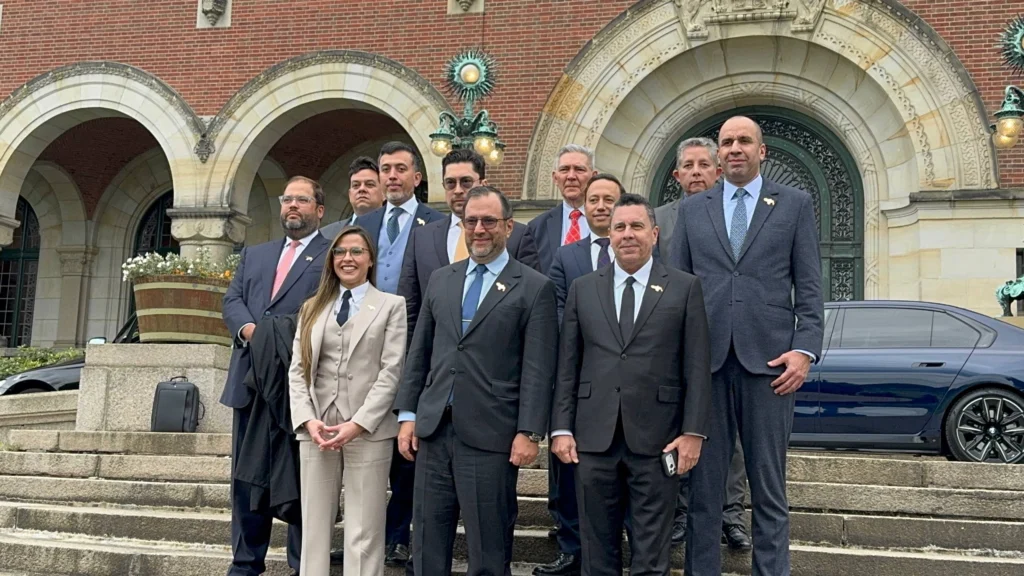
The Venezuelan delegation at the ICJ hearing on the Essequibo dispute. Photo: Telesur.
The Venezuelan delegation at the ICJ hearing on the Essequibo dispute. Photo: Telesur.
On Friday, May 8, Venezuelan Foreign Minister Yván Gil led the national delegation at the International Court of Justice (ICJ) in The Hague, Netherlands, to continue defending Venezuela’s historical rights over the Essequibo region.
Gil emphatically stated that, although the delegation is attending the trial to exercise Venezuela’s right to defense and to show the truth to the world, “this court has no jurisdiction over us.” He clarified that Venezuela does not recognize the ICJ’s authority to resolve the Essequibo dispute with Guyana.
Venezuela participated in the session where the Cooperative Republic of Guyana’s arguments were heard.
Foreign Minister Gil insisted that the definitive resolution of the conflict must be based on the principles of good neighborliness and coexistence. He highlighted that “the Geneva Agreement is the only mechanism for bilateral negotiation” and is the only viable option, which both countries had already agreed to follow.
View this post on Instagram
According to the Venezuelan State, the trial at the ICJ allows Venezuela to present the international community with the foundations of a historical position that rejects unilateral impositions. At the end of his speech, the foreign minister said that Venezuela’s presence aims to “show the world all the components supporting the historical position” of sovereignty over the territory.
With a firm stance adhering to international law, the Venezuelan government maintains its willingness to reach a practical and satisfactory solution for both parties. It reiterates that the path to peace and territorial integrity necessitates resuming the direct negotiations contemplated in the 1966 Geneva Agreement.
Regarding the allegations presented by Guyana before the International Court of Justice in The Hague, Gil called them “denialist and repetitive.”
After listening to Guyana’s arguments, Gil said that Guyana is trying to disregard the Geneva Agreement, an instrument that allows direct negotiation and has discarded the fraudulent 1899 Arbitral Award.
The Venezuelan minister was emphatic in pointing out that Guyana aims to “judicialize a controversy that already has an agreed-upon path to resolution between the parties” and ignores Caracas’ willingness to work in a spirit of good neighborliness and shared development.
During his statement, Minister Gil emphasized that Venezuela used compelling evidence to demonstrate how the territorial dispossession was forged, arguments that Guyana is systematically trying to deny. Gil pointed out that Venezuela’s policy is one of solidarity, citing programs such as Petrocaribe launched by former President Hugo Chávez, which directly benefited Guyana.
At The Hague, Venezuela’s Ambassador Dismantles Guyana’s Narrative, Reaffirms Venezuelan Sovereignty
Gil opined that the judges were able to assess the strength of Venezuela’s position against Guyana’s claims, which even included requests for “unusual” and interventionist measures aimed at compelling Venezuela to cease its social policies and presence in the Essequibo. These requests lack a legal basis.
In anticipation of the next hearing on Monday, May 11, Venezuela’s legal, political, and technical team is preparing to present evidence of the historical and legal truth supporting Venezuela’s claim.
Gil stated that the goal is to “bring the Cooperative Republic of Guyana to negotiate face to face in favor of peace and coexistence,” insisting that any route other than the Geneva Agreement is doomed to fail.
The Venezuelan delegation reaffirmed that, as Global South nations, both countries must resolve their differences through mutual understanding and without third-party intervention that undermines regional sovereignty.
(Telesur)
Translation: Orinoco Tribune
OT/SC/SF