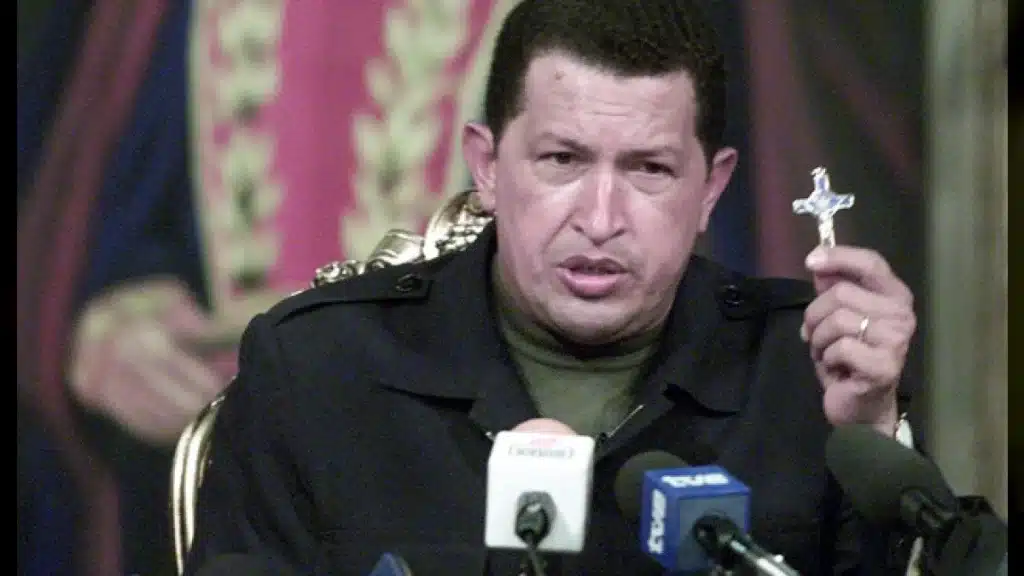
Venezuelan President Hugo Chávez holding a small crucifix in his hand in a televised address to the nation minutes after being reinstated as president as the result of a failed coup d'etat against him on April 11, 2002. Photo: Con el Mazo Dando/File photo.
By William Castillo Bollé – Jun 33, 2026
“Peace will be my harbor, my glory, my reward, my hope, my happiness, and all that is precious in the world.”—Simón Bolívar, 1820.
In the face of slanderous narratives against the Bolivarian Revolution and its leadership, in the face of those who appoint themselves the Inquisition and condemn our process to the pyre of their feelings and frustrations, stoking division among popular forces, uncertainty, and hatred, there is no room for hesitant responses. In the face of those who hurl very serious accusations against comrades who have taken on the responsibility of leading our Homeland in this decisive moment, a calm response is warranted. Look each other in the eye. Participate in the debate with the complexity that historical time demands. Look at the history we have traversed. Reflect.
Here, we reflect on four moments when Hugo Chávez could have done something else. Yet, he chose life. He chose peace.
ONE
February 4, 1992. Chávez’s “For now.” A moment of strategic inflection, responsibility, and heroism. Facing the inevitable defeat of the military rebellion, Chávez had the first of his many gestures of political greatness and strategic clarity. He surrendered, just like that.
However, he did not just lay down his arms. He took responsibility for the conspiratorial movement, calling on his comrades—who still controlled positions in Valencia, Maracay, and Maracaibo—to do the same. He urged the country to reflect. Chávez, who knew that several of his comrades on both sides in the Armed Forces had already died, wanted with his surrender to avoid a greater confrontation, which could have filled the streets and barracks with more pain and victims. He also wanted to give the movement of young people who had sworn before the Samán de Güere to free the homeland from the yoke of the elites a path. The “For now” shook the nation’s conscience and soul. Something changed after those brief seconds. That afternoon of pain and failure became a prophecy.
So no, it is not true, dear Luis Britto. It is not always better to die than to surrender. In fact, it is almost never better to die than to live. Above all, it is not about personal death, but about choosing between sacrifice and the life of a people. Bolívar told Francisco de Paula Santander, president of Colombia in 1822: In the end, it is always better to exist, with the defects and difficulties that define our human condition. In politics, being will always be better than not being. From the shadows of a defeat on February 4, 1992, a force, an idea, a project emerged victorious. If the then-young and impetuous lieutenant colonel had not negotiated that day, we would not be here today.
TWO
Chávez was released from prison in 1994. He immediately announced that he is going “to the heart of the people” to form a political party and take the democratic and electoral path to power. In prison, Chávez understood that the failure of the 4F military rebellion marked the end of a historical cycle and forever ruled out armed struggle. He announced a strategic change of course. He chose the path of politics, debate, organization, and partisanship. The path of building a popular force that would develop and embrace a Bolivarian project to transform the country. In peace. That day, he was emphatic: violence will never again be the way. Tactics, strategy, votes, and ideas instead of weapons.
THREE
On the afternoon of April 11, 2002, thousands of furious opponents head toward Miraflores, most unaware that they were the cannon fodder of a sinister plan. In one blow, President Chávez realized that something had broken in his fragile control of the military establishment. The media were up in arms, operating under the United States’ plan, and stoking violence from the screens and through electromagnetic waves. The newspaper El Nacional went further with the headline “The final battle will be in Miraflores” in an extra edition, announcing the outcome. It is the order that came from abroad. Chávez perceived key absences in his surroundings. Some of his companions did not answer his calls. They were fully involved in the coup plan. Or they were waiting in the shadows for the events to unfold. Snipers surrounded Miraflores. The Metropolitan Police and National Guard units turned into the shock force, the phalanx of the conspiracy. The blood of several citizens stained the streets of downtown Caracas. It was a media and military ambush, which threatened a greater bloodbath. Hugo Chávez knew that he had the people with him (he heard their shouts and slogans from the presidential office), and was determined to resist. And to die, like Allende, if necessary. At that moment, he received a call from Fidel Castro: “Chávez, do not make yourself a martyr. You cannot die today, Chávez. The people chose you to make a Revolution, not to make yourself a martyr.”
The Commander decided to negotiate. He surrendered to the coup plotters to avoid further violence, without resigning from the presidency. In less than 48 hours, the people and a patriotic sector of the Armed Forces rescued him. In the early hours of April 13, he returned to the presidential palace by helicopter. From the air, he had seen the city in flames. He did not want that. We did not come here for that. He clutched a crucifix and called for peace, for dialogue. He knew that he was back in Miraflores, but that he did not fully control power. He knew that the conspiracy continued. He survived the coup and chose peace: the country returned to calm. Years later, he would declare in an interview: “On April 11, my death was written. It was written in Washington.”
FOUR
After the failed coup in April 2002, Chávez faced a tense and perhaps more complex situation. Through a negotiation, in which the Organization of American States intervened, a dialogue process was agreed upon with the right-wing parties. One of Washington’s most nefarious operatives, César Gaviria, was installed in Caracas to oversee the Venezuelan political process. Chávez had no other choice but to swallow it. Swallowing toads, swallowing sand. It was part of the self-imposed task to maintain the fragile balance and the brittle peace achieved after the victory over the coup plotters.
However, that was not the only open front. Nor the most dangerous. A group of coup-supporting military personnel, emboldened by the pardon granted by the Supreme Court of Justice (“on April 11, they were filled with good intentions,” the magistrates had said), defiantly installed themselves in a public square to give a peaceful appearance to the continuation of the coup. Everything was being directed from the US. Chávez understood that it was a provocation to revive violence and justify a direct intervention by the United States. A phrase that would later be attributed to José Vicente Rangel echoes in his ears: “Hugo, patience. Let them stew in their own juice.”
Thus, amid heated streets, marches and counter-marches, and complex negotiations, Chávez lowered the political temperature. He pacified the country and led extremism back to the fold of democracy. It was a path paved with low passions, traps, and threats, like that strike-sabotage that paralyzed the oil industry for over two months. In those days, Chávez remembered Bolívar. Patience and more patience. Work and more work to have a homeland.
On August 15, 2004, the Venezuelan people rewarded Hugo Chávez’s fortitude, patience, strategic vision, and vocation for peace by re-electing him as president of Venezuela with an overwhelming majority. Years later, Nicolás Maduro—resisting over a decade of aggression—would inherit that legacy.
EPILOGUE
From these vivid memories, from this collective epic that defines the course of our steps, from these moments that some forget or hide to sell a distorted image of the Bolivarian Revolution, the present is also made.
The present is one of struggle, of work, and of peace. As history shows, the effort, courage, and sacrifice demanded by a noble cause dignify and transcend the people’s struggle. Overcoming setbacks today is about continuing to try. To keep fighting. To keep building. That is the beauty and moral greatness of the Venezuelan people and their Revolution. The future belongs to us.
William Castillo Bollé is the Venezuelan deputy minister for Anti-Blockade Policies.