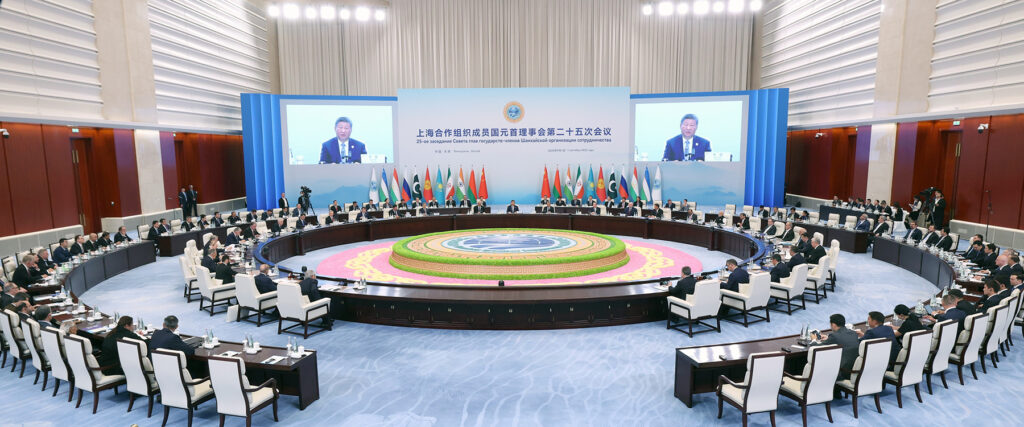
President Xi Jinping addresses the 25th Meeting of the Council of Heads of State of the Shanghai Cooperation Organization in Tianjin on Sept 1, 2025. Photo: Wang Zhuangfei/China Daily/file photo.
President Xi Jinping addresses the 25th Meeting of the Council of Heads of State of the Shanghai Cooperation Organization in Tianjin on Sept 1, 2025. Photo: Wang Zhuangfei/China Daily/file photo.
By Jiang Shixue – Jul 28, 2026
At the 25th Meeting of the Council of Heads of State of the Shanghai Cooperation Organization, in Tianjin, China, on September 1, 2025, Chinese President Xi Jinping put forward the Global Governance Initiative (GGI). On June 17, China’s State Council Information Office released a white paper titled “More Just and Equitable Global Governance: China’s Principles, Proposals and Actions”.
What is GGI?
According President Xi Jinping’s speech and the white paper, the GGI has five core concepts:
In order to uphold sovereign equality, all countries should engage in equal consultation in a spirit of mutual respect and properly manage differences. In particular, the major countries of the world should behave themselves and promote win-win cooperation, rather than to seek hegemony and bullying. Deviation from the principle of sovereign equality would reduce international relations to a zero-sum game of power politics and plunge the world into endless instability. Acting against the trend of history by seeking hegemony and bullying is doomed to fail.
The UN Charter clearly sets forth the principles such as “maintaining international peace and security,” “promoting international cooperation,” “settling international disputes by peaceful means,” and “refraining from the threat or use of force in international relations.” These principles manifest the basic norms of international relations and constitute an important cornerstone of the stability of the post-war international order. Therefore, to push forward global governance, it is highly necessary to maintain the rule of law in international relations by adhering to the purposes and principles of the UN Charter.
Again, major countries are key forces in promoting the rule of law in international relations. In particular, they should take the lead in observing rules and upholding the law, and avoid placing their own interests above international law or imposing their own domestic rules on others.
What Is a ‘Multipolar’ World? China Says Equality; Trump & Marco Rubio Say Imperial Rivalry
The essence of promoting multilateralism is that international affairs should be addressed through dialogues, consultation and cooperation based on shared benefits. In this regard, the UN is the most important platform for practicing multilateralism and resisting unilateralism. In addition, it is necessary to make good use of the constructive roles of various global and regional multilateral mechanisms, mobilize the resources and strengths of governments, international organizations, non-governmental organizations, and other parties, and make global governance more coordinated and effective.
Placing people at the center also means that great attention must be attached to the people’s livelihoods, dignity and common prosperity. It also means that the gap between the Global North and the Global South must be narrowed. Therefore, development must be re-centered on the international agenda, global development resources must be mobilized, and the implementation of the UN 2030 Agenda for Sustainable Development must be accelerated.
Developed countries should fulfill their international obligations in good faith, honor their commitments on development assistance and climate financing, and should not evade their international responsibilities under any pretext. Developing countries should strengthen themselves through unity, improve South-South cooperation mechanisms, and inject enduring momentum into improving global governance. That is to say, the North and the South should complement each other’s strengths and work in the same direction.
As a responsible major country, China champions the building of a community with a shared future for humanity and takes the lead in promoting global governance. Furthermore, it has consistently been a builder of world peace, a contributor to global development, a defender of the international order, and a provider of public goods, while actively advancing the efforts for building a more just and equitable global governance system.
China stands ready to work hand in hand with Latin America and the Caribbean to implement the GGI under the principles of extensive consultation, joint contribution, and shared benefits.
Let’s hope that, with the implementation of the GGI, we can create a brighter future for the world.
JS/OT