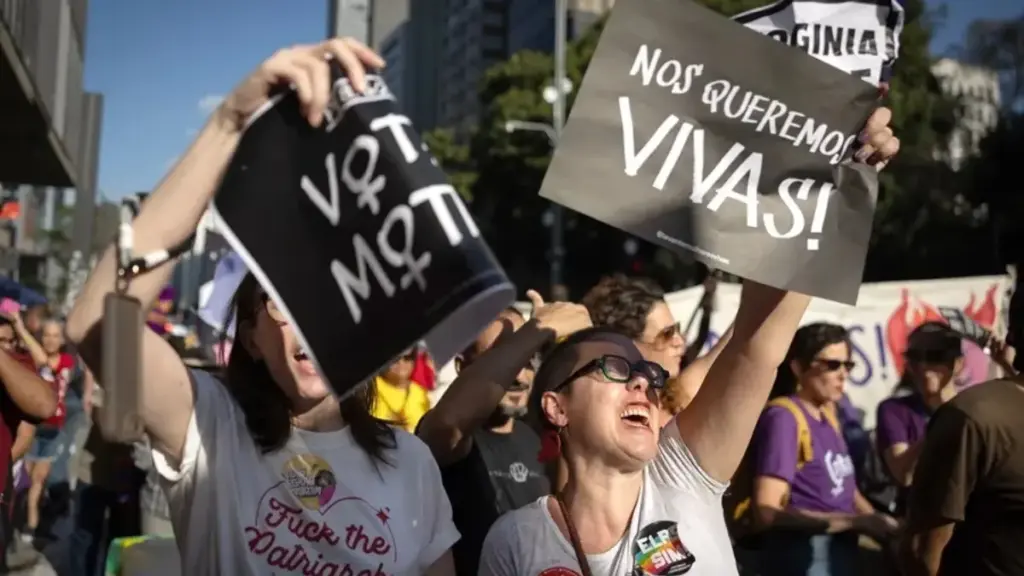
Protesters participate in demonstrations in various cities of Brazil to demand that the National Congress approve Bill 896/2023. Photo: EFE.
Protesters participate in demonstrations in various cities of Brazil to demand that the National Congress approve Bill 896/2023. Photo: EFE.
Women’s groups took to the streets this Sunday across several cities of Brazil to demand that the National Congress vote on and immediately approve Bill 896/2023, scheduled for August, which equates misogyny with the crime of racism.
The demonstrations were spearheaded by the Ascent for Living Women (Levante das Mulheres Vivas) movement and took place on August 2 ahead of the resumption of legislative activities. The main objective was to pressure the speaker of the Federal Chamber, Representative Hugo Motta, to bring the bill to a vote within the next 15 days, specifically between August 11 and 12.
The protests were organized in 10 states across the country, including the capital cities of São Paulo (Avenida Paulista), Brasília, Rio de Janeiro, Salvador, João Pessoa, Boa Vista, Curitiba, and Campo Grande and the cities of Medianeira, Ponta Grossa, and São José.
Irina Cezar, a member of Levante das Mulheres Vivas, stated in an interview with the program Es de Mañana on Radio Brasil de Fato that support for the bill is widespread. The movement engaged in dialogue with legislators from the left, right, and center, securing support from parliamentarians across various ideological sectors, including members of parliament and activists.
The legislative text was unanimously approved by the Senate in March and sent to the Chamber of Deputies, where it remained stalled without a scheduled vote. It includes a report prepared by federal deputy Tabata Amaral and awaits debate in plenary session following its approval as an urgent matter in early July.
The passage of this law seeks to establish a legal framework for violence against women that protects collective rights, an area not covered by current legislation. Cezar emphasized the urgency of the law given the discourse disseminated by digital content creators that promotes the subordination or harassment of women, behaviors that lack adequate legal definition in current criminal law regarding collective violence.
From the movement’s perspective, collective protection has a direct influence on reducing individual attacks.
Criminalizing hate speech reduces violence against women as a collective, thus decreasing the intervention of the judicial system, police action, and the burden of prosecution in Brazil.
Lula Rejects US Terrorist Designation of Brazilian Criminal Gangs
(Telesur)
Translation: Orinoco Tribune
OT/CB/SL
Cameron Baillie is an award-winning journalist, editor, and researcher. He won and was shortlisted for awards across Britain and Ireland. He is Editor-in-Chief of New Sociological Perspectives graduate journal and Commissioning Editor at The Student Intifada newsletter. He spent the first half of 2025 living, working, and writing in Ecuador. He does news translation and proofreading work with The Orinoco Tribune.