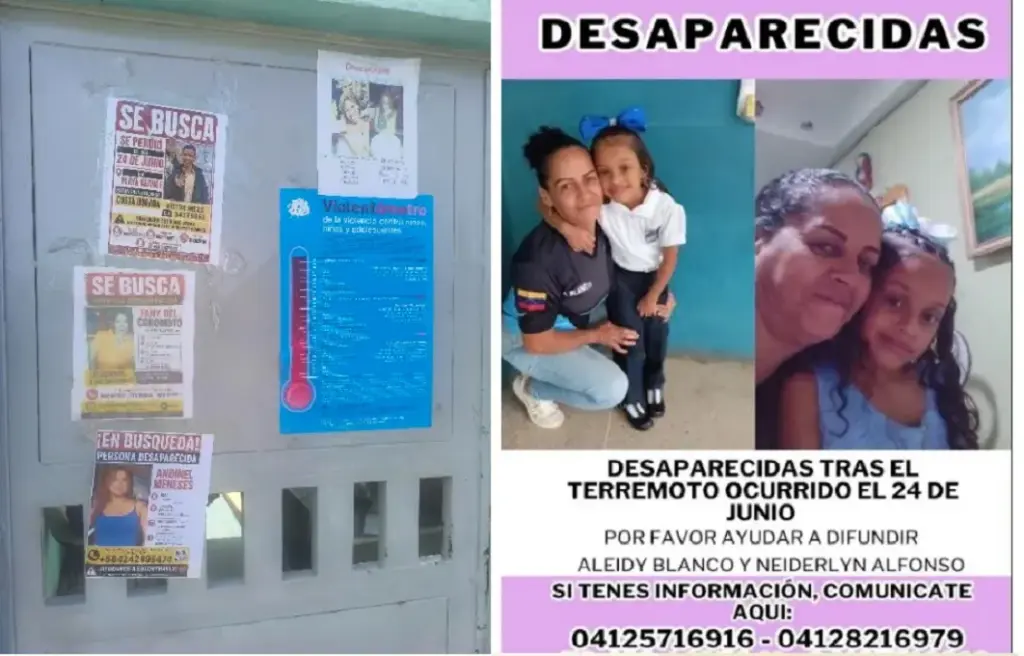
Posters of people missing in the June 24 double earthquake in La Guaira, placed in various locations by the relatives of the missing people. Photo: social media.
Posters of people missing in the June 24 double earthquake in La Guaira, placed in various locations by the relatives of the missing people. Photo: social media.
More than a month after the double earthquake of June 24, 1,338 people remain missing in La Guaira, the state hardest hit by the seismic event. The information was made public on Thursday, July 30, by the governor of La Guaira, José Alejandro Terán, who added that the figure is based on the information provided by families in the Unique Housing Registry.
“We have opened the Unique Housing Registry here, and we have been doing it for 15 days; as of yesterday, 95,080 people have participated, belonging to 29,344 households,” he explained in an interview with Unión Radio. “Some of these people have informed us that they are relatives of the deceased, the 5,943 dead that match the official figures that Dr. Jorge Rodríguez has announced … while 1,338 people are reported as missing.”
“This is a figure provided by 100,000 residents of La Guaira who have already gone to the Unique Housing Registry where 1,338 missing persons are reported. In addition, private lines have also been opened where these reports have been made, we have points of attention where these reports have been made, figures that are being cross-referenced in a single system to be able to reach an official report of that number, which is one of the most difficult tasks, because it requires the collaboration of people to report their missing relatives,” he said.
8.55% of La Guaira affected
The governor emphasized that “no one is prepared to be the victim of two earthquakes, and see 180 buildings collapse, 750 with structural damage.”
He added, “8.55% of our territory was affected, and the largest number of affected buildings are in the coastal axis of four parishes: Catia La Mar, the Playa Grande sector of the Urimare parish … the Macuto parish, everything from 15 Letras to Cristal Mar, all those buildings completely collapsed. And the parish of Caraballeda is ground zero, it was highly impacted.”
On June 24, Venezuela was struck by a double earthquake, the first with a magnitude of 7.2 and the second with a magnitude of 7.5, with 39 seconds of difference between the two.
Assistance in three levels
The governor stated that in La Guaira, a three-level plan was launched on the day of the earthquake itself. The first level was emergency response, the second, recovery, and the third, reconstruction and social development.
In the context of emergency response, he said that it was essential to ensure that “our hospitals were operational to care for the more than 10,000 injured in the state of La Guaira. On the first day alone, 2,600 people were hospitalized, and by the third day, 95% had been discharged, while 138 were transferred to Caracas for more complex surgeries. There were doctors, mainly in La Guaira, who emerged from the rubble, like the director of the Social Security, Omar Bolívar, whose building in Arnedillo collapsed, and he went to his hospital to take charge of the situation.”
In that phase, the plan was to rescue all the people who were alive under the rubble. He explained that the national government had activated an air bridge to Valencia because it was not possible to land in La Guaira. “And from there, hundreds of rescuers began to arrive, not only from Civil Protection and Firefighters but also groups of volunteers registered with the Ministry of Interior and Justice, who arrived that very morning to rescue more than 6,000 people who came out alive from the rubble. Those are the official statistics, but I am sure there were many more. From the early hours, amidst the chaos that we were witnessing and the consternation of that nightmare, that night, many family members and neighbors were rescuing their relatives, their neighbors.”
He stated that the figure that was officially recorded “is for those who participated actively and directly, the various national and international rescuers with their volunteer groups … but the rescuers from the first hours, who were mainly neighbors and family members, are not included. The anonymous heroes, as I call them, rescued countless people.”
In this regard, he told the story of an employee of La Guaira government, Jairo Galindo, who had managed to get out with his wife Esther after the earthquake; however, upon hearing the screams of his neighbors, he returned to help the families. “He rescued several people from that building, and while he was returning, a cornice from the El Jurel building fell on him, killing him instantly. He is a hero … surely people like him are not in the statistics of the rescuers, they were those anonymous heroes who, even at the cost of their own lives in the first hours, contributed to rescuing many people.”
He reported that approximately 20,000 people are in the temporary camps that were set up after the emergency on the central coast. They are receiving adequate care, and “showers, laundries, and accommodations at schools, with bunk bed furniture, mattresses, some even with privacy, ventilation, air conditioning, and fans” have been guaranteed.
Venezuela Advances Post-Earthquake Housing Recovery as Controlled Demolitions Begin
Removal of debris
The Santa Eduvigis landfill in the Urimare parish of La Guaira is receiving tons of debris.
“We have the best landfill in the entire country in Santa Eduvigis, and there we have an engineering marvel that I invite you to see,” the governor said in the interview. “There we have two cells prepared with volumetric capacities. Cells number 6 and 7, which will receive more than 3.1 million tons of debris, which is above the estimates of 2 million tons of debris created by the double earthquake. That is to say, we have a guaranteed site for final disposal.”
He added that with the Ministry for Ecosocialism, 13 places with temporary provisions were set up “where we have crushing machines, classifiers, because all the ferrous material is being taken by CVG under the acting president’s order to be melted, and other materials that will be necessary for the reconstruction phase.”
He pointed out that with the processed rubble, “with the crusher, we are putting together a project for the block, curb, and brick factory that will be used in the reconstruction phase.”
“It is not a lie that there was a disposal of debris by some individuals in a coastal strip that we have in the Caraballeda parish, past the Tanaguarena Club, but that has been a historical issue here in La Guaira. I constantly fight when people carry out renovations, reconstructions, because for them it is easier to dump the debris on the coast, knowing that later the State will come and collect it. I have always had to set up checkpoints in those places,” he mentioned, condemning the malicious media narrative that supposedly the State was dumping debris into the sea.
“In the first three days, when we were rescuing people from the rubble, attending to the injured, receiving homeless individuals, providing the first comprehensive assistance, there were trucks that dumped debris,” he said. “They did not throw it into the sea, they dumped it on that shore where historically in La Guaira trash has been dumped and we have fought against that. This led to that media psyop that all the debris was being dumped on the beaches of La Guaira, that it was part of a state policy to dump the debris on the beach, which is a lie.”
He added that those places have been cleared.
Translation: Orinoco Tribune
OT/SC/