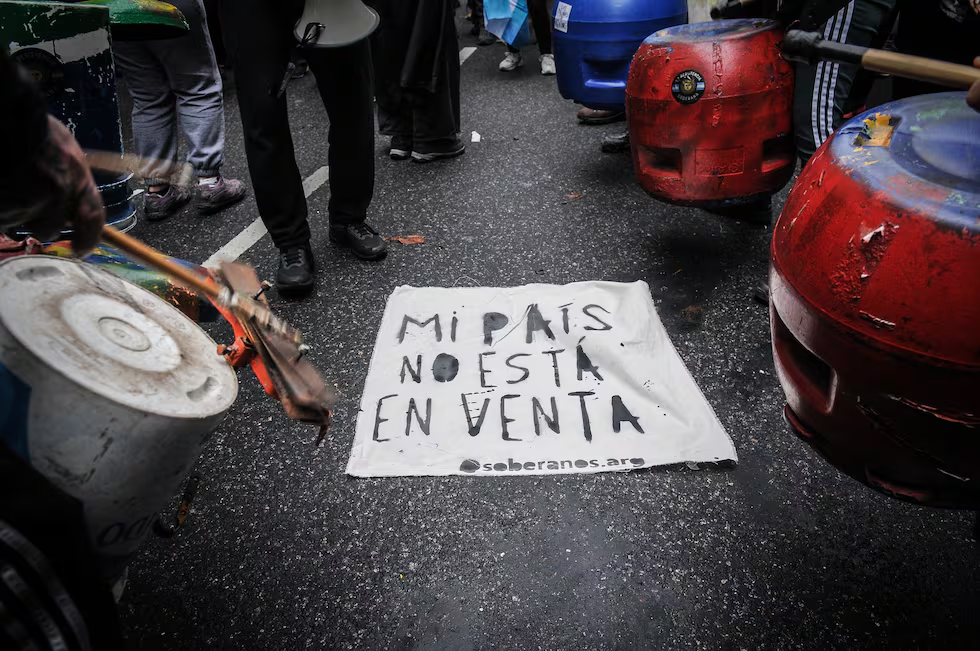
Argentinian protesters show a banner that says "My country is not on sale" against the Land Law proposed by the government. Photo: Guadalupe Lombardo.
Argentinian protesters show a banner that says "My country is not on sale" against the Land Law proposed by the government. Photo: Guadalupe Lombardo.
By Juan Carlos Junio – Aug 14, 2026
Inside the Congress, defeat for Milei, Sturzenegger, and the local and foreign establishment. Outside in the streets, the people in all of the country’s squares, and in San Cayetano with the priests who call upon everyone to “not resign and not be silenced.” Archbishop García Cuerva did not hesitate to point out that “there is a ruling class that sometimes seems to look the other way, putting energy and disqualifications into sterile debates that do not solve anyone’s life.” In just two days, the alliance between the real power and the ruling party suffered three defeats: Decree 690 on the practice and piloting of ships was not approved, the Land Law was not approved the next day, and the criminal mutilation of the Fire Management Law did not pass on the third day. Analysts at major media outlets are trying all kinds of “realistic” explanations, but no one can avoid the main conclusion: the government suffered a major and unexpected defeat. Consequently, the opposition achieved a victory from which it must urgently take on the challenge of politically uniting, developing ideas, and a program that proposes a political project in line with the people’s current needs.
In the circumstances, the sense of frustration is growing among the segment of society that trusted Milei, and the theatrical fictions of his cultural battle are collapsing, from the “caste” and the chainsaw to blaming Kirchnerism and the leftists for all the world’s evils. The myth of Milei’s admiration and love for despots like Trump, his adoration of Margaret Thatcher, and now the Spanish monarch, is melting away. The effect of the Malvinas flag on the people remains alive, imbuing their dignity in the most diverse social strata, their cultural life, and democratic institutions. Unexpectedly, a sense of nationalism returned, fueled by an anti-foreigner sentiment, whose cultural roots trace back to the public school teacher who, on the first day of class, would write on the blackboard: “The Malvinas Islands are Argentinian.” That is the feeling that must have emerged in the members of the National Team when they came across the banner, just when they were defeating the English on the field, expressing their feelings of reclamation against colonial plunder.
At the same time, a large part of the population that suffers firsthand the consequences of the current policy is coming to realize that the cause of their situation is the current economic model, the plan, and the “unchangeable course” of the increasingly darker red circle. Meanwhile, all these power factors continue to thrive on brutal adjustments to public spending and the “bargain” purchase of public assets. That behavior is in their nature, characteristic of an opportunistic, predatory, and fleeing capitalism. The latter explains the formation of the $450 billion in “external assets.” They earned these assets here in Argentina through the people’s work and production, through Argentinian scientists and professionals. Then, they sent them, or directly robbed them, to stash in their hideouts in Delaware, Dakota, Luxembourg, Caribbean islands with charming names, or Switzerland, the oldest and most prestigious.
The far-right got carried away by the support of the PRO right, radicals, and governors with their legislators who voted for everything in exchange for some funds to pay salaries, a stretch of road, or the appointment of an electoral judge. The wave of public rejection returned governors to stances aligned with their Peronist political identities and the voting preferences of their electorate. The parliament was a sounding board for the ideological and emotional shift taking place in a significant part of the population, particularly among the youth, influenced by the notable role played by various cultural expressions, musicians, and artists whom they felt represented them. In short, it was a triumphant cultural battle with a simultaneous massive popular mobilization across the entire country, even firmly enduring the repression of Milei and Macri in Buenos Aires. In other words, it was proven that the cultural battle had not ended. On the contrary, its ending is still open. The president’s invocations of the Marxist Gramsci proved fruitless.
Argentina: Protesters March Against Privatization of National Territory, Face Police Repression
Meanwhile, serious media outlets announce the inevitable visit of Pope Leo XIV. That said, they are crying out for his “depoliticization.” They are exhausted by the criticisms and the explicit activism of the Argentinian bishops who have been defending the lives of the impoverished majorities and our natural resources, such as land, water, and glaciers, and demanding an economic and social model that protects the work and lives of their parishioners, a stance they call “social justice.” From his first day, the Pope himself declared that he was a follower of Francis, focusing on the most vulnerable and overcoming the inequalities exacerbated in the current phase of capitalism. The Church continues to promote a development project without excluding millions of human beings abandoned on the sidelines of “the disposable,” or as Pope Leo bluntly points out, “it must be ensured that the economy does not produce waste.” Yet, it also takes on another defining issue: the serious social problem of poverty is a consequence of the extreme wealth of a minority. “Profitability cannot become the only parameter for making business decisions,” said the Pope. He asked the young people to “break with individualism” and move towards “cooperation and solidarity.” In summary, the Pope expresses the continuity of a Christian spirit centered on the human being, as part of a social and cultural community sustained by humanistic ties.
Amid a growing loss of consensus and legitimacy of President Milei and his government, the business elite demands “the continuity of the model beyond the electoral cycle.” Business organizations demand that “the pending tasks” be undertaken, not only maintaining what has been achieved but also extending it. At the same time, the political opposition has failed to articulate an adequate response to the grave social situation faced by the poor people and the middle classes, failing to send clear signals aimed at building unity that offers a new electoral political project. However, from the mists of social and cultural pain, from the streets and squares, from the deep cultural and democratic reserves, hope is emerging. It is the task of those who have the responsibility to channel this hope, amalgamate it, and guide it toward the triumph of the popular majorities and for dignity and national sovereignty.
Juan Carlos Junio is the general secretary of the Solidarity Party and director of the Floreal Gorini Cultural Center for Cooperation.
Translation: Orinoco Tribune
OT/SC/SF