By T.J. Coles – Nov 30, 2021
Cobalt, a key metallic element used in lithium batteries and other “green” technology, is sourced from slave labor in the Democratic Republic of Congo. As the West points the finger at China, the US Africa Command is indirectly policing mining operations that profit US corporations.
Ever since Belgium’s King Leopold II (1835-1909) established the Congo Free State in 1885, international powers have exploited the region’s vast resources. Leading a regime that went on to kill an estimated eight million people to plunder their gold, ivory, and rubber, Leopold reportedly described Congo as “a magnificent African cake.”
More recently, US President Biden’s International Trade Administration declared: “With total mineral wealth estimated in the tens of trillions of dollars,” what is now called the Democratic Republic of Congo (DRC) “offers opportunities for American firms with a high tolerance for risk.” The role of the Africa Command is to reduce that risk. The US Department of Defense says that Africa “has a plethora of strategic materials, such as cobalt, chromium, tantalum and more. African resources are critical to 21st century progress” (read: US corporate dominance).
From the late-1990s to the present, Euro-American mining, processing, and financial corporations have relied on the slave-labor of miners and the muscle of armed gangs to export rare earth metals, such as coltan and tantalum, to the West for vital components in computers, phones, missiles, etc. The rush to renewables ushers in a new era of competition for the rare metal, cobalt.
The US sets its sights on a mineral rich Congo
DRC has an estimated population of 93 million. The country’s entire gross domestic product is around $50 billion, making it one of the poorest countries in the world. As trillion-dollar companies like Apple, Microsoft and Tesla rely on DRC’s materials, seven in 10 Congolese survive on less than $1.90 a day. Life expectancy is 60 years, compared to 78 in the US, and infant mortality is 66 deaths per 1,000 live births compared to 5.6 in the US.
The Pentagon’s main interest in Congo began during the Second World War (1939-45). Owned by Belgium’s Union Minière, the Shinkolobwe mine in the southern Katanga province contained the purest known uranium ore, which the US Army Corps of Engineers used in the Manhattan Project launched in 1942 to construct the world’s first nuclear weapon. Ore from the mine was used in the subsequent manufacture of nuclear weapons.
By the 1950s, the US State Department planned to invest $660 million (around $7 billion today) to “develop” Congo’s infrastructure for corporate exploitation. In 1960, Prime Minister Patrice Lumumba declared independence from Belgium, naming the country the Republic of the Congo (RoC), and making relatively mild overtures to the USSR. The politician Moïse Tshombé declared Katanga’s independence from RoC.
MI6 murdered Lumumba and the CIA replaced him with its asset,General Mobutu Sese Seko, who later renamed the country Zaire and ruled until his overthrow in 1997.

Throughout the 1960s, the CIA essentially created and managed the Zairian Armed Forces (Forces Armées Zaïroises, ZAC), training special air units and hiring mercenaries to bolster Mobuto’s forces. Tshombé’s secession was crushed, as were intermittent struggles, such as the Simba Rebellion from 1963 to ’65; one of whose leaders was future President, Laurent-Désiré Kabila. The US reluctantly tolerated smallCuban and Chinese military contingents in Zaire because they did not affect mining operations. By the 1980s, Belgian, French, German, and Israeli personnel were also training the ZAC.
Washington plays innocent bystander while fueling intrigues
Geographical considerations, the involvement of neighboring states, international interference, the role of specific ethnic groups in particular conflicts, and shifting paramilitary alliances make the Congo Wars extremely complicated. What follows is a basic outline focusing on the largely-overlooked US role.
Since at least 1990, the US has used Uganda as a conduit to arm Zaire/DRC. Until Uganda’s role in the wars was exposed, the Bill Clinton administration’s African Crisis Response Initiative saw an initial round of US military training for the Uganda People’s Defense Force. Clinton’s International Military Education and Training programs continued regardless. Both programs worsened the Congo crises, as we will see.
The centerpiece of the First Congo War that began in 1996 was the overthrow of Gen. Mobutu, led by Kabila’s Alliance of Democratic Forces for the Liberation of Congo (Alliance des Forces Démocratiques pour la Libération du Congo-Zaïre, AFDL). The AFDL was supported by the Rwandan Patriotic Front (RPF), whose Maj. Gen. Paul Kagame, now the president of Rwanda, had been trained by the US at Fort Leavenworth. RPF personnel were trained by the Green Berets.

Described as a “visionary” by US Gen. George Joulwan, Kagame had honed his craft murdering Hutu during the Rwanda Genocide in 1994. Hundreds of thousands of Hutu fled into DRC, settling in the eastern regions where the mineral resources happened to be located. The RPF and its allied paramilitaries occupied DRC, initially to help build up Kabila’s Armed Forces, but also to avenge massacres of Tutsi and secure the mines.
We can plausibly assume based on chronicles of events that Washington’s role was to play innocent bystander while benefiting from the mining and supply-chain operations of the RPF, Ugandan military, and related gangs.
Foreign demand for rare earth minerals drives an unprecedented death toll
Even before Kabila seized power, international mining and infrastructure giants were negotiating contracts with his AFDL party.
American Mineral Fields landed a $1 billion deal to mine DRC. Bechtel hired NASA to provide satellite images of mineral-rich regions and allegedly acquire information on rebel movements for Kabila’s military. As Anglo-American, Barrick Gold, DeBeers, and other corporations signed mining contracts, Kabila created the Banque de Commerce, du Developpement et de l’Industrie to finance mining operations. The bank was based in Rwanda, from which untraceable coltan sourced from DRC conflict areas was exported to Western corporations, including Afrimex, Banro-Resources, and Union Transport.
The Second Congo War, from 1998-2003 and de facto to the present, has led to the deaths of an estimated 5.4 million people: most of them civilians who perished from war-related hunger and disease. The war was, in large part, an effort by different powers and factions to back or depose the Kabila family dynasty, seize control of resource-rich areas, and to settle long-standing rivalries. Unlike the first war, this one was explicitly driven by demand in Asia, Europe, and North America for rare materials.
The Wall Street Journal reported at the time that Kabila’s nationalizations “sent a worrying signal … to foreign companies that are eager to do business in this mineral-rich country.” Kabila soon fell out with his Ugandan and Rwandan backers, who in 1998 helped to form a new party: the Rally for Congolese Democracy (Rassemblement Congolais pour la Démocratie, RCD). The anti-Kabila RCD splintered into militant rebel groups and advanced across the country. Troops from Angola, Chad, Libya, and Zimbabwe entered DRC to back Kabila, who was assassinated in 2001, leaving his son Joseph (b. 1971) to rule from 2003 until 2019.
As far as international investors were concerned, the myriad rebel factions were crucial for maintaining the supply lines of rare materials. Typically, they were smuggled to Europe-bound cargo planes via Rwanda.

Kony 2012: a US psy-war op aimed at protecting a key proxy
Uganda’s President Yoweri Museveni was one of America’s top proxies in DRC, and a UN report describes Uganda as a main sponsor of the conflict. In his effort to remove Museveni, the so-called Lord’s Resistance Army (LRA) led by the cultist Joseph Kony attacked Uganda from DCR. In 2006, the UN backed Uganda’s invasion of DRC to hunt for Kony. The newly-formed US Africa Command (AFRICOM) provided covert assistance to Uganda, including training and satellite phones, in a failed counterinsurgency war which caused the LRA to exacerbate their killings in DRC.
From 2011 to 2017, the US initiated the anti-Kony operation, Observant Compass. As part of the mission, the US Special Operations Command Africa established a task force “to command and control the operation that stretched from Uganda, through the eastern [DRC] into the Central African Republic, and across South Sudan.” Personnel from the fabled A-Team “served as advisors to [the] African Union Regional Task Force.”
Released in the eponymous year, the documentary Kony 2012 brought the atrocities of the LRA to international attention. But US Special Operations Command documents suggest that the film’s producer, the NGO Invisible Children, was unwittingly part of a US psychological warfare operation. Army Special Operations Forces name the Congolese and Ugandan militaries, as well as several NGOs including Invisible Children, as “partners” in their operations.
Unlike the first attempt, Observant Compass reduced the LRA’s numbers and notoriety.
As China fears rise, AFRICOM enters the fray – and atrocities ensue
Washington and various European “former” colonial powers shifted policy from indirectly backing proxies, like the Uganda and Rwanda-supported rebels, to “professionalizing” the central Armed Forces (Forces Armées de la République Démocratique du Congo, FARDC). The George W. Bush administration introduced a DRC “security sector reform” program, which included hiring the private “contractor,”Camber Corporation.
The Bush administration’s urge to “professionalize” and “legitimize” the FARDC coincided with China’s growing activities in the country. A Fort Benning Training and Doctrine Command document bemoaned the fact that in 2007 “China signed an agreement with [DRC] in which China provides $5 billion for infrastructure improvements in exchange for rights to DRC’s natural resources.”
Now that China was in DRC, human rights and traceable supply lines suddenly became a concern for Washington. US advanced training of the FARDC coincided with the passing of Dodd-Frank 2010, which requiredthe Securities and Exchange Commission (SEC) to mandate companies to verify supply chains.
In the same year, AFRICOM facilitated the US-DRC military partnership. The objective was “to transform the [FARDC],” among other things for “internal security operations.” A new Light Infantry Battalion was inaugurated by US Ambassador William Garvelink at the Kisangani Base Camp in north-central DRC. Training was provided under AFRICOM’s Special Operations Command, led by Brig. Gen. Christopher Haas, and unnamed State Department “contractors.”
By September, 750 soldiers had graduated in what AFRICOM describesas “a model for future reforms within the Congolese armed forces” and reveals the creation of a new 391st Commando Battalion. Commander of training at Camp Base, Maj. John Peter Molengo, said: “In 2006 our president [Bush] promised a transformation of the [DRC] armed forces. I see this as an important step.”
Within a few years, the “important step” was revealed for what it was. Members of the Battalion had been exposed by the UN looting villages, murdering civilians, and raping dozens of women and girls, some as young as six. Stars and Stripes reported: “AFRICOM declined to comment …, referring questions to the U.S. State Department.”
Uganda’s military spreads chaos
If adding to chaos is the goal, AFRICOM’s strategy is working. To date, there are 4.5 million internally displaced Congolese, over one million of whom lost their homes during fighting in 2016-17 alone.
Like the LRA, another rebel group – this time, Islamic – called the Allied Democratic Forces (ADF), bolted from the Ugandan military and based itself in DRC where it is now attempting to establish a caliphate. The UN Organization Stabilization Mission DRC is helping the FARDC. Operations that began in North Kivu in November 2019 wound up displacing 400,000 people. In a repeat of botched US efforts to conquer the LRA, FARDC tactics caused the ADF to enter previously peaceful territory.
Founded in the 1970s, the Cooperative for Development of the Congo (Coopérative de développement économique du Congo, CODECO) is an umbrella of militia based in Ituri province in the northeast. CODECO mainly consists of ethnic Lendu whose are engaged in long-standing conflict with the Hema people. Despite the July 2020 peace agreement, FARDC operations have exacerbated the violence.
Founded in 1969, the ethno-federalist Kongo-majority Bundu Dia Kongo (BDK) is a Christian cult that encourages violence against non-Kongo peoples, even setting up roadblocks to divide communities. The BDK faces crackdowns by the police and FARDC, which in April 2020 launched anti-BDK operations in Kongo Central and in the capital, Kinshasa.
Greenwashing the race for trillions in renewables profits
As the violence continues across much of the country, so do the exports to most of the world. Corporate profiteering from the global climate emergency has triggered a cobalt rush. The unreliability of DRC supply chains has also triggered a move to design cobalt-free renewables.
Concentrated among 3,000 companies, the so-called global green economy is worth $4.5 trillion; more than the international oil and gas sector. The renewables market alone is worth over $600 billion. Electric vehicles (EV) are valued at around $170 billion and expected to growth to $700 billion within the next five years.
Cathodes are an essential part of the lithium ion batteries (LiBs) that, until recently, had been ubiquitous but tiny, hitherto requiring small amounts of cobalt. The emerging EV market means that large 100 kilowatt-per-hour LiBs contain 20 kg of cobalt in their cathode components. The US Department of Energy explains that in addition to being mined, cobalt (Co) is obtained as a by-product of other materials and almost entirely sourced from abroad, making US businesses dependent on metal markets and exporting countries. American corporations are therefore “looking to secure sources of Co, to drastically reduce the Co content in LiBs, or both.”
At present, 255,000 Congolese mine for cobalt, mainly in the conflict-free south, earning less than $2 per day with no benefits in conditions that are both immediately hazardous (e.g., collapsing tunnels, dangerous tools) and carry long-term risk (e.g., respiratory, orthopedic). Some 40,000 cobalt miners are children.
Bolstered by their legal obligations to report to the Securities and Exchange Commission, numerous US corporations have attempted to greenwash their supply chains by claiming that they are sourced ethically. The Anglo-Swiss mining giant, Glencore, has a market capitalization roughly equal to DRC’s entire GDP. In recent years, it has signed partnership pledges with renewables customers to ethically source cobalt.
Other initiatives include Apple’s Supplier Responsibility Progress reports. BMW, Samsung, and others, meanwhile, have launched the Cobalt for Development Project. Tesla says that it will phase out cobalt from its lithium batteries and, in the meantime has, joined the Fair Cobalt Alliance. But a recent class action lawsuit on behalf of several injured Congolese miners alleges that Alphabet (Google), Apple, Dell, Microsoft, and Tesla are “aiding and abetting the cruel and brutal use of young children … to mine cobalt.”
Playing the blame China game
Despite the greenwashing, the cobalt mining, refining, smelting, and exportation industries remain dangerous, exploitative, polluting, and terrible for public relations. On the other hand, these conditions help to keep production costs low and profits high. The informal solution for many Western businesses and governments is to deploy media, NGOs, and the intelligentsia to point the moral finger of blame at China, whose corporations operate extensively in southern, cobalt-rich DRC.
For example, a recent Guardian article exposes the cruel working conditions in the town of Fungurume imposed on small and “artisanal” miners contracted by the big, so-called legitimate companies, like China’s Molybdenum. Describing a “slave and master” relationship, one of thousands of miners revealed how he works for $3.50 a day, eating two tiny bread rolls, with wages deducted for missing work.

The report was funded by Humanity United, an NGO founded by eBay billionaire and Intercept owner Pierre Omidyar’s wife, Pam. Humanity United has received grant money from numerous sources, including the William J. Clinton Foundation. “This grant funded Humanity United’s continued contribution and membership to the 2011 Clinton Global Initiative.”
But such reports omit that China’s Molybdenum is owned by US institutional investors: JPMorgan Funds, Vanguard Total International, Vanguard Emerging Markets, BlackRock, and others. Amnesty International traces the “downstream” supply chain of Chinese-acquired cobalt to Asian, European, and US corporations.
Cobalt is typically smelted and refined by China’s Huayou and its CDM subsidiary, put into batteries by Amperex, BYD, LG, Samsung, Sony, and others, and sold as components in Apple, BMW, Dell, Fiat-Chrysler, GM, Microsoft, Tesla, and other Western products.
Weaponizing space to win the “Great Power Competition”
DRC is directly linked to Washington’s long-term efforts to rule the world by force. Just as King Leopold II described Congo as a “magnificent African cake,” ex-US Naval Intelligence Officer, Dr. Mir Sadat, Policy Director of the National Security Council, says:
“Great Power Competition in space is in some ways analogous to the Great Game of the 19th and early 20th centuries between Great Britain and Russia, which competed over access to resources and geostrategic positioning in Central and South Asia. Today, there is a similar great game brewing between China and other spacefaring nations led by the United States over access to potential cislunar [between Earth and Moon] resources and overall space dominance.”
RELATED CONTENT: AFRICOM: An Extension of US-European Colonialism and Genocide
But it wasn’t China that first declared its intention to rule space and therefore the world. In 1997, the US Space Command published its “full spectrum dominance” doctrine: to weaponize space by the year 2020 “to protect U.S. interests and investment” (read: corporate profits). Endangering us all, “full spectrum dominance” includes hypersonic missile drones and high-altitude craft that can strike Russia and/or China with “low-yield” nuclear weapons.
Like other products that emerged from taxpayer funding under the cover of military research and development (satellites, computers, the internet, etc.), space exploration is now commercialized through companies like Jeff Bezos’s Blue Origin company, while serving the Pentagon by, for instance, launching military satellites, as Elon Musk’s SpaceX has done. The Pentagon and other federal agencies describe this arrangement as the Space Industrial Base.
Sadat helped to establish the Space Force, which largely took over from the Space Command. Specifically naming cobalt and other rare materials as the “greatest” supply risks, a fear-mongering report about supposed lack of US influence, co-authored by Sadat and sponsored by the Space Force, says: “The United States must compete for global market share and leadership – currently dominated by China, Russia over terrestrial commodities – basic and manufactured – into the space economy.”
It may turn out that the millions of destitute Congolese sitting on tantalum and coltan, and the hundreds of thousands of slave-like and child miners toiling in hazardous conditions to extract these products are not the only victims. If the “Great Game” for “full spectrum dominance” continues without grassroots pressure to end it, escalating geopolitical “competition” between nuclear powers could annihilate the rest of the world as well.
T.J. Coles is a postdoctoral researcher at Plymouth University’s Cognition Institute and the author of several books, the latest being We’ll Tell You What to Think: Wikipedia, Propaganda and the Making of Liberal Consensus.
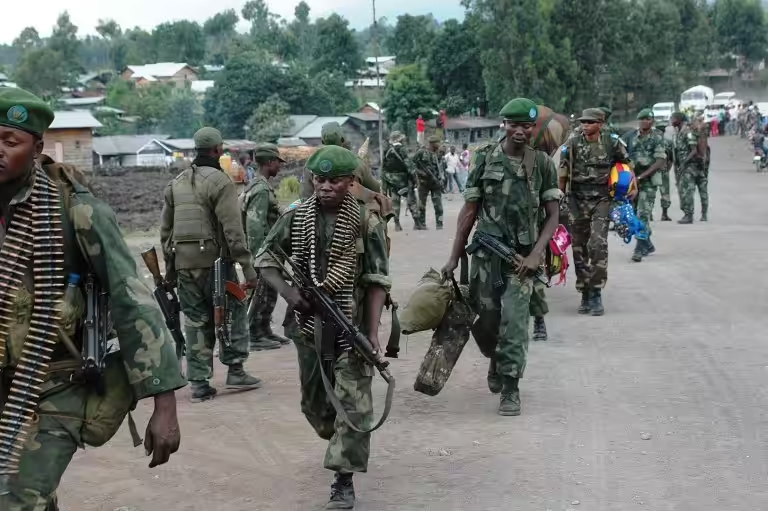
Featured image: By MONUSCO Photos – The Congolese National Armed Forces (FARDC) in 2013