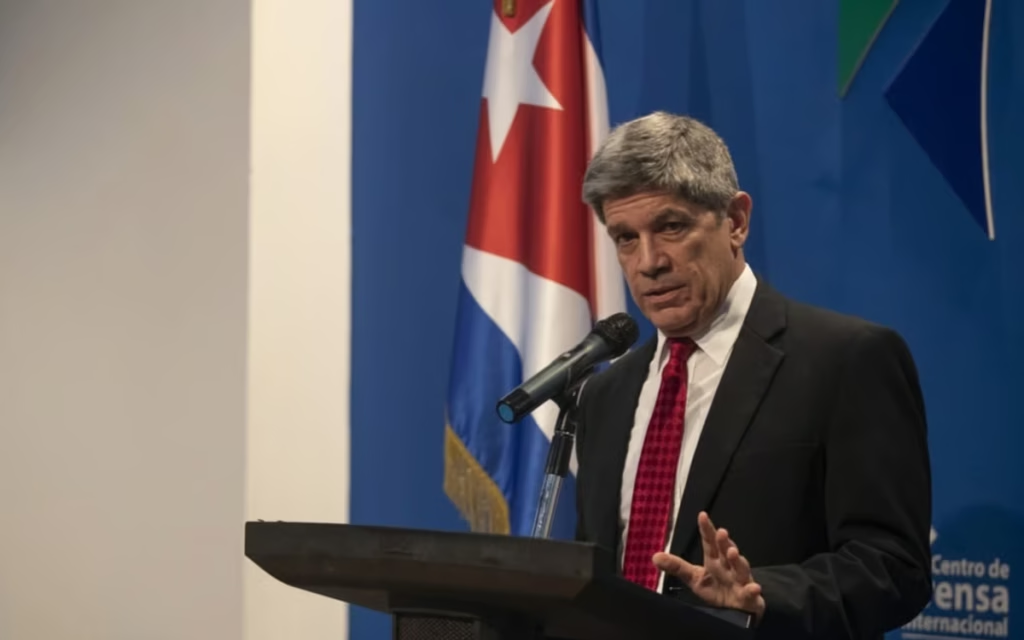
The deputy foreign minister of Cuba, Carlos Fernández de Cossío. Photo: EFE.
The deputy foreign minister of Cuba, Carlos Fernández de Cossío. Photo: EFE.
The deputy foreign minister of Cuba, Carlos Fernández de Cossío, condemned the accusations presented by the United States against General Raúl Castro Ruz, former president of Cuba, on Wednesday, May 20. The diplomat called the accusations unfounded, lacking legal, political, or moral basis, and a “cowardly act” that is part of Washington’s aggressive escalation to discredit the Cuban Revolution and its leaders.
Participating in the Cuban television program Mesa Redonda, the deputy minister stated that the fraudulent accusation presented by Washington “should be considered as part of the aggressive, growing escalation that we have seen throughout this year from the US against Cuba … It is part of that aggressiveness, a cowardly act within that aggressiveness.”
Fernández de Cossío underscored that the hegemonic international press and several US media outlets promote the idea of the inevitability of a military aggression against Cuba, and that these media corporations use the incident of February 24, 1996 as a pretext. This is a strategy fueled by requests from the US government itself or by a desire for sensationalism.
He pointed out that the downing of the two planes that violated Cuban airspace in 1996 was completely the responsibility of the US government.
He explained that between 1994 and 1996, dozens of incursions by the self-proclaimed Brothers to the Rescue organization occurred, and that Cuba diplomatically warned the US State Department and the Federal Aviation Administration on 25 occasions about the existing danger, requesting the revocation of the pilots’ licenses.
Havana demonstrated that the White House, the State Department, and security agencies were aware in advance that the incursions would provoke a defensive response. The deputy foreign minister cited declassified documents from the US National Security Archive, in which Washington acknowledged the violation of international law, the danger of provocations from the organization based in Florida, and the likelihood that Cuba would exercise defense of its territory after years of patience and tolerance.
The Cuban Foreign Ministry stated that the actions of February 24, 1996, corresponded to the fulfillment of the Cuban government’s duty to protect national airspace and sovereignty.
Fernández de Cossío argued that the current indictment against General Raúl Castro and other Cubans represents an additional threat, due to Washington’s historical practice of using pretexts to justify armed interventions against sovereign states, and emphasized that any attempt at military aggression will face fierce resistance from the Cuban people.
According to the deputy minister, the reactivation of the case can be seen as a political favor by the US government intended to appease an economically and politically positioned clique in Miami. He added that this sector is not representative of the entirety of the United States or the Cubans residing in the US, but it exerts a disproportionate influence on the decisions of the White House due to the nature of the US political system.
The White House knew about the incursions into Cuban airspace but did not act
In his statements, Fernández de Cossío explained that on January 15, 1996, about 40 days before the incident, the Cuban government issued a public statement which explicitly stated that any aircraft flying over its territory and airspace without authorization would be intercepted and, if necessary, neutralized. In addition, the government warned that Cuba had the necessary means to protect its airspace.
He emphasized that the violations of Cuban airspace by the terrorist organization Brothers to the Rescue and its leader, CIA agent José Basulto, were not secret. Although the Cuban government knew about it from beforehand through intelligence information, the aggressive flights were public because the group broadcasted them on the radio and boasted about them in the same way that it boasted about terrorist actions.
He explained that Basulto would call the press, such as NBC and local Miami media, with the intention of bringing reporters on one of his expeditions flying over Havana to demonstrate the impunity with which he did it. He used to comment that Cuba did not have defenses to protect its airspace, which turned out to be incorrect.
US Media Reports Growing Likelihood of Military Invasion of Cuba
The minister went on to say that in January 1996, the Cuban government, through various channels, conveyed a direct message to then-president of the United States, Bill Clinton, warning and alerting about the danger, and there was confirmation that the message was received. The White House was aware of the danger, but chose not to act, asserted Fernández de Cossio.
He added that in subsequent years more information emerged regarding this matter, including communications from the State Department and other US government agencies in which they acknowledge that the flights constituted a violation of international law.
Fernández de Cossío emphasized that this is historical fact. Cuba repeatedly demanded that the United States government take action, and it did not. “Therefore, we are looking at an act for which the United States government was absolutely responsible,” he stated. “The comrades accused in this case acted in fulfillment of a duty, the duty to protect the airspace, the homeland, and the peace of the Cubans.”
(Telesur)
Translation: Orinoco Tribune
OT/SC/DZ