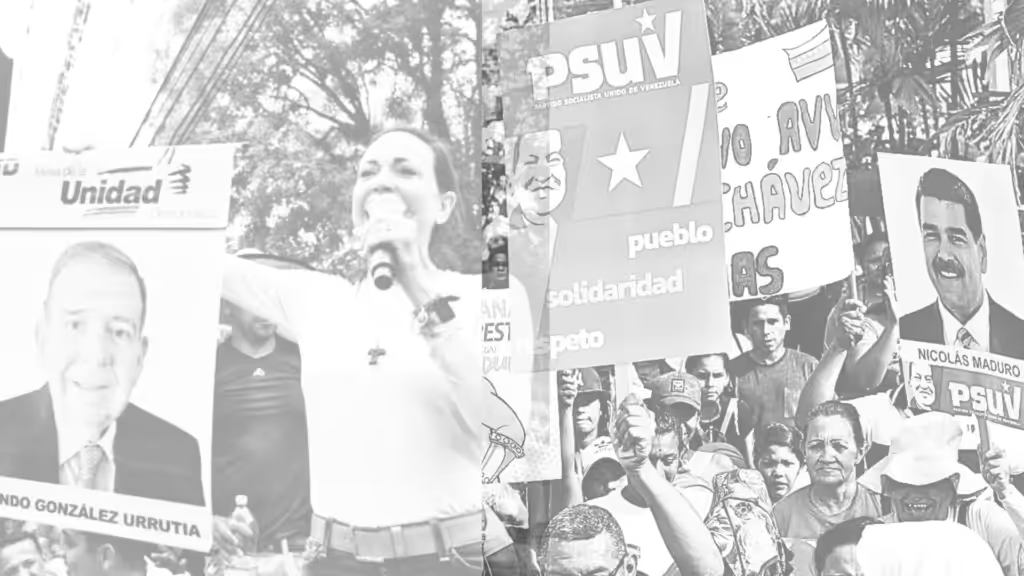
Photo composition showing far-right politician Maria Corina Machado (left) during a campaign rally. Machado holds a poster with a photo of Edmundo González. On the right, we are shown images of a Chavista rally with people holding banners with the campaign poster of President Nicolás Maduro (right). Photo: Orinoco Tribune.
Caracas (OrinocoTribune.com)—International Manifesto Group and Orinoco Tribune are inviting everyone to a series of two webinars organized to highlight the relevance and the regional and international implications of the July 28 Venezuelan presidential elections. These webinars will be held on July 7 and July 14.
A roster of outstanding panelists have already confirmed their participation for the first webinar, scheduled for Sunday, July 7, at 12:00 pm (EST) and for the second webinar, scheduled for Sunday, July 14 at the same time. The organizers are also putting together a post-election webinar with relevant speakers.
Below you have the details for the series of webinars entitled “Venezuela Chooses: What is at Stake in the Coming Elections?”
Speakers: Part 1: July 7, 12 p.m. (EST), 5 p.m. (London) • Joe Emersberger
• Maria Paez Victor
• Williams Camacaro
• Francisco Dominguez
• Saheli Chowdhury, moderator
Registration here
Part 2: July 14, 12 p.m. (EST), 5 p.m. London • Diego Sequera
• Steve Ellner
• Ben Norton
• Alan MacLeod
• Radhika Desai, moderator
Registration here
Description: Venezuela goes to the polls on July 28, 2024, to choose a president for a six-year term beginning on January 10, 2025. The second term of incumbent President Maduro has continued the radical transformation that began with the election of Hugo Chávez in 1998.
Venezuela has weathered a ferocious and unrelenting campaign against it led by the USA, UK, Canada, and the European Union, including punitive illegal sanctions and repeated coup attempts. Shortages and hyperinflation have been overcome, and in a remarkable but quiet transition, Venezuela has become self-sufficient to a degree unknown for over half a century.
Maduro’s astute political strategy has brought all but a tiny fraction of the opposition into the ballot process, driving a rift between the hardliner Unitary Platform and its US backers. In October 2023, the opposition parties signed the Barbados Agreement and pledged that each political faction would select its candidates freely as long as they were eligible to participate under the Venezuelan Constitution and laws.
In the face of these achievements and the self-inflicted loss of oil supplies provoked by the Ukraine war, the USA and its allies negotiated a short-lived agreement with the Maduro government. The US issued limited licenses for the Venezuelan oil, gas, and gold sectors under sanctions in return for the release of opposition figures and US citizens jailed in Venezuela due to their participation in coup and terrorist plots.
The US has now returned to an intransigent policy whose purpose is to deny the legitimacy of the July 28 election result, continue its punitive and illegal sanctions, and return to a regime-change course.
The agreement included a commitment to allow appeals from opposition leaders banned from participation in elections due to their support for coup attempts. In January, the Venezuelan Supreme Court (TSJ) lifted several bans but refused far-right politician María Corina Machado’s challenge to her long-standing 15-year disqualification, pointing to her participation in coup attempts, treason, and corrupt dealings.
The US State Department responded by revoking the gold license and threatening to do the same for the energy sector when the sanctions waivers expire in April, as they actually did. An earlier agreement signed in Mexico City by the end of 2022 had included a $3 billion fund, drawn from Venezuelan seized assets abroad, to attend to urgent social needs. These resources have not been delivered by the US government.
Machado won primaries of the opposition Unitary Platform in October 2023, but the process was deemed illegal by the Supreme Court. Instead of an internal primary of party members, it was an open primary using the Venezuelan electoral roll. Therefore, it should have been conducted under the auspices of the Venezuelan National Electoral Council (CNE). Machado refused this adamantly and pushed through an illegitimate process using an organization named the National Primaries Commission and controlled by her own NGO, Sumate, against which there is a case in the Supreme Court for “usurpation of electoral powers.”
Machado, despite knowing she was disqualified to run for office, said she would continue to push her candidacy, although her political party, Vente Venezuela, does not belong to the Unitary Platform and does not participate directly in the dialogue with the government.
The government has called for respect for the judicial authorities’ decision and has condemned any violations of the Barbados Agreement. Jorge Rodríguez, National Assembly president and head of the government dialogue delegation, said the accord had been discarded and replaced by the document reached in May in the national consensus dialogue that produced the electoral schedule.
As Machado remains disqualified, the Unitary Platform named a substitute candidate, Corina Yoris, who, under unclear circumstances, was taken out of the race. Then, Machado chose retired career diplomat Edmundo González Urrutia, thus remaining on the electoral path, as the hardline opposition’s representative Gerardo Blyde had commented earlier. However, even among the PUD sympathizers, there are voices that question González Urrutia’s “autonomy” and decision-making independence from Machado, as it appears that he is only acting as her agent, which, due to her disqualification, borders on illegality once again.
The stage is being set for the US to return to its hardline policies of denying the legitimacy of an electoral process that former President Carter described as “the best in the world.” The US and its allies may refuse to recognize the results of the election and use this as justification to continue and amplify their illegal economic coercive measures—euphemistically referred to as “sanctions”—extend their seizure and blocking of Venezuelan assets abroad, and return to seeking regime-change in a country at the forefront of the multipolar and democratic transition sweeping Latin America and the world.