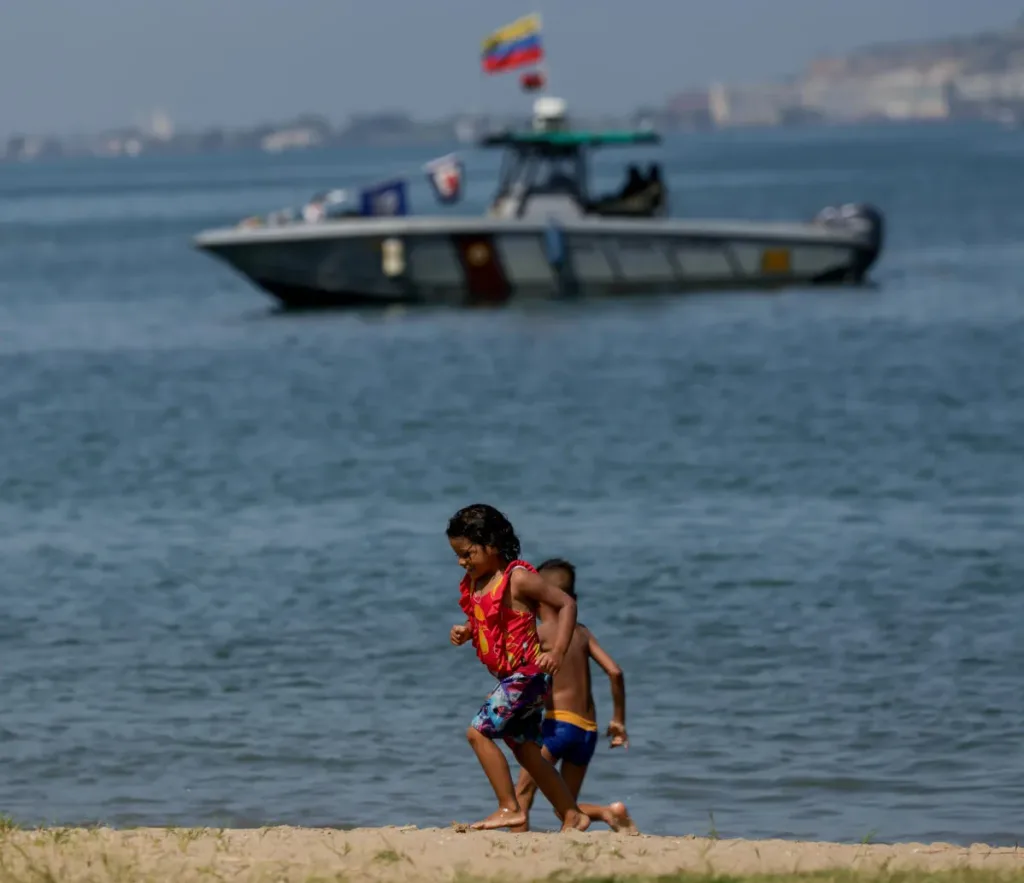
Children play on the beach during a security deployment in Anzoátegui, Venezuela, 19 September 2025. Photo: Rosana Silva R.
Children play on the beach during a security deployment in Anzoátegui, Venezuela, 19 September 2025. Photo: Rosana Silva R.
By Vijay Prashad – Nov 6, 2025
With rapid military escalation and a redeployed ‘War on Drugs’ narrative, the Trump administration appears to be laying the groundwork for an attack on the Venezuelan people.
Since early September, the United States has given every indication that it could be preparing for a military assault on Venezuela. Tricontinental: Institute for Social Research partnered with ALBA Movimientos, the International Peoples’ Assembly, No Cold War, and the Simón Bolívar Institute to produce red alert no. 20, ‘The Empire’s Dogs Are Barking at Venezuela’, on the potential scenarios and implications of US intervention.
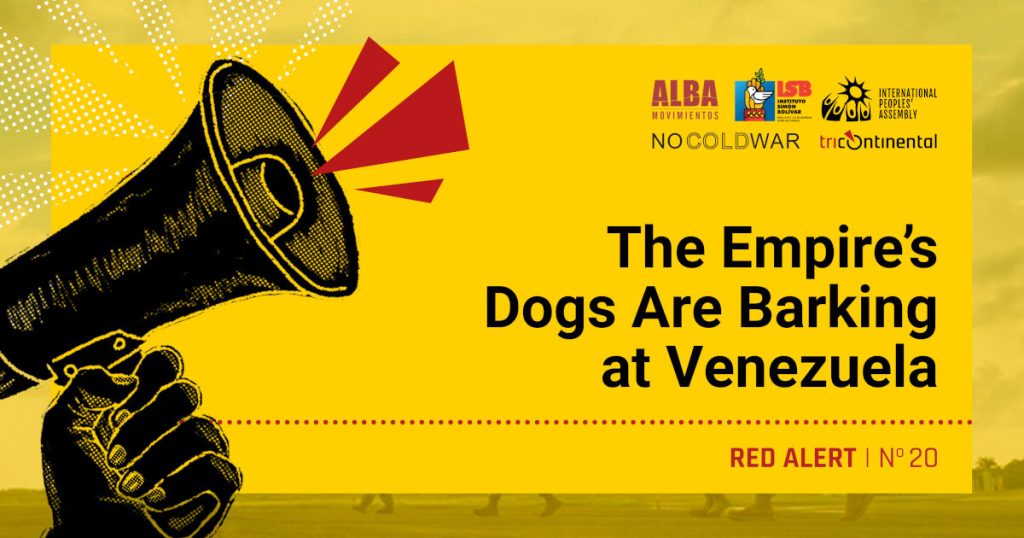
In February 2006, Venezuelan President Hugo Chávez travelled to Havana to receive the United Nations Educational, Scientific and Cultural Organisation’s José Martí Prize from Fidel Castro. In his speech, he likened Washington’s threats against Venezuela to dogs barking, saying, ‘Let the dogs bark, because it is a sign that we are on the move’. Chávez added, ‘Let the dogs of the empire bark. That is their role: to bark. Our role is to fight to achieve in this century – now, at last – the true liberation of our people’. Almost two decades later, the empire’s dogs continue to bark. But will they bite? That is the question that this red alert seeks to answer.
The Sound of Barking
In February 2025, the US State Department designated a criminal network called Tren de Aragua (Aragua Train) as a ‘foreign terrorist organisation’. Then, in July, the US Treasury Department added the so-called Cartel de los Soles (Cartel of the Suns) to the Office of Foreign Assets Control’s sanctions list as a ‘transnational terrorist group’. No previous US government report, either from the Drug Enforcement Administration (DEA) or the State Department, had identified these organisations as a threat, and no publicly verifiable evidence has been offered to substantiate the claimed scale or coordination of either group. There is no evidence that Tren de Aragua is a coherent international operation. As for the Cartel de los Soles, the first time the name appeared was in 1993 in Venezuelan reporting on investigations of two National Guard generals – a reference to the ‘sun’ insignia on their uniforms – years before Hugo Chávez’s 1998 presidential victory. The Trump administration has alleged that these groups, working with Venezuelan President Nicolás Maduro’s government, are the primary traffickers of drugs into the US – while providing zero evidence for the connection. Moreover, reports from the UN Office on Drugs and Crime (UNODC) and the DEA itself have consistently found Venezuelan groups to be marginal in global drug trafficking. Even so, the US State Department has offered a $50 million reward for information leading to Maduro’s arrest – the largest in the programme’s history.
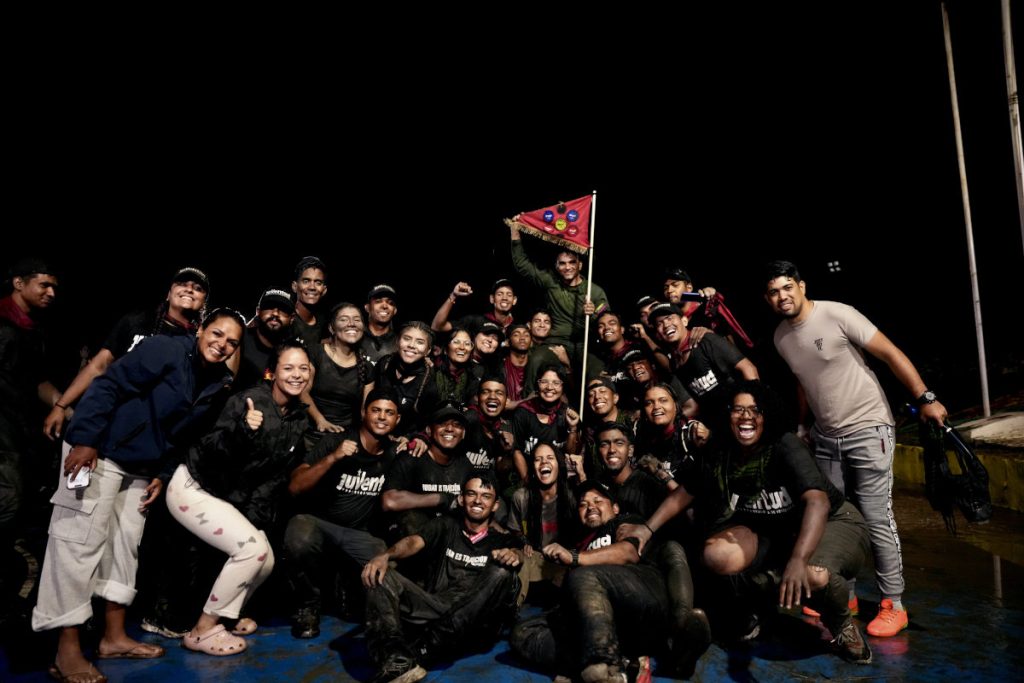
The US has revived the blunt instrument of the ‘War on Drugs’ to pressure countries that are not yielding to its threats or that stubbornly refuse to elect right-wing governments. Recently, Trump has targeted Mexico and Colombia and has invoked their difficulties with the narcotics trade to attack their presidents. Though Venezuela does not have a significant domestic drug problem, that has not stopped Trump from attacking Maduro’s government with much more venom. In October 2025, the Venezuelan politician María Corina Machado of the Vente Venezuela (Come Venezuela) movement won the Nobel Peace Prize. Machado was ineligible to run for president in 2024 largely because she had made a series of treasonous statements, accepted a diplomatic post from another country in order to plead for intervention in Venezuela (in violation of Article 149 of the Constitution), and supported guarimbas (violent street actions in which people were beaten, burned alive, and beheaded). She has also championed unilateral US sanctions that have devastated the economy. The Nobel Prize was secured through the work of the Inspire America Foundation (based in Miami, Florida, and led by Cuban American lawyer Marcell Felipe) and by the intervention of four US politicians, three of them Cuban Americans (Marco Rubio, María Elvira Salazar, and Mario Díaz-Balart). The Cuban American connection is key, showing how this political network that is focused on the overthrow by any means of the Cuban Revolution now sees a US military intervention in Venezuela as a way to advance regime change in Cuba. This is, therefore, not just an intervention against Venezuela, but one against all those governments that the US would like to overthrow.
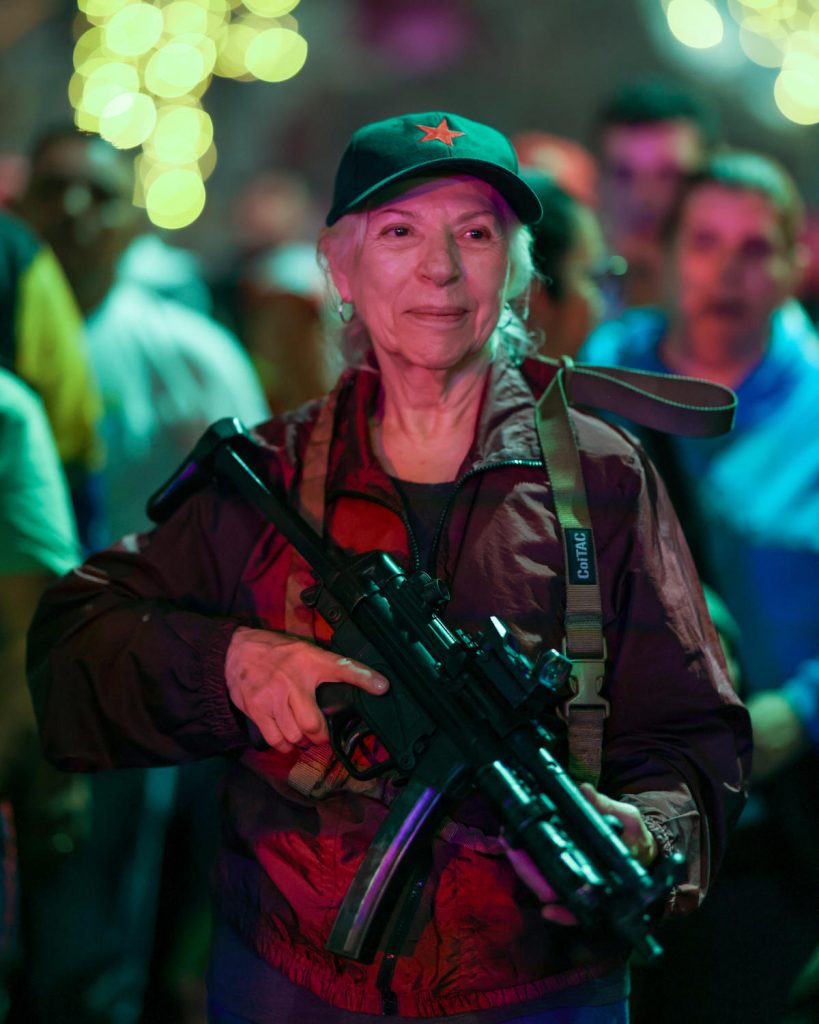
The Bite
In August 2025, the US military began to amass naval forces in the southern Caribbean, including Aegis-class destroyers and nuclear- powered attack submarines. In September it began a campaign of extrajudicial strikes on small motorboats in Caribbean waters, bombing at least thirteen vessels and killing at least fifty-seven people – without offering evidence of any drug trafficking links. By mid-October, the US had deployed more than four thousand troops off Venezuela’s coast and five thousand on standby in Puerto Rico (including F-35 fighter jets and MQ-9 reaper drones), authorised covert operations inside the country, and flown B-52 ‘demonstration missions’ over Caracas. In late October, the USS Gerald R. Ford carrier strike group was deployed to the region. Meanwhile, Venezuela’s government has mobilised the population to defend the country.
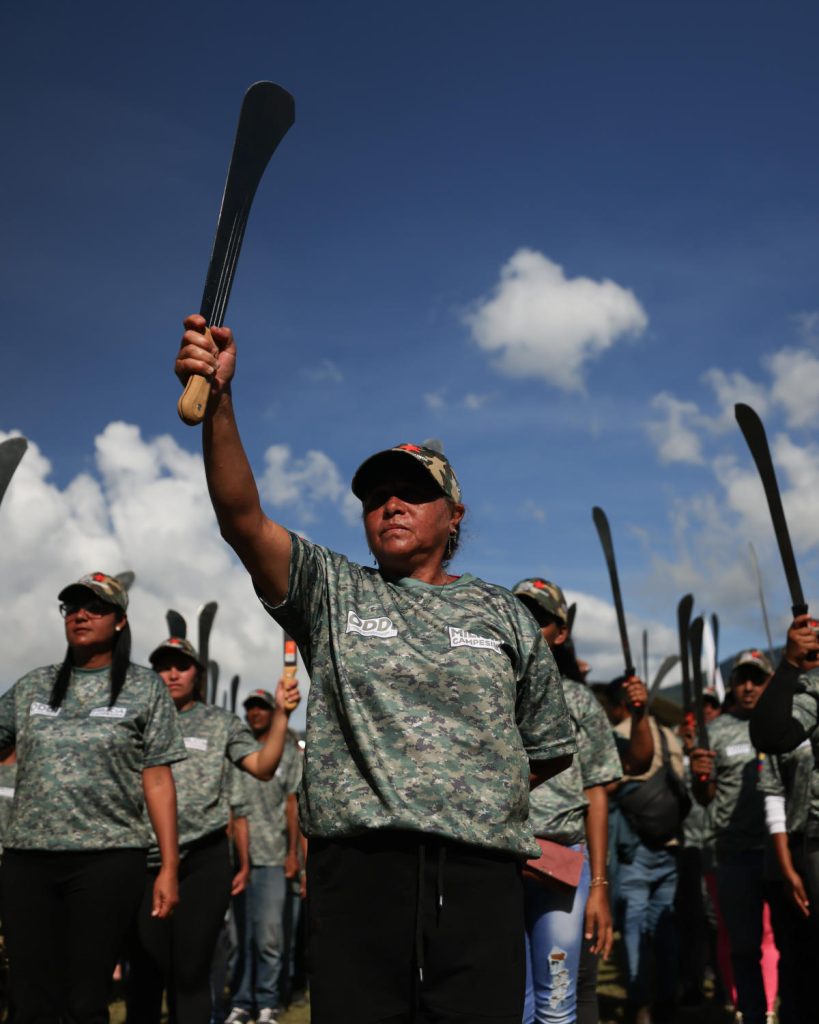
Five Scenarios for US Intervention
Scenario no. 1: the Brother Sam option. In 1964, the US deployed several warships off the coast of Brazil. Their presence emboldened General Humberto de Alencar Castelo Branco, chief of the Army General Staff, and his allies to stage a coup that ushered in a twenty-one-year dictatorship. But Venezuela is a different terrain. In his first term, Chávez strengthened political education in the military academies and anchored officer training in defence of the 1999 Constitution. A Castelo Branco figure is therefore unlikely to save the day for Washington.
Scenario no. 2: the Panama option. In 1989, the US bombed Panama City and sent in special operations troops to capture Manuel Noriega, Panama’s military leader, and bring him to a US prison while US-backed politicians took over the country. Such an operation would be harder to replicate in Venezuela: its military is far stronger, trained for protracted, asymmetric conflicts, and the country boasts sophisticated air defence systems (notably the Russian S-300VM and Buk-M2E surface-to-air systems). Any US air campaign would face sustained defence, making the prospect of downed aircraft – a major loss of face – one Washington is unlikely to risk.
Venezuela’s Defense Minister: ‘Building Destiny of Peace’ Amid ‘Wild West’ US Policy (+FANB)
Scenario no. 3: the Iraq option. A ‘Shock and Awe’ bombing campaign against Caracas and other cities to rattle the population and demoralise the state and military, followed by attempts to assassinate senior Venezuelan leadership and seize key infrastructure. After such an assault, Nobel Peace Prize winner Machado would likely declare herself ready to take charge and align Venezuela closely with the US. The inadequacy of this manoeuvre is that the Bolivarian leadership runs deep: the roots of the defence of the Bolivarian project run through working-class barrios, and the military would not be immediately demoralised – unlike in Iraq. As the interior minister of Venezuela, Diosdado Cabello, recently noted, ‘Anyone who wants to can remember Vietnam… when a small but united people with an iron will were able to teach US imperialism a lesson’.
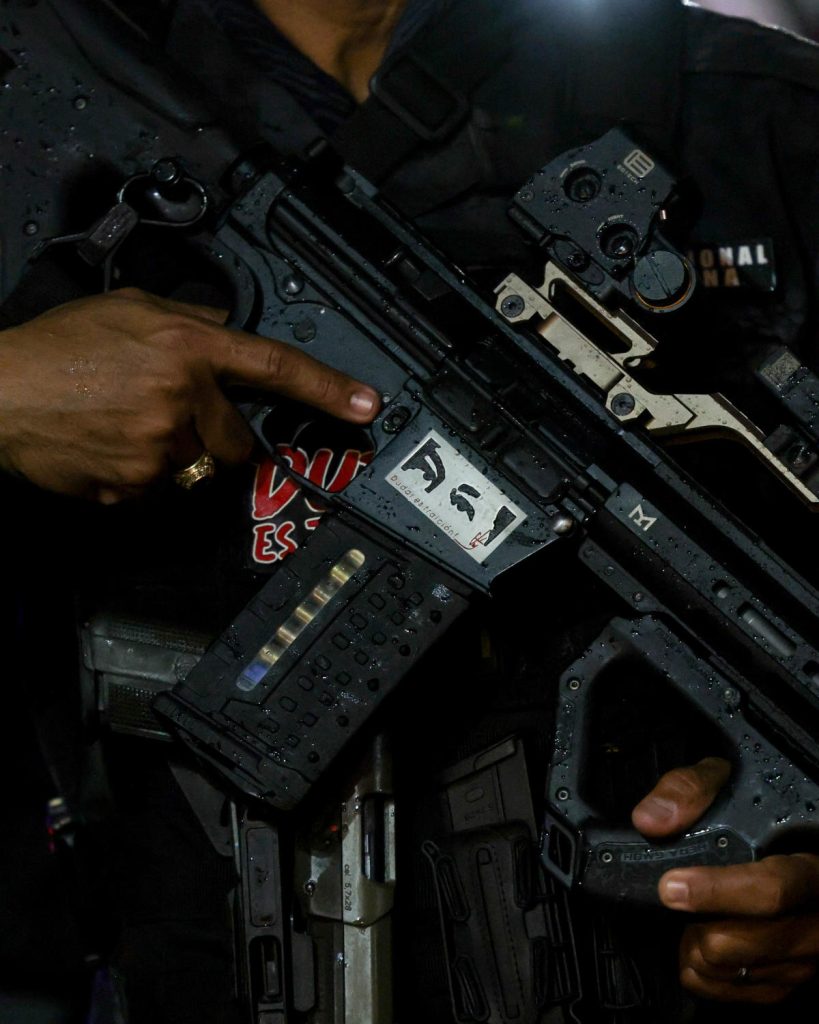
Scenario no. 4: the Gulf of Tonkin option. In 1964, the US escalated its military engagement in the Vietnam War after an incident framed as an unprovoked attack on US destroyers off the country’s coast. Later disclosures revealed that the National Security Agency (NSA) fabricated intelligence to manufacture a pretext for escalation. The US claims it is now conducting naval and air ‘training exercises’ near Venezuelan territorial waters and airspace. On 26 October, the Venezuelan government said it had received information about a covert CIA plan to stage a false-flag attack on US vessels near Trinidad and Tobago to elicit a US response. Venezuelan authorities warned of US manoeuvres and said they will not give in to provocations or intimidation.
Scenario no. 5: the Qasem Soleimani option. In January 2020, a US drone strike ordered by Trump killed Major General Qasem Soleimani, head of Iran’s Quds Force. Soleimani was one of Iran’s most senior officials and was responsible for its regional defence strategy across Iraq, Lebanon, Gaza, and Afghanistan. In an interview on 60 Minutes, former US chargé d’affaires for Venezuela James Story said, ‘The assets are there to do everything up to and including decapitation of [the] government’ – a plain statement of intent to assassinate the president. After the death of President Hugo Chávez in 2013, US officials predicted that the project would collapse. Twelve years have now passed, and Venezuela continues along the path set forth under Chávez, advancing its communal model whose resilience rests not only on the revolution’s collective leadership but also on strong popular organisation. The Bolivarian project has never been a one-person show.
China and Russia are unlikely to permit a strike on Venezuela without pressing for immediate UN Security Council resolutions, and both routinely operate in the Caribbean, including joint exercises with Cuba and global missions such as China’s Mission Harmony 2025.
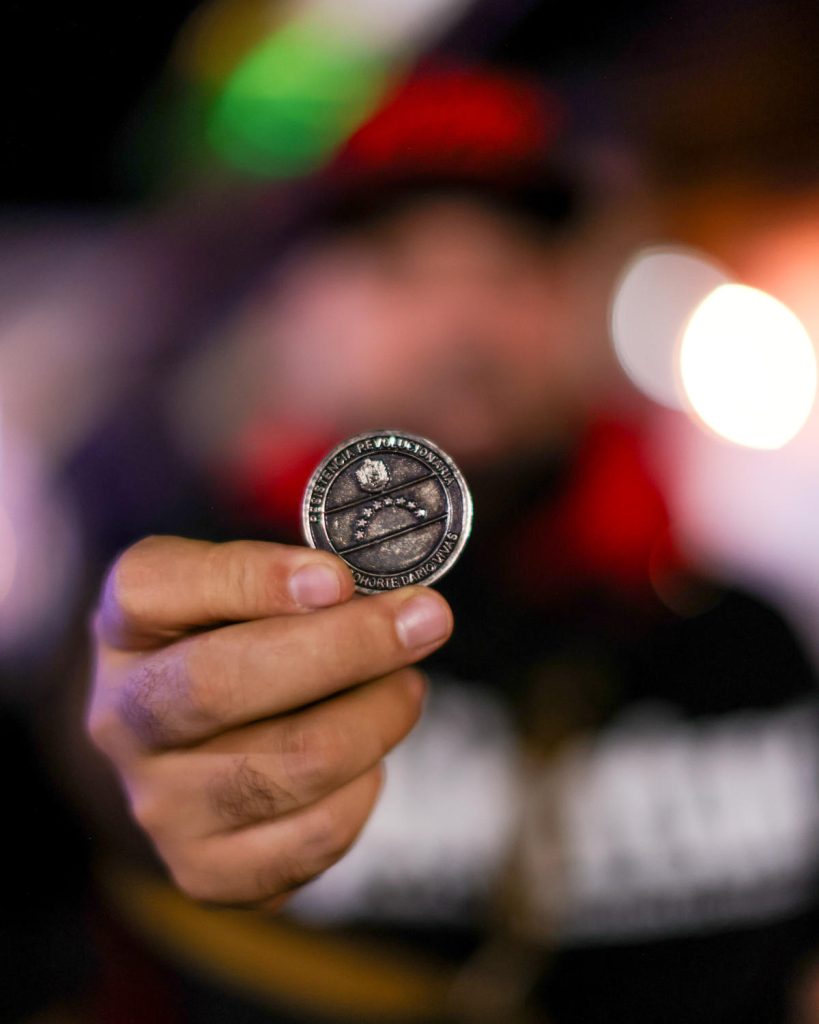
We hope that none of these scenarios come to pass and that the United States takes its military options off the table. But hope alone is not enough – we must work to expand the camp of peace.
Vijay Prashad is an Indian historian, editor, and journalist. He is a writing fellow and chief correspondent at Globetrotter, a project of the Independent Media Institute. He is the chief editor of LeftWord Books and the director of Tricontinental: Institute for Social Research. He has written more than 20 books, including The Darker Nations: A People’s History of the Third World (The New Press, 2007), The Poorer Nations: A Possible History of the Global South (Verso, 2013), The Death of the Nation and the Future of the Arab Revolution(University of California Press, 2016), and Red Star Over the Third World (LeftWord, 2017). He writes regularly for Frontline, the Hindu, Newsclick, AlterNet and BirGün.