
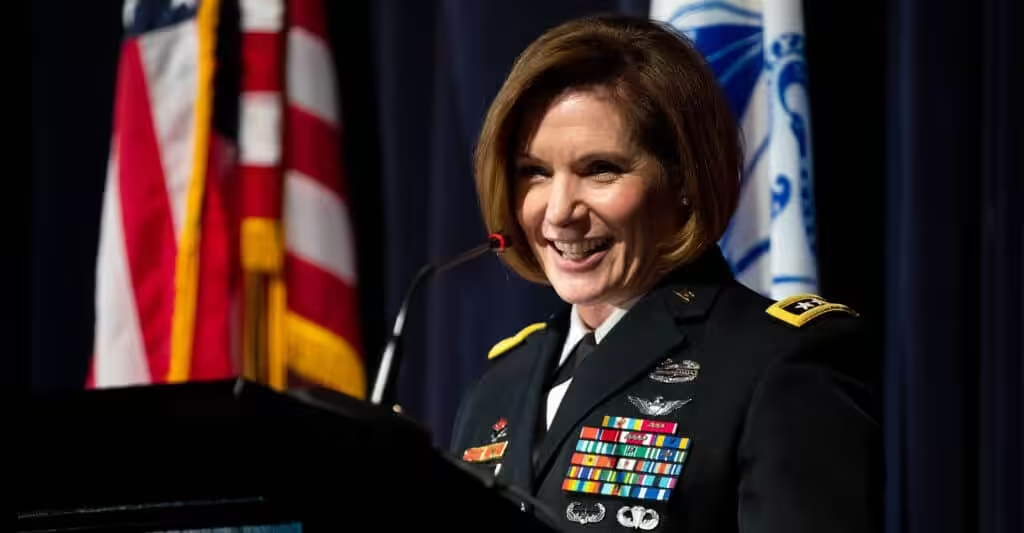
US Southern Command Chief, Laura Richardson, smiling profusely. Photo: US Army/File photo.
US Southern Command Chief, Laura Richardson, smiling profusely. Photo: US Army/File photo.
By Maria Paez Victor and Nino Pagliccia – Feb 1, 2023
“A melon-cup that no longer resembles a melon-cup and people still say, “A melon-cup! A melon-cup!”
– Confucius
We read with stupefaction the recent declarations of the head of the Southern Command of the USA Armed Forces, General Laura Richardson to the Atlantic Council think tank about the Latin American region. In language devoid of any obfuscation, she quite openly said what is well known, that Washington’s foreign policy in the region is exclusively based on its interest in its resources, not its people. As Orinoco Tribune reported, she stated:
“We have a lot to do. This region matters. It has a lot to do with national security, and we have to step up our game,” Richardson said, referring to the “rich resources and rare earth elements” located throughout Latin America. “But why is this region important? You have the lithium triangle, which is necessary for today’s technology. 60% of the world’s lithium is in the lithium triangle: Argentina, Bolivia and Chile…the largest oil reserves, light and sweet crude discovered in Guyana more than a year ago. You also have the resources of Venezuela with oil, copper, gold…this region also features the “lungs of the world,” the Amazon, and 31% of the world’s fresh water.”[1]
No word about establishing friendly relationships, about facing together shared problems of poverty, about encouraging social development, fighting environmental degradation, or drug trafficking. No “good neighbour” niceties. It is almost funny, if it wasn’t so ominous. Let us not forget that according to a UN study, more than 40% of armed conflicts of the last 60 years were linked to natural resources.[2] And with looming environmental disasters, increasing scarcity and competition, the pillage of natural resources and ensuing environmental deterioration can only get worse.
This top USA army spokesperson even forgoes notions of courtesy and diplomatic language. She used the sheer language of domination, the ugly head of the Monroe Doctrine that basically says that the region belongs to the USA. Let us remember that the mandate of the USA Southern Command based in Florida is the watchful eye over any “transgression” against the USA “national security”. And they will intervene if necessary.
Washington Grants License to Trinidad and Tobago to Resume Gas Projects With PDVSA
An exaggeration? Not really. Just recently the US Treasury Department gave a “license” for the exploitation of a gas field to companies belonging to Venezuela and Trinidad.[3] As if it were the lord and owner of those waters and gas deposit. What it means really is that Washington -in a staged act of generosity- will turn a blind eye to its own illegal and criminal unilateral coercive measures (ill named sanctions) and, in this instance, will not penalize those involved in the exploitation of this recourse. However, the real reason is quite obvious: they and especially their ‘allies’ in Europe need the gas of which there is a shortage, due to their undeclared war on Russia. That managing their own resources is an inalienable right of both Trinidad and Venezuela to start with is ignored. The fact that at this particular time this pseudo “license” is beneficial to both countries is not the point. What is clear is that cynically, the USA empowers itself as a biased (and corrupt), self-appointed policeman of the world acting as accuser, judge, and executioner whenever it suits them, enforcing extraterritorially their own laws to other sovereign nations and shamelessly breaks international laws in order to serve its own interests.
A recent article by USA historian Alfred W. McCoy in COUNTERPUNCH, while recognising the setbacks that the USA has encountered in its dreams of empire, still advocates more of the same failed foreign policy recipes. [4] McCoy proposes a remedy for “the US fading hegemony” which is to maintain it with the help of institutions like NATO, NORAD, NAFTA and countries like Canada, the USA’s trusted friend. Is this new or just more of the same?
McCoy’s attitude is representative of many who believe they are aware and open minded about policy mistakes that Washington has made, such the ones he mentions: the wall along the southern border with Mexico, the mistreatment of Haiti migrants, reference to one failed US-led coup d’etat in Venezuela, repeated military interventions in the region (Puerto Rico, Panama, Haiti), and the CIA’s covert wars with death squads and criminal gangs in Central America.
It is unfortunate that these events are listed almost as if they were independent of one another, anomalies, almost accidents or errors, certainly not central to the main tenet of the ideology of exceptionalism that pervades all of Washington’s foreign policy, past and present. The author, and indeed many who consider themselves progressive, friendly, and well meaning, put forth the idea that if they could just overlook these lamentable “mistakes” of the past, the USA could go forward politically unscathed and maintain its hegemony in the region. Alas, this is like putting old wine in new bottles.
That is not to be. The recent declarations of the head of the Southern Command of the USA Armed Forces, put an end to this pipe dream.
To be clear, McCoy speaks mostly of the USA “home region” which includes only Canada, Mexico, Central America, and the island nations of the Caribbean, with little reference to South America. Quite arbitrarily drawing up convenient lines and divisions. To McCoy’s credit in his article, he recognises “the fading hegemony” in his apparent concern about the “rise of regional powers”, which he does not view favourably. However, what he proposes as a remedy is not for the benefit of the region but rather for the self-interest of the USA.
He suggests two models for the resurgence of US hegemony: (1) The US-Canada relationship and (2) A regional union like the one with European Union. Ultimately, his dream is: “To create a successor to the long-moribund Organization of American States (OAS), Ottawa and Washington [which] could lead North America’s 23 sovereign nations in forming a permanent secretariat, akin to the European Commission.” [5] He is correct about the “moribund” OAS, (which the USA did much to undermine) but seems unaware that the Latin American and Caribbean nations have already, in 2011, formed a regional alliance in CELAC (Community of Latin American and Caribbean States) which most emphatically excludes the USA and its junior partner, Canada. The foxes were not invited into the hen coop.
Let us put aside the idea that the “ideal” relationship is the one Washington has with Canada. First of all, there is a shared political, economic, military, and cultural foundation between the two nations, that does not exist with the rest of the continent.
Second, there is a marked asymmetry in economic power which Canadian politicians and elites have meekly accepted to the point that the idea of “sovereignty” is to all effects and purposes an invisible issue politically (with the exception of the Province of Quebec and the Indigenous peoples). On a positive side there is a plethora of bi-national initiatives at lower levels of governance on specific issues (such as commerce, border security, the Great Lakes). However, as USA political adventures of regime change, full scale sanctioning of nations, and even war, have been steadily increasing, the unenviable role of being a “branch plant” of USA capitalism is starting to arise in the Canadian political consciousness.[6] So much so that for a country that once took the lead in establishing the United Nations, it has now twice been denied a seat at the Security Council since many nations see Canada as the Washington’s errand boy without an independent voice. It is starting to be an awkward role.
The other “ideal” relationship mentioned by McCoy is that between the US and the European Union. Again, there is a shared political, economic, military, and cultural background. But despite this, as of late the stark differences in the economic and political interests between the USA and Europe are daily rearing their heads and causing unheard of stress in the relationship.
One of these stresses on the EU is the Ukraine proxy war against Russia which has caused scarcity of oil and gas in Europe. The USA is a nation that is geared to war. As former US president Jimmy Carter has stated, “The US is the most warlike nation in the history of the world…the US has been at peace for only 16 of its 242 years as a nation”. [7]Its economy necessitates perpetual war to sustain its industrial military complex – as President Dwight D. Eisenhower so clearly warned about half a century ago. Today, the Europeans, with the conflict with Russia and Ukraine that the USA and NATO have clearly provoked, know perfectly well that any war in Europe will involve risking their land, their nations, and their people, not Washington’s which is protected an ocean away. So again, the issue of “sovereignty” – i.e. who’s political will prevails? – is the elephant in the room in this relationship also.
So, what would it take for the USA to engage in a truly constructive way with the rest of the region? If the USA wants to signal a new relationship with its continental neighbors here’s what it needs to do.
The first step the USA could take for a new relationship potentially with the whole of Latin America, would be the repudiation, in law, of the Monroe Doctrine, recognizing the self-determination of the nation states to the south of it.
The second step would be the affirmation of its adherence to the Charter of the United Nations in terms of respecting the sovereignty of those independent nations; in particular, adherence to Paragraph 1 of Article 1 of the UN Charter.[8] In practice, this would mean the re-formulation in law of the mission and aims of the US’s foreign policy, including the role of the State Department and the intelligence agencies with respect to said nations.
US Vows to ‘Step Up its Game’ in Latin America (+Weapons for Ukraine)
The third step, mutatis mutandis, would need to be the immediate dismantling of the Guantanamo prison, and the returning the naval base occupied territory to Cuba. This would also include dropping the blockade against “communist Cuba” as McCoy disparagingly calls the country.
The fourth step would be the re-establishment of full diplomatic relations with Cuba, Venezuela and Nicaragua, and the cessation of all economic and financial sanctions against them. It would mean the return of all Venezuelan assets and accounts that have been seized by USA and European banks. It would also mean the release of the Venezuelan Special Envoy Alex Saab whom the USA kidnapped and incarcerated despite his rights to diplomatic immunity based on the 1961 Vienna Convention on Diplomatic Relations.
The fifth step would involve a veritable economic restructuring within the USA, by re-directing its economy away from arms manufacturing to construction and rebuilding of their sorely needed infrastructure and housing, strengthening social programs such health and education, increasing development aid, and accelerating the transition from fossil fuels to renewable sources of energy as part of a comprehensive environmental program. Only then could the USA present itself to the rest of the hemisphere and the world as a nation of peace and respect.
The key question is: how is this to be done? That is in the hands of the people of the USA, who exercising their own sovereignty, should use all the measures open to them to bring about well-being, justice, and prosperity for all. Instead of ‘stepping up its game’ as General Richardson put it, the USA should recognise that the game is changing, with new players and new rules. The melon-cup is no more. Only when the USA gives up its pipe dreams of empire, recognizing the new multipolar world, will their people and the world be able to look forward to a brighter and more secure future.
Notes.
[1] Orinoco Tribune, “US Vows to “Step Up Its Game” in Latin America “ https://orinocotribune.com, 23 January 2023
[2] Xicotencatle, “Ciudad de México- San Petersburgo, dos fragmentos del mismo texto bélico”, rebellion, 26 January 2023
[3] Orinoco Tribune, “Washington Grants License to Trinidad and Tobago to Resume Gas Projects with PDVSA”, 26 January 2023
[4] Alfred W. McCoy, “The Fading of Washington’s Global Dreams and the Coming of a New world”, CONTERPUNCH, 12 January 2023
[5] Op. cit “US Vows to Step Up Its Game….”
[6] See, George Grant, “Lament for a Nation”, Carleton University Press, 1989
[7] Jimmy Carter, quoted in Brett Wilkins, “Jimmy Carter: US Most Warlike Nation in the History of the World”,Common Dreams, 18 April 2019,
[8] https://www.un.org/en/about-us/un-charter/chapter-1