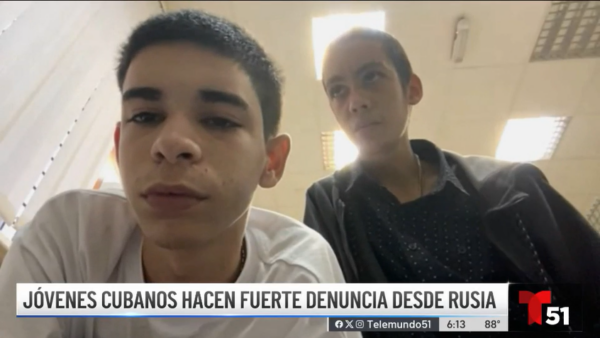
Two young Cubans in an online interview with Telemundo. Photo: FAIR.
Two young Cubans in an online interview with Telemundo. Photo: FAIR.
By Julie Hollar – Oct 4, 2023
When Cubans began telling stories of being lured into Russia with promises of jobs and instead being sent to the front lines in Ukraine, many US media outlets seemed eager to report the story. But what might on the surface seem like journalism to expose the plight of the powerless was really just another exercise in bolstering official US narratives and whitewashing US complicity.
Reports emerged that Cuban recruits were promised citizenship and a monthly salary far higher than what most Cubans could ever hope for in their native country, in exchange for what some described as support work for the Russian military—things like construction or driving. Once they arrived in Russia, however, they found themselves sent to the front lines.
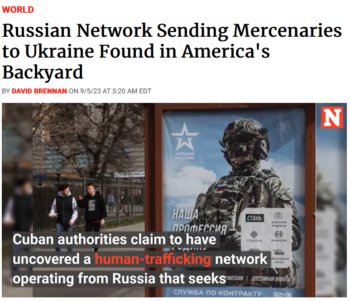
The Cuban government blamed a “human trafficking network,” and soon announced that they had arrested 17 people in connection with the scheme. FAIR could find no news reports confirming whether those involved in luring the Cubans were working for Russian or Cuban authorities.
US corporate media were happy to comment on Russia’s military weakness, speculate about the role of the Cuban government and paint a picture of bleak economic conditions in Cuba. But they were almost entirely silent on one of the key causes of that bleakness, which made the victims so susceptible in the first place: the US embargo on Cuba, ongoing now for more than 60 years and ramped up under Trump.

‘To bring about hunger’
The US imposed an embargo on Cuba in 1962 and has steadfastly maintained it since then, in a failed attempt to overthrow the Communist government. President Barack Obama began normalizing relations with Cuba in 2016, but Donald Trump sharply reversed course. He issued a series of new sanctions over the course of his presidency, including curtailing remittances from relatives in the US, barring US tourism and designating Cuba a state sponsor of terrorism—which, combined with the Covid-19 pandemic, helped send Cuba’s economy into a tailspin. Despite campaign promises to restore diplomatic relations, Joe Biden has largely maintained Trump’s sanctions on Cuba.
The purpose of the embargo is precisely to inflict economic hardship on civilians so that they rise up against the government. As the State Department argued in 1960, recognizing that the Castro government had the support of the Cuban people, “The only foreseeable means of alienating internal support is through disenchantment and disaffection based on economic dissatisfaction and hardship.” Therefore, “every possible means should be undertaken promptly to weaken the economic life of Cuba” and “to bring about hunger, desperation and overthrow of government.”
While the embargo has been a miserable failure at its end goal of regime change, it has been much more effective at its intermediary goals of hunger and desperation. In 2018, the UN estimated that the sanctions had cost the country $130 billion (Reuters, 5/8/18); last year Cuba reported that number had risen to $154 billion (UN, 11/3/22). With the tightened Trump-era sanctions and the added impact of the pandemic, Cuba’s economy has nosedived in recent years, crucial context for a story of the exploitation of Cuban citizens.

Economy ‘devastated’—but why?
The New York Times‘ first story (9/5/23) didn’t mention economic conditions in Cuba, let alone the US embargo. In a followup article, the Times (9/8/23) again elided any US role, but did note that “US officials have said that Russia has struggled to attract recruits for its war effort.”
The Washington Post (9/5/23) offered a more in-depth report that included the tale of two victims of the scheme who had been featured on Telemundo (9/3/23). The Post quoted one: “Given the situation in Cuba, we didn’t think twice.” The article then offered an explanation of Cuba’s “crippled” economy, pointing to a list of causes: “the coronavirus pandemic, lackluster tourism, US punitive action and inefficient policies.”
What “punitive action” might that be, and for what? The Post didn’t bother to clarify.
NPR‘s Morning Edition (9/6/23) chose to cover the story by interviewing Chris Simmons, described as “an expert in Cuban spycraft.” Simmons, who has not worked in counterintelligence in over ten years, and did not claim to have any inside information about the case at hand, nevertheless asserted confidently that “this is just the latest in a long series of criminal enterprises run by the Cuban government.” The Cuban government denies involvement, but aside from noting that perfunctorily, anchor Leila Fadel did not challenge Simmons’ speculation or offer any other perspectives.
Fadel asked if Cuba needs Russia, noting that Cuba “is a relatively isolated place. It’s one of the few remaining Communist countries. It’s facing its worst economic crisis in decades.” Simmons responded: “They absolutely do need Russia. The Cuban economy remains devastated, and the Russians have been their biggest and most generous supporter.” But neither Fadel nor Simmons made any effort to explain why Cuba is isolated, or why its economy is devastated.
A report on NPR‘s website (9/5/23) was more circumspect, offering a brief summary of the facts without “expert” commentary like that of Simmons, but provided only this explanation of the economic context:
Cuba is facing the worst economic crisis in decades. The government is struggling to keep the lights on and Cubans are struggling to keep food on their tables. If already bad relations with the United States deteriorate, things could get worse.
‘Aligned against its foreign policies’
Newsweek published an article (9/5/23) explaining that “Russian forces have been badly mauled in 18 months of combat in Ukraine.” Its only mention of US sanctions came in an explanation of Cuba/Russia relations: “Both have been under US sanctions for years and have generally aligned against its foreign policies in the Americas and beyond.”
A second Newsweek piece (9/8/23) cited Luis Fleischman of the Palm Beach Center for Democracy and Policy Research as its only expert source. Fleischman suggested that the Cuban government was involved, and argued that “Cuba’s economy is in dire straits, mainly because Venezuela’s oil bonanza is over.”
Fleischman did mention sanctions, but without reference to who imposed them or how they impact civilians, only the state: “Remember, both countries are under sanctions,” he said. “In other words, there is no reason for both countries to break such a convenient relationship.” Newsweek offered no further context.
Cuba Is Angry That a Russian Network Allegedly Tried to Recruit Its Citizens as Mercenaries
In fact, FAIR only found two explicit references in US news coverage to the US embargo as a cause of economic crisis in Cuba. A CNN.com article (9/19/23), headlined “Why Cubans Are Fighting for Russia in Ukraine,” explained in its second paragraph:
Across much of Cuba, the economy has ground to a standstill as the Communist-run island reels from a sharp drop in tourism, spiking inflation and renewed US sanctions.
Time (9/18/23) reported that “Cuba has been crippled by a 60-year US embargo, island-wide blackouts and a hunger crisis.” It gave a sense of why these recruits were such easy targets:
The recruits’ social-media accounts underscore the hardship of their lives in Cuba, with posts begging for medicine and selling everything from cell phone parts to rationed meat on black market sites. “With the money you’ll pay me,” one Cuban man said in a video on WhatsApp addressed to Russian recruiters, “if I’m killed or not, at least I’ll be able to help my family.”
Time also spent most of its lengthy article attempting to establish the Cuban government’s complicity.
Uncovered denunciations
Meanwhile, when both Cuba and Brazil denounced the US embargo at the UN General Assembly in New York last week, none of those outlets saw fit to mention it.
Not a big enough story? How about when the General Assembly voted for the 30th year in a row to condemn the US embargo, 185–2, with only the US and Israel opposing. (Brazil and Ukraine abstained.) The only one of the above outlets we could find covering the vote was Newsweek (11/5/22).
The US sanctions on Cuba are an act of war, condemned globally and with immense impact on the lives of the Cuban people. US reporting on the plight of Cuban civilians that does not provide that context is little more than state propaganda.
(FAIR)