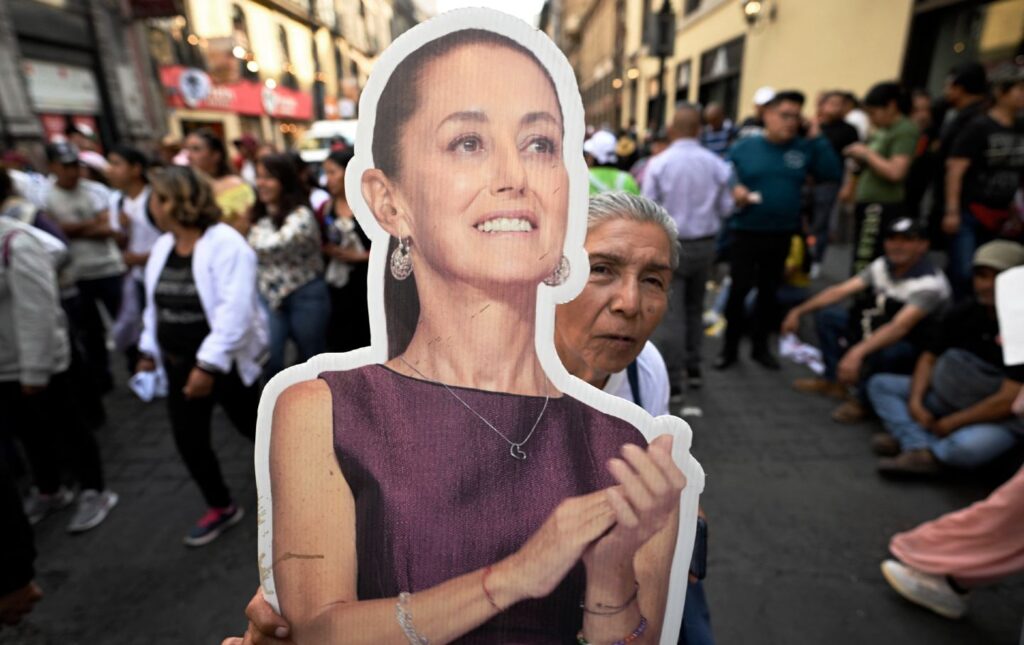
Supporters of Mexican presidential candidate Claudia Sheinbaum attend a rally in Mexico City on March 1, 2024. Photo: Alfredo Estrella/AFP.
Supporters of Mexican presidential candidate Claudia Sheinbaum attend a rally in Mexico City on March 1, 2024. Photo: Alfredo Estrella/AFP.
By Saheli Chowdhury – May 30, 2024
Part 1 of this series can be read here.
Intervention of judicial and electoral authorities in government functioning
Some type of “cross-over” between judicial and electoral authorities and executive and legislative branches of the state has existed for decades in Mexico, although according to the constitution of the country, the three powers of the state should be independent of one another. It is well documented that in 2006, the Federal Electoral Institute (predecessor of the current National Electoral Institute or INE) worked in tandem with the government of Vicente Fox to execute a fraud that stole the election from Andrés Manuel López Obrador. The fraud received the backing of the judiciary and was legalized by the Electoral Tribunal of the Judicial Power of the Federation (TEPJF), the body that ratifies election results and whose decisions cannot be appealed. Earlier, the electoral and judicial instances were mostly on the same side as the government of the day, but during the current administration, led by López Obrador, they turned into appendages of the opposition, constituted by the neoliberal right bloc (referred to as PRIAN in non-mainstream media and by MORENA sympathizers, clubbing together the initials of the main parties in the bloc) and the de facto powers (economic and media elite and US government).
Over the last few years, most of the members of INE openly supported the opposition and confronted the government, and acted in highly questionable ways, always intending to favor the opposition parties. Two former INE council members—Lorenzo Córdova and Ciro Murayama—while still in their posts, attended opposition political events poorly disguised as “civil society” events. Córdova is currently part of the Xóchitl Gálvez campaign and has acted as convenor of numerous electoral campaign events, many of them in the name of “civil society.” The opposition has even been using the color of INE, pink, and bragging about it with slogans such as “the INE should not be touched,” until very recently the president of the national electoral authority, Guadalupe Taddei, asked all organizations backing Gálvez to stop using the color so as “not to confuse the electorate” during the ongoing electoral process. Still, this “respectful request” was very much in contrast with the way INE has prohibited AMLO from uttering Gálvez’s name in his press conferences or showing the progress of public works even if their construction began years ago, and countless other orders and prohibitions regarding innumerable topics.
Similarly, the judiciary’s intervention in government and parliamentary affairs has reached a historically unprecedented level in recent years. As explained by Mexican author and journalist Fabrizio Mejía Madrid, “The Supreme Court has, in fact, changed the political system of the country by usurping the powers of the legislative branch. These ministers [of the Supreme Court], who have not been voted in by anyone, supplanted the Congress of the Union in these six years of obradorismo.” He went on to describe that during AMLO’s term, the Supreme Court of Mexico annulled 74 laws that had been approved by the majority of congressmembers and senators. In contrast, during the term of ex-President Ernesto Zedillo (who changed all ministers of the court with the stroke of a pen on January 1, 1995), the Supreme Court did not annul a single law; during Vicente Fox’s term, it rejected only three laws; during Felipe Calderón’s term, seven; and during Enrique Peña Nieto’s presidency, 16. The Supreme Court based all those 74 annulments on “a tricky, unconstitutional argument, that there was not enough debate” about them in the parliament, although, as Mejía Madrid pointed out, the lack of debate was precisely due to the opposition’s “legislative moratorium,” which is simply its refusal to read any and all bills sent to the parliament by the president.
This unprecedented intervention was justified by the Supreme Court as its duty to protect “deliberative democracy,” something that does not exist in the Mexican constitution. To do this, the court has misused—deliberately—Article 26 of the Constitution, which is about state planning and national development programs, but the court claimed that it refers to the parliament. Article 26, originally designed to protect social minorities from possible negative impact of economic or industrial projects, for example, protecting the rights of a community affected by the construction of a dam or the granting of concessions for open-pit mining, has been weaponized by the judiciary to protect economic minorities, such as multi-millionaire media owners or foreign multinationals. “We have seen this every time the Supreme Court annuls a law approved by Congress: it considers the transnational economic elite a minority,” commented Mejía Madrid. The most significant of these laws was the Electrical Reform, which was aimed at eliminating the Spanish electricity company Iberdrola’s near-monopoly in the electrical supply system and providing a greater share of the market to the Mexican public company Federal Electricity Commission (CFE), which owns and maintains the national grid but goes on incurring losses because the Supreme Court protects the multinationals’ “free competition” rights (something that does not exist in the Mexican constitution either).
Nevertheless, the worst action by the judiciary against the government was “the fatal blow it dealt to the Ayotzinapa forced disappearance investigation,” opined Mejía Madrid. He explained that in September 2022, “Judge Samuel Ventura Ramos of the Third District Court of Federal Criminal Proceedings based in Matamoros, Tamaulipas, issued an acquittal sentence for the crime of abduction in favor of José Luis Abarca, former mayor of Iguala [where 43 students of the Raúl Isidro Burgos Rural Teachers’ College were forcibly disappeared on midnight of September 26-27, 2014] and alleged mastermind of the attack on the students of Ayotzinapa.” That same month, the same judge released 24 municipal police officers who had been prosecuted for the attempted murder of student Aldo Gutiérrez, who remains in a vegetative state after having been shot in the head on the night of September 26, 2014. Earlier, in 2019, Ventura Ramos acquitted Gildardo López Astudillo, alleged leader of the criminal gang Guerreros Unidos, who had been prosecuted in the case. This judge also released 88 people who had been allegedly tortured for the construction of the false “Historical Truth” narrative of the Ayotzinapa case, although it was later discovered that many of them were indeed involved in the forced disappearance, but neither did he prosecute the torturers: former Prosecutor General Jesús Murillo Karam (currently in prison for his role in Ayotzinapa) and former head of the Criminal Investigation Agency, Tomás Zerón de Lucio (currently in “Israel” under “political asylum”). Thus, this judge single-handedly blew up the Ayotzinapa investigation, and the opposition has taken advantage of this situation to accuse the Attorney General’s Office, the Secretariat of the Interior, and President AMLO of not wanting to resolve the case or even of “protecting the military.” Self-styled human rights defender, PRI Senator Emilio Álvarez Ícaza, the most vocal in making these accusations, conveniently forgets not only the terrible role of the judiciary but also the fact that his own party held the presidency, the governorship of Guerrero state (where Ayotzinapa is), and the mayorship of Iguala when the forced disappearance happened.
More recently, as the nation entered the presidential pre-campaign phase, the president of the Supreme Court, Norma Piña, tried to control the Electoral Tribunal (TEPJF), as revealed by two reports by Salvador Frausto published this month on the portal Milenio. In early December 2023, days before the presidential pre-campaign was to begin, the TEPJF turned into a scene of open tensions among its five magistrates. They were divided into two blocks, with three of them, namely, Mónica Soto, Felipe Fuentes, and Felipe de la Mata, demanding the resignation of the president of the tribunal, Reyes Rodríguez Mondragón, who only had the support of the remaining magistrate, Janine Otárola. The allegations against Rodríguez Mondragón included allowing Supreme Court President Norma Piña to intervene in the functioning of the tribunal and unilaterally employing people in various posts without consulting the other magistrates. The division within the TEPJF became public knowledge on December 4, 2023, when the three “rebel magistrates,” as the press called them, did not attend the Supreme Court plenary session where Rodríguez presented a report of his work, and instead spent the morning having breakfast at a restaurant in southern Mexico City, and even posted their photos on social media. The next day, Rodríguez gave interviews to several TV and radio channels, where he insisted that he would not resign. The tensions continued for another week until, on December 11, Rodríguez was finally forced to resign, after not having attended his impeachment hearing on the evening of December 7. It will remain forever in public memory that Rodríguez, aware that he stood no chance, left the impeachment hearing halfway through and informed the other magistrates on a phone call, from his personal chamber, that he would not return to the meeting. On December 11, Mónica Soto was elected the new president of the magistrates of the Electoral Tribunal.
The interference, threats, and warnings that went on behind the scenes during those days were recently uncovered by Salvador Frausto, who released some WhatsApp messages that Norma Piña sent to Felipe Fuentes in her attempt to save Rodríguez Mondragón, who was her “chess piece” in the TEPJF that would have allowed her to intervene in the upcoming elections. Both Piña and Rodríguez are close to former President Peña Nieto, and both worked for the former president instead of maintaining the neutrality of their positions. After AMLO became the president of Mexico, both started working against the new government.
The way in which Piña became the president of the Supreme Court also remains controversial. In late December 2022, after former President of the Supreme Court Arturo Zaldívar resigned from his post, Minister Yasmín Esquivel, who is supposedly close to López Obrador, had a high chance of becoming the new president of the court. Then, suddenly, Guillermo Sheridan, an emeritus professor of the National Autonomous University of Mexico (UNAM), who remains entrenched in his post despite having crossed the retirement age, published an article claiming that Esquivel had committed plagiarism in her undergraduate thesis, that she had copied large parts of another classmate’s thesis while both were studying law at UNAM. The person who had allegedly suffered the plagiarism never showed his face but gave a few telephone interviews to some select media, and then went silent. After an investigation, the Attorney General’s Office of Mexico City ruled in January 2023 that Esquivel did not incur plagiarism, but her character assassination was complete by that time, and she lost the possibility of becoming the Supreme Court president. Instead, Norma Piña got elected after several rounds of voting by the court ministers.
A year later, Piña was threatening an Electoral Tribunal magistrate, as revealed by the WhatsApp messages leaked to Frausto. On the evening of December 4, 2023, she rebuked Magistrate Felipe Fuentes for not attending Rodríguez Mondragón’s conference. Starting from that moment, her messages became steadily more sinister, and she would send those messages at all hours of the day, once even at 3:13 a.m., although Fuentes appeared mostly laconic or not responding at all. In those messages, she called the magistrates “politicians” and warned Fuentes that she would make public “the dirty secrets” of his “little companions,” referring to his two colleagues. According to an unnamed source within the Supreme Court, Piña “threatened the magistrates that she would open investigations against them if they proceeded with their intention to remove Rodríguez. ‘I am going to fuck them,’ she would say in the corridors of her office.”
As if all this was not enough, a day after Rodríguez’s resignation, Piña organized a private meeting where she invited the three magistrates whom she had been threatening until the previous day. At that meeting, she also invited the national secretary of the opposition party PRI, Alejandro Moreno, without previously informing the magistrates about the presence of the politician. The private dinner was held on December 12, 2023, at the house of Supreme Court Minister Juan Luis González Alcántara Carrancá, in Lomas de Chapultepec, Mexico City. The dinner was also attended by several judges and ministers of the Supreme Court, while Santiago Creel, coordinator of Xóchitl Gálvez’s campaign, did not attend although he had been invited. According to one person who was present at the meeting, the Supreme Court president said “Alito [Alejando Moreno] is my friend and ally,” as a way of explaining why one of the country’s most important politicians was invited to what appeared to be a meeting of members of the judicial bodies. Salvador Frausto opines that this was unmistakable evidence of the Supreme Court favoring the opposition coalition amidst an electoral process, something that President López Obrador has been criticizing for months.
In separate interviews with Milenio, Magistrates Felipe Fuentes and Felipe de la Mata admitted that the dinner did take place, but that nothing of a political nature was discussed there and that they only “ate and left.”
Norma Piña’s vindictive reaction against anyone who refuses to toe her line has directly impacted Claudia Sheinbaum’s campaign as well. The former president of the Supreme Court, Arturo Zaldívar, joined the Sheinbaum campaign after resigning from his post. Thereafter, Piña opened a case against him on the basis of an “anonymous complaint,” accusing him of taking bribes while he was the court president to help a “band of kidnappers” get favorable sentences. The alleged “band of kidnappers” refers to the six accused in the forced disappearance of Hugo Alberto Wallace, a case that shook Mexico about two decades ago. However, as the legal process continued, it started getting revealed that evidence had been fabricated against the alleged kidnappers by the (erstwhile) Prosecutor General’s Office and the investigative agencies in collusion with Wallace’s mother, Isabel Miranda de Wallace (currently part of Xóchitl Gálvez’s campaign). Meanwhile, the alleged kidnappers have been in prison for over 18 years without firm sentences, and three of them are in preventive detention. The appeal of one of the accused, Juana Hilda González, is close to being resolved, and according to her lawyer, Salvador Leyva, it would be resolved in her favor, which spurred Isabel Miranda de Wallace to send an “anonymous complaint” to Piña. It has been over a month since the news of the investigation against Arturo Zaldívar was made public, yet there have been no updates about it, but the issue has been weaponized by the mainstream media to try to hurt Sheinbaum’s chances.
In addition to all this, whispers of the Supreme Court annulling the election results are floating in the wind. Over the last two months, the PRIAN opposition bloc, particularly the media apparatus associated with it, is engaged in a propaganda operation trying to paint the upcoming elections as “State elections,” implying—without evidence—that President López Obrador is using the government apparatus and public resources to promote his party’s candidates. In the opinion of these “experts,” the government’s social programs and public works constitute utilizing public resources for “political purposes” and make the playing field “uneven,” and therefore they should be suspended during the election period. These experts fail to mention that existing electoral laws mandate that the government declare no new projects once the campaign period has started, or the fact that the government paid the financial aid of the social programs beforehand, in respect for electoral norms. What is more, “the opposition wants to make the people believe that the social programs are not the government’s achievements, as if they fell from the sky,” says linguist and political analyst Violeta Vázquez-Rojas. She opines that the narrative of State elections “is fundamental to delegitimize the result of the June 2 election which, as the opposition already knows, it will lose in a landslide.” Given the fact that State elections did exist in Mexico, with each president from 1946 onwards imposing his successor by any means possible (including assassination), a cycle that was broken in 2018 with the election of AMLO, the political commentators of the opposition are trying to use this history as a basis to construct its “post-truth” narrative, where “the truth is irrelevant,” Vázquez-Rojas explains.
On May 15, the PRIAN campaign team, including its presidential candidate, Xóchitl Gálvez, went to the Electoral Tribunal to discuss a possible annulment of the elections. They presented a “risk map” to the tribunal, pointing out voting districts where they think there may be violence on election day, although the fact remains that the majority of political violence in the country is committed by the very same opposition parties. Responding to the press after the meeting, Gálvez repeated the media commentators backing her, “The president’s interference will have to be evaluated when certifying the election results. The playing field is uneven.” She went on to claim that AMLO’s criticisms of her corrupt dealings constitute “open interference in favor of his candidate.”
Some political analysts believe that the risk map, in all probability, projects the districts where the opposition would try to get 30% of the ballots annulled and thus open a route for annulling the presidential election. The opposition has the judicial and electoral authorities on its side and would try to opt for the annulment plan if the difference in votes obtained between the two leading candidates is not high enough, given that frauds were carried out in this way many times in Mexico.
June 2 and beyond
All projections for the presidential election, during the three months of the campaign and even from months before, have shown a comfortable margin for Claudia Sheinbaum, with 20-30% of voting intentions over Xóchitl Gálvez (except Massive Caller that put Gálvez in the lead, but this pollster got all its electoral surveys wrong since at least 2018). The two latest opinion polls, carried out by Bloomberg and Reforma, two media outlets that are by no means pro-AMLO, reiterate this trend, placing Sheinbaum in the lead with 55-57%, Gálvez in second place with 30-35%, while the other candidate, Jorge Álvarez Máynez of Movimiento Ciudadano party who is presenting himself as a “third option,” is polling around 10%.
Nevertheless, the operatives and sympathizers of MORENA and its allies call upon the people to not feel comfortable due to the polls and to make sure to vote on June 2 to prevent any possibility of fraud. That is because this possibility will always exist in Mexico as long as the likes of INE, TEPJF, and the Supreme Court exist in their current forms. They have never protected democracy in Mexico, rather they accommodated all sorts of attacks on democracy. Instead, what really protected democracy in 2018 was the 30 million votes for López Obrador, given that he had already been the victim of fraud twice in presidential elections and once in the governor election in his home state of Tabasco. The people of Mexico have learnt from past experiences that it is essential to vote en masse and for the same party, otherwise, there may be electoral fraud.
However, as mentioned earlier, the presidency is not the only post up for grabs, and the outcome of the national and state legislature elections will impact the next government to a large extent. This brings us to Plan C, MORENA’s call to vote for its candidates and those of its national-level allies, Labor Party (PT) and Green Party of Mexico (PVEM), and its regional allies, to ascertain the greatest possible support for the next president who, as matters now stand, will undoubtedly be Sheinbaum. For the president to be able to execute any constitutional reform, the minimum requirement includes the support of a qualified majority (two-thirds majority) in both houses of parliament and the support of a simple majority of state legislatures (50% + 1). The indispensability of this requirement came to the fore during AMLO’s term, as he could get approved the least number of initiatives among all presidents since 1917, because his party bloc lacked a qualified majority in Congress. This means that the president had to institute his flagship social welfare programs through decrees, which in turn implies that they may be revoked by some other head of state in the future. On the other hand, integrating the programs into the constitution would convert them into universal rights guaranteed by the constitution, which would provide people with constitutional protection in their right to access the schemes. In fact, AMLO proposed 20 constitutional reforms covering social, economic, political, and environmental aspects, but could not get any one of them approved, leaving them as a monumental task for the next president if his party’s candidate wins plus if Plan C succeeds.
Even if the alliance backing Sheinbaum achieves its Plan C, the judiciary will remain a hurdle for the next president, as evident from the actions of the Supreme Court throughout AMLO’s term. During the last few years, the Supreme Court had become the last resort for the opposition parliamentarians who refused to even read the president’s initiatives. From 2019 to 2023, the Supreme Court issued 425 rulings on unconstitutionality complaints: in 102 of them, it analyzed the issue of violations of the legislative process and decreed approved laws to be invalid in 74 instances (38 totally and 36 partially). Thus, the Supreme Court acted as a watchdog—not of the Constitution, but against it—allowing a minority to undermine a majority elected by popular vote. This led President López Obrador to propose a judicial reform to modify the selection methods for judges and magistrates so that they “respond to the interests of the people and not of the oligarchy.” In order to achieve this, he proposed “election by the popular vote of ministers of the Supreme Court of Justice of the Nation, circuit magistrates, district judges, Electoral Tribunal magistrates, and members of a new body called the Court of Judicial Discipline” to audit and uproot corrupt practices from within the judiciary. All these posts were proposed to be elected by the people through a special election in 2025. As expected, this caused a huge outcry from both the opposition and the judiciary, but Sheinbaum has included the proposal among her campaign promises. This reform can only be carried out through the constitutional route, which again highlights how indispensable Plan C is for an eventual Sheinbaum administration.
Who Is Claudia Sheinbaum, Favored to Win Mexico’s Presidential Election?
There is, however, another factor in this dirty water that remains, and will remain, outside the control of the Mexican government: the role of US imperialism. According to Chilean lawyer and political analyst Ingrid Urgelles Latorre, this is true not only for Mexico but for Latin America as a whole. “Latin America has always been a territory of plundering of natural resources; therefore, when there are more or less left-wing progressive governments that try to put limits to this extractivism, all these soft coups arise,” she commented. “We live in a world of extractive capitalism and, therefore, those who really have the power are the large extractive transnationals. It is not simply that Biden wants to destabilize Mexico; it is that there are probably economic questions, such as corn, and energy and mining issues, which are the most important ones. We have to ask who loses when there is a government that puts obstacles to transgenic corn and ends open-pit mining concessions, and that, moreover, fights for a program to recover natural resources, especially energy resources. None of this is in the interests of the de facto economic powers.”
According to Rafael Barajas “El Fisgón,” Mexican cartoonist, political analyst, and director of MORENA’s National Institute of Political Education, the dirty war in Mexico is part of a “highly used strategy” in Latin America. “A media war is generally a prelude to a judicial war or lawfare,” he said, referring to infamous cases of media warfare and lawfare against progressive leaders such as Rafael Correa, Cristina Fernández de Kirchner, Lula da Silva, Dilma Rousseff, etc.
“There is another factor, which to me is the most obvious, but which is less talked about; it is the USAID and the National Endowment for Democracy, that is, the US State Department,” he pointed out. The financing by these CIA cutouts for Mexican opposition groups masquerading as “civil society,” such as the NGO Mexicans Against Corruption and Impunity (MCCI), belonging to Claudio X. González Guajardo of the Kimberly-Clark Mexico fortune and currently directed by academician María Amparo Casar, is well documented. It is this Claudio X. González who brought together PRI, PAN, and PRD parties to form the opposition coalition (which has had several names over the past years but has currently settled for Broad Front for Mexico), and it is he who imposed Xóchitl Gálvez as the group’s candidate. MCCI, in turn, funds several other NGOs focusing on various issues, but all having an anti-AMLO, anti-Fourth Transformation slant. Receiving foreign funding from organizations for political purposes is considered treason by the Mexican constitution, and AMLO has sent diplomatic notes to the US government for financing MCCI, accusing it of fomenting a soft coup in Mexico. The US government, however, has not stopped these interfering activities.
Historian, political scientist, and lifelong left activist Pablo Moctezuma Barragán considers that the media-economic-judicial-political nexus against the Fourth Transformation is working to prepare the grounds so that eventually the opposition can request the United States for a military intervention in Mexico. The narratives of narco-president, authoritarianism, militarization of the state, state elections—all constitute a prelude to an eventual claim that democracy is at risk in Mexico, or that the Mexican state is controlled by organized crime, opines Moctezuma Barragán. “They are taking as models the characters of the pro-Yankee Venezuelan oligarchy, such as Juan Guaidó and María Corina Machado, who are backed by the State Department in the United States’ attempt to bring about a coup in Venezuela,” he points out. “The US is trying the same tactic against the president of Colombia, Gustavo Petro, to create a climate of coup d’état.”
Rafael Barajas and Ingrid Urgelles agree about the probable long-term plan behind the “soft coup.” “It is a strategy that allows them to win, whatever the electoral result may be… To sow doubt in the electoral result is an attempt to weaken from the start the government of Claudia Sheinbaum, who, as everything indicates, is going to be the next president,” Barajas said. Similarly, according to Urgelles, the opposition’s strategy is to make sure, in any way possible, “that Sheinbaum arrives at the presidency in a weakened form and with the ground laid for an eventual lawfare… like what was done against Dilma [Rousseff].”
For Moctezuma Barragán, the definitive way out for Mexico is “to reject the sellouts and fight for complete independence of Mexico. We must fight against neocolonialism and demand that our rights, our country, and our future be defended.” To achieve this, it is necessary for Mexicans to elect a government that will “advance in the transformation that will lead us to real sovereignty.” However, to achieve this, it is also urgent to look beyond the elections, to overcome the current situation of dependence on the empire, with Mexicans being “the United States’ southern slaves,” and to completely reintegrate into Latin America and the Caribbean.
Special for Orinoco Tribune by Saheli Chowdhury
SC/OT/JRE/SF

Saheli Chowdhury is from West Bengal, India, studying physics for a profession, but with a passion for writing. She is interested in history and popular movements around the world, especially in the Global South. She is a co-editor and contributor for Orinoco Tribune.