Venezuelan National Assembly approves the Partial Reform of the Organic Law of Hydrocarbons, January 29, 2026. Photo: Wilmer Errades.
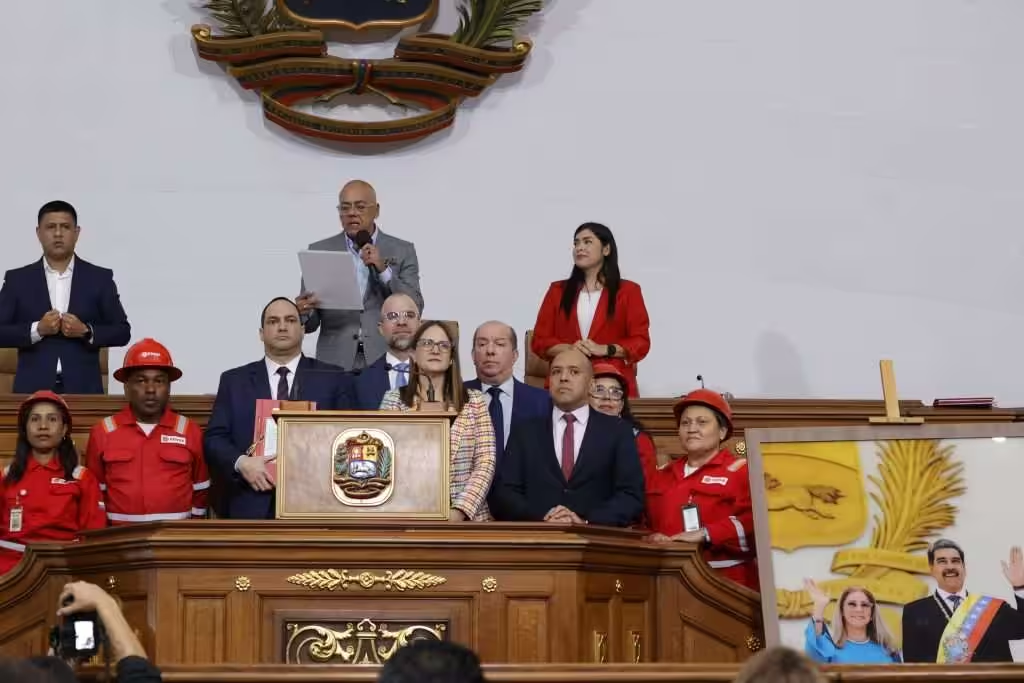
Venezuelan National Assembly approves the Partial Reform of the Organic Law of Hydrocarbons, January 29, 2026. Photo: Wilmer Errades.
The Venezuelan National Assembly has unanimously approved the partial reform of the Organic Law of Hydrocarbons.
The discussion, held on Thursday, January 29, during the plenary session of the parliament, was chaired by the president of the National Assembly, Deputy Jorge Rodríguez. Participating in the debate were oil industry workers, PDVSA President Héctor Obregón, Minister of Economy and Finance Anabel Pereira, Sectoral Vice President of Economy Calixto Ortega, PDVSA Vice President of Exploration and Production Eduardo Pinto, PDVSA Vice President of Gas Yaniel Viloria, President of the Bank of Venezuela and Acting President of Pequiven Román Maniglia, as well as other officials linked to the hydrocarbons industry and the economy sector.
Deputy Orlando Camacho, president of the Standing Committee on Energy and Petroleum, highlighted that the reform was previously submitted for public consultation with the participation of industry workers throughout the country, in order to learn about their experiences, and that more than 120 written proposals were received from various locations. He added that this reform “will change the country’s economy and bring about great transformations.”
He explained that the proposals were systematized and that the 35 articles of the law were submitted for consideration and approved by the deputies of the Standing Committee on Energy and Petroleum. “Today, a reform is being brought up for a second discussion that will change the economy and bring about great transformations for us, for our children, for our grandchildren, and for the future of Venezuela.”
Several articles were modified, taking into consideration the proposals of some parliamentarians regarding the incorporation of terms, including that of Deputy Antonio Ecarri, of the opposition Alianza Lápiz party. He described the session as historic, saying that “the just content of this law will change the next 50 years for better or for worse.”
The president of the National Assembly, Jorge Rodríguez, responded that a good transitional provision would be “that the Venezuelan opposition will never again call for or paralyze the oil industry, never again ask for blockades, sanctions, or thefts such as that of Citgo,” a statement that was met with applause from the members of the parliament. He added that “only one sector has turned off the lights on the oil industry,” referring to far-right opposition.
Some articles regulating oil operations
Article 1 of the law was approved by consensus as follows: “The purpose of this Law is to regulate all matters relating to the exploration, extraction, collection, transportation, storage, processing, upgrading, refining, industrialization, marketing, conservation, and comprehensive use of hydrocarbons, under the principles of energy sovereignty, public ownership of deposits, progressive maximization of profits, legal certainty, contractual transparency, accountability, environmental protection, and adaptation to the energy transition, in accordance with the provisions of Article 141 of the Constitution of the Bolivarian Republic of Venezuela.”
Article 8, which was also incorporated, establishes that: “In contracts for the execution of activities regulated by this law, the parties may agree that any doubts or disputes of any nature arising from the execution of such activities, which cannot be resolved amicably by the parties, may be decided by the competent courts of the Republic or through alternative dispute resolution mechanisms, including mediation and arbitration. The Ministry with Competence in Hydrocarbons, in consultation with the Attorney General’s Office of the Republic, shall establish the general guidelines for establishing the dispute resolution clauses referred to in this article. The clauses agreed upon in accordance with these guidelines shall not require the opinion or authorization provided for in the decree with the rank, value, and force of Organic Law of the Attorney General’s Office and the Commercial Arbitration Law.”
Article 25 reads as follows: “The Ministry with Competence in Hydrocarbons may grant operating companies, referred to in paragraphs one and two of Article 23, the right to carry out primary activities. It may also transfer to them ownership or other rights over movable or immovable property belonging to the private domain of the Republic, required for the efficient exercise of such activities. The Ministry with Competence in Hydrocarbons may revoke these rights when the operators fail to comply with their substantial obligations, thereby preventing the achievement of the purpose for which such rights were transferred. Operating companies wholly owned by the Republic or their subsidiaries may assign, in whole or in part, by contract to the companies referred to in paragraph three of Article 23 of this law, the rights that have been granted to them in accordance with the provisions of this article, with the prior authorization of the Ministry with Competence in Hydrocarbons.”
Article 34 states the following: “The establishment of joint ventures and the conditions governing the execution of primary activities shall be authorized by the President of the Republic and notified to the National Assembly for the purposes of exercising parliamentary control. The National Government, through the Ministry with Competence in Hydrocarbons, shall submit a report containing the relevant circumstances of said establishment and the agreed conditions, including the special advantages in favor of the Bolivarian Republic of Venezuela. Joint ventures shall be governed by this law and, in each particular case, by the decree authorizing their creation, their articles of incorporation, and, supplementarily, by the Commercial Code and other applicable laws. Joint ventures shall be excluded from the scope of application of the decree with the rank, value, and force of law on public procurement and its regulations, and shall implement transparent procurement mechanisms in accordance with the principles of honesty, efficiency, equality, planning, publicity, and simplification.”
Article 35 states that: “The establishment of joint ventures shall be subject to the following conditions:
Delcy Rodríguez Rejects US ‘Orders’ as Venezuela Advances Hydrocarbons Law Reform
“Only good things will come after the suffering”
After the Partial Reform of the Hydrocarbons Law was unanimously approved, the president of the National Assembly, Jorge Rodríguez, emphasized that this legal instrument has been enacted “for history, for the future, for our children” and stressed that “only good things will come after the suffering.”
Rodríguez explained that the reform was the result of “an arduous process of consultations throughout the country, with more than 120 proposals received from across the national territory, with an in-depth debate” that took place in the Standing Committee on Energy and Petroleum. He congratulated the committee “for the strength and tenacity, patience, and depth with which they handled such complex issues.”
He also congratulated “the Venezuelan patriotic bloc for the strength with which it is carrying out these transformations. I congratulate the opposition for the constructive nature of its proposals. I congratulate the oil sector workers who will carry out the most important elements of this reform of the law, and I congratulate the people of Venezuela. Only good things will come after the suffering. Only good things for everyone, which we must build together, irrespective of how we think, for the prosperity of our republic.”
He then invited PDVSA President Héctor Obregón and the board of directors of the company to come up to the podium to receive the approved bill.
Communication to Acting President Delcy Rodríguez
The president of the parliament also read out in the chamber the communication that would be sent to the acting president of Venezuela, Delcy Rodríguez: “Dear President, please accept my warmest regards. I am pleased to address you on the occasion of sending you the Partial Reform of the Organic Law on Hydrocarbons, approved in a plenary session on Thursday, January 29 of this year, in accordance with Article 213 of the Constitution of the Bolivarian Republic of Venezuela, reiterating my feelings of high esteem and consideration. Sincerely, Deputy Jorge Rodríguez Gómez, President of the National Assembly.”
(Últimas Noticias) by Aura Torrealba
Translation: Orinoco Tribune
OT/SC/SH