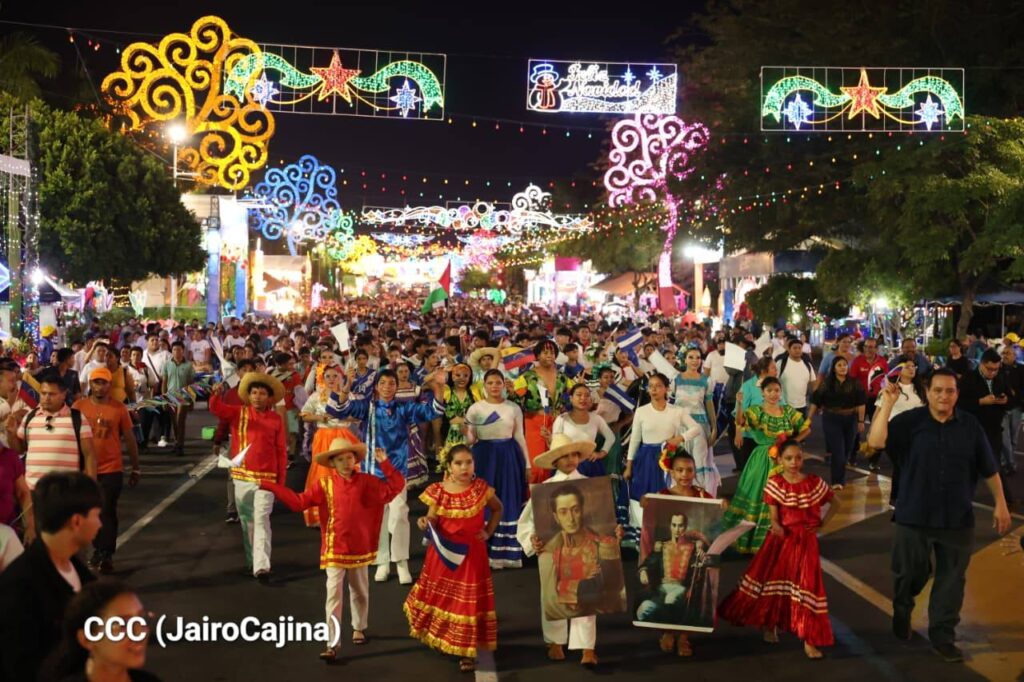
The real Nicaragua: A march in solidarity with Venezuela and with Palestine in December 2025. Photo: Jairo Cajina/El 19/file photo.
The real Nicaragua: A march in solidarity with Venezuela and with Palestine in December 2025. Photo: Jairo Cajina/El 19/file photo.
By John Perry – Mar 24, 2026
United Nations “experts” on Nicaragua, working to sanitize the effects of a failed U.S.-inspired coup attempt, have not visited the country since the violence occurred eight years ago.
Yet, for them, Nicaragua is “a giant prison” in which the Sandinista government “has effectively taken its own population hostage.”
According to lawyer Jan-Michael Simon, the German leader of the group who is not known to have ever visited Nicaragua, its government is doing “exactly what the Nazi regime did.”
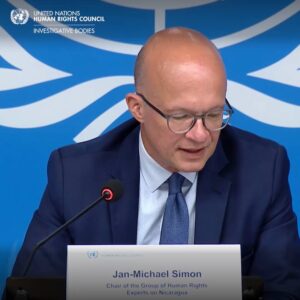
Two aspects of its work reveal its function as part of the U.S. propaganda machine. One is that the group ignores detailed evidence presented to it that does not comply with Washington’s narrative on Nicaragua; in fact, it accepts evidence only from so-called “human rights” groups opposed to the Sandinista government.
The second is that it feeds its material to Nicaragua’s opposition media, to which Simon readily gives interviews. Their role is to give rolling coverage to the reports and—if possible—attract the attention of corporate media, such as The New York Times.
But these “human rights” groups and opposition media are far from independent. They all receive considerable U.S. funding.
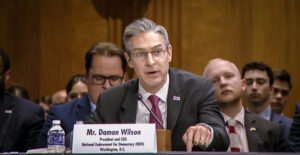
Giving evidence in February to the U.S. House Appropriations Committee, the president of the National Endowment for Democracy, Damon Wilson, said that funding such “partners” who oppose the Nicaraguan government was the NED’s “third largest program” in the hemisphere after Venezuela and Cuba. The NED is a CIA cutout that uses federal funding to promote U.S. interests globally, especially when this involves inciting regime change.
Wilson was reluctant to name the “extraordinarily courageous folks” from Nicaragua he met in a recent visit to Costa Rica. But he did refer to one NED partner by name, the so-called Rural Workers’ Movement. Was he aware that this group organized fatal attacks on police stations in rural Nicaragua in 2018 (documented in detailed witness statements)? Did he know that its attacks resulted in multiple deaths and injuries, kidnappings and firearm thefts, and terrorized local populations? Apparently not, because Wilson said that the NED supports groups that “understand the importance of non-violent, peaceful resistance.”
The role of the current UN group of “experts” is to firmly establish the narrative that the Sandinista government is to blame, without exception, for the hundreds of deaths and injuries that resulted from the coup attempt.
In their latest report, the “experts” take this one step further: They make the bizarre claim that hundreds of violent opposition attacks were, in reality, “false-flag” incidents. “Acts of vandalism against FSLN [Sandinista] militants’ properties and private businesses, such as stoning, looting and arson,” they allege, were actually carried out by “pro-government armed groups” paid for from state funds.
This would be laughable had these incidents not been extremely serious, that in many cases surviving victims were able to identify their attackers, and that the coup leaders and their followers openly bragged about the attacks and posted videos of them (mostly since deleted) on social media.
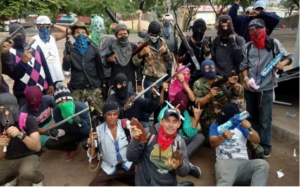
Nicaraguans assaulted by opposition thugs or whose houses were burned down (many known to me personally) would be appalled that the UN has published such obvious lies.
The new report also claims that “public funds” were diverted from social projects in order to suppress the 2018 violence, as if this is an act of malfeasance on the government’s part. Yet, of course, three months of violent attacks on police, government workers and public buildings, including setting fire to schools and health centers, carried an enormous cost.
The government asked for, and was refused, an IMF loan to help pay for losses of more than $1 billion. They were told that, if they applied formally, the request would be vetoed by the U.S. government.
Naturally, once the coup attempt ended, the Sandinista government sought to ensure that any new acts of terrorism, whether instigated inside Nicaragua or abroad, are identified and, if possible, halted. Such a response would be expected in any civilized country. However, for the “expert” group, this has morphed into a “transnational surveillance and intelligence network” which carries out assassinations abroad.
Their argument centers on the case of Roberto Samcam, who led one of the most violent opposition groups in 2018 and fled to Costa Rica to avoid arrest. He was murdered in June 2025 but, despite extensive efforts by opposition groups to blame the Sandinista government for his killing, the authorities have since arrested five Costa Ricans.
‘Worthy Children of Heroes and Martyrs’: How Nicaragua Cultivates Peace
In February, the Costa Rican authorities announced that “all individuals linked to Samcam’s murder have been apprehended”; none was Nicaraguan nor apparently linked to Nicaragua. There were implications, however, that the homicide was drug-related.
Of course, since the day of the killing, opponents of Nicaragua’s government have been claiming that it ordered the assassination. Speaking to opposition outlet Confidencial, Jan-Michael Simon simply announced that this was the case, despite having no proof. So did Damon Wilson in his February testimony to a sub-committee of the House Committee on Appropriations.
A final example of the extreme partiality of these “experts” is their take on Nicaraguans who have left the country. They quote figures showing that more than 300,000 Nicaraguans have sought asylum in Costa Rica. But they fail to note that Costa Rican authorities regularly claim that most of these applications are from Nicaraguans who simply want to regularize their status in the country: only one in ten has so far been approved.
The “experts” also ignore the extreme fluidity of traffic across the border, with around 900 Nicaraguans crossing daily in both directions, according to another UN body. If they are escaping the “surveillance, threats, harassment and physical violence” they allegedly experience in Costa Rica at the hands of Nicaragua’s “undercover officials,” it seems extraordinary that so many return to the “giant prison” created by the Sandinista government.
The narrative of Sandinista “repression” (a characterization used 42 times in a 26-page report) suits Washington’s tightening of the screws on Nicaragua. The “experts” call for additional “targeted sanctions,” disregarding their illegitimacy in international law and that the UN itself rejects their unilateral imposition.
Former UN independent adviser Alfred de Zayas observed that the “human rights industry” is in dire condition. As the group of “experts” continues to demonstrate, the main purpose of the “industry” is manufacturing consent for regime change. Its agenda is Washington’s—not one that resonates with most Nicaraguans, who simply want the stability recovered after the 2018 coup attempt to be maintained.
A poll in February showed that—across the whole of Latin America—their country has the third most popular government. It gives the lie to the monstrous portrayal of Nicaragua offered by the UN’s so-called “experts.”

John Perry is a writer based in Masaya, Nicaragua whose work has appeared in the Nation, the London Review of Books, and many other publications.